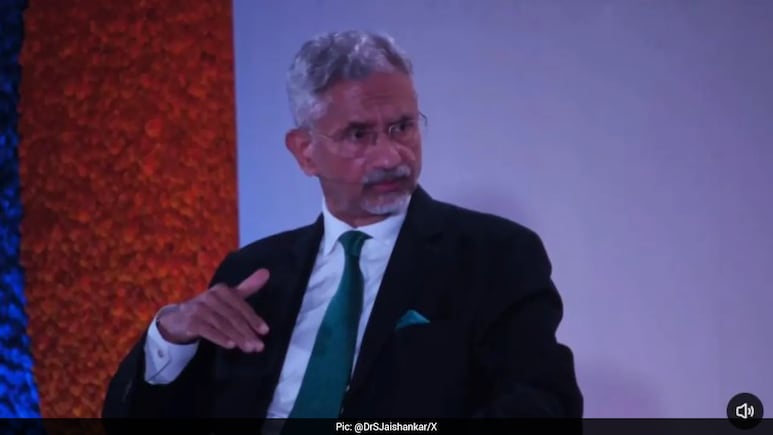
External Affairs Minister S. Jaishankar called for more reliable and diversified global energy supply chains at the G20 Foreign Ministers' Meeting in Atlanta, US, held from October 29 to 31, 2026. He warned that growing geopolitical tensions and conflicts were disrupting trade routes and making countries more vulnerable to supply shocks.
Speaking at the meeting convened by US Secretary of State Marco Rubio, Jaishankar also raised concerns over the use of trade and energy supplies as tools of political pressure, stressing the need for fairer access to resources, particularly for developing and low-income countries.

-
 Indian Markets Turning Corner After Two Tough Years, Says Sandeep Tandon
-
 NDTV Profit Ignite 2026: Experts See Opportunity In Equities, Stay Bullish For Long-Term
-
 Buy Right, Sit Tight Does Not Work for Individual Stocks, Says Dinshaw Irani
-
 'Worst Is Behind': Quant MF Sees Market Bottom, Flags 'Extreme Euphoria' In Midcaps
-
 India's Mutual Fund Industry Could Become A $1 Trillion Opportunity, Say Fund Managers
-
 'Foreign Investors Are Baraatis': Raamdeo Agrawal's Take On LTCG Tax
-
 Stay Invested Through Market Cycles: Raamdeo Agrawal at NDTV Profit Ignite
-
 Ramesh Damani Remains Bullish On India For Next 20-30 Years, Sees Bargains Amid Market Weakness
-
 CAS Came After A Long Consultation Process: SEBI Chairman Tuhin Kanta Pandey AT NDTV PROFIT IGNITE
-
 Aim To Cut FPI Onboarding Time From Mth To Five Days: SEBI Chairman Tuhin Kanta Pandey AT NDTV PROFI
Also Read: The Economic Imperative: Analysing The Material Driving Force Behind India-Canada Strategic Reset
Also Read | Layoffs Are Rising In Tech, But These Skills Are Helping People Unlock Better Pay
The Diagnosis: An Artificial Crisis of Predictability
Jaishankar framed the global energy dilemma not strictly as a crisis of physical production, but as a crisis of unpredictability, disruption, and access. In his remarks at the G20 plenary, he underscored that deliberate interference—through unilateral sanctions, maritime chokepoints, and targeted disruptions of energy infrastructure—functions as a calculated strategy to hold global prices hostage.
For major emerging economies like India, which remains among the world's largest importers of oil, liquefied natural gas (LNG), and fertilizers, these market distortions carry immediate domestic consequences. Jaishankar pointed out that continuous market manipulation displays little regard for the economic survival of low-income and developing nations. Furthermore, he criticized the habit of drawing convenient, selective distinctions between oil and gas, noting that selective carve-outs distort fair competition and stability.
Diversification and De-Risking as Strategic Imperatives
Jaishankar called for countries to diversify their energy supplies and reduce dependence on a limited number of trade routes and suppliers. He said geopolitical tensions, including conflicts around the Strait of Hormuz, had exposed the risks of relying on concentrated supply chains.
He urged G20 members to keep energy trade insulated from political disputes and ensure more predictable access to resources. For India, which depends heavily on imports of crude oil, liquefied natural gas (LNG) and fertilisers, reliable energy supplies are important for both economic growth and domestic needs.
Jaishankar also highlighted India's efforts to secure supplies of critical minerals, which are essential for the shift to renewable energy. Referring to the National Critical Minerals Mission, which covers everything from exploration to recycling, he proposed a 'G20 Critical Minerals Circularity Initiative' to encourage resource sharing and prevent supplies from being concentrated in the hands of a few countries.
The Broader Geopolitical Context
Jaishankar's intervention in Atlanta did not happen in a vacuum. It coincided with parallel deliberations, including a Quad Foreign Ministers' meeting on the sidelines and broader U.S.-led foci on maritime security, sea lanes, and economic resilience. While Western powers often frame supply chain resilience through the lens of strategic competition, Jaishankar's stance injected the perspective of the Global South—insisting on the right to industrialize, resist predatory commercial practices, and prevent the weaponization of trade.
Jaishankar pointedly noted that the deliberate weaponization of energy trade and calculated attacks on infrastructure are being used to hold global energy prices hostage. In a globalised economy, these continuous distortions—manifesting as sanctions, geopolitical obstacles, and selective carve-outs between oil and gas—reverberate far beyond their intended targets. Jaishankar's sharp critique exposed the hypocrisy of wealthy nations drawing convenient distinctions in energy policies, which ultimately leave the Global South to bear the brunt of unaffordable costs and compromised access.
Conclusion
S. Jaishankar's address at the Atlanta G20 ministerial serves as a wake-up call against the geoeconomic fragmentation of energy and resource flows. By tying market predictability directly to the welfare of developing populations, India positioned energy security not as a narrow national metric, but as a collective global public good. As geopolitical fault lines continue to test maritime trade routes and commodity flows, Jaishankar's message remains pertinent: true economic resilience requires open markets, protected transit lines, and a genuine commitment to multilateral cooperation rather than coercion.Ultimately, the Atlanta address reinforces India's role as a pragmatic, balancing power in an unsettled world.
Also Read: Navigating Friction And Energy Realities: An Analysis Of Marco Rubio's October Visit To India
By engaging in extensive bilateral diplomacy on the margins of the G20—meeting with counterparts from Latin America, Europe, and East Asia to secure lithium, technology, and manufacturing partnerships—India is actively practicing the diversification it preaches. Jaishankar's call to action is a reminder to the G20 that keeping energy markets open and predictable requires genuine multilateral leadership, wider access to green financing, and advanced collaboration in technologies like green hydrogen and small modular reactors. Only by de-politicising energy flows can the international community build a resilient economic architecture that protects the vulnerable and fuels global growth equitably.
Essential Business Intelligence, Sharp Market Insights, Practical Personal Finance Advice, Daily Fuel, Gold and Silver Prices and Latest Stories — On NDTV Profit.