The Economic Imperative: Analysing The Material Driving Force Behind India-Canada Strategic Reset
This economic complementarity is further reinforced by deep institutional investment ties and talent mobility, which form the bedrock of the bilateral framework.
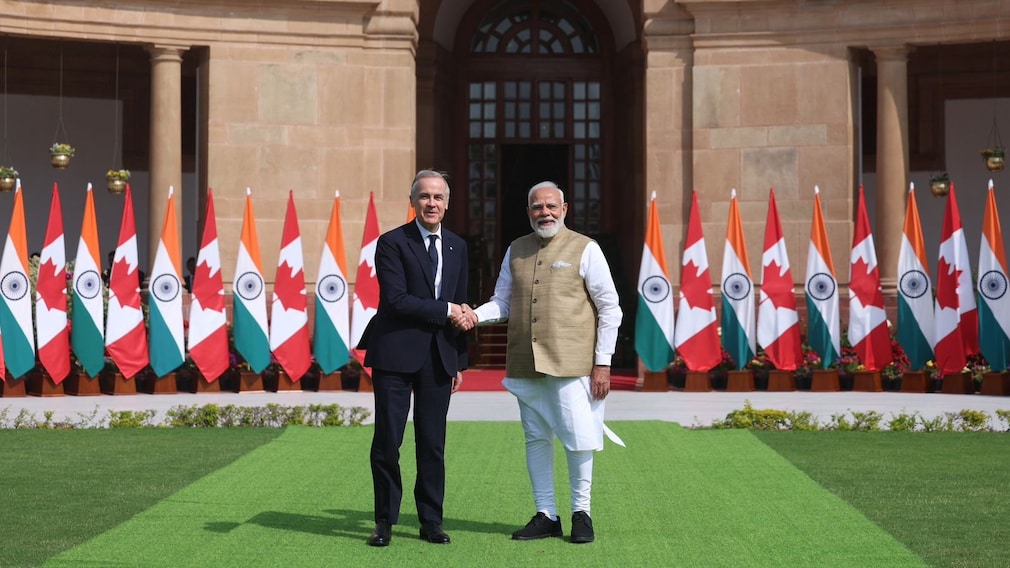
The trajectory of contemporary international relations is fundamentally anchored in the cold logic of economic realism. While political rhetoric, ideological alignments, and historical friction often dominate the public discourse, the material undercurrents of trade, resource security, and capital flows ultimately dictate the long-term behaviour of states. This pragmatic reality has been starkly illustrated by the profound turnaround in India-Canada relations.
Following a period of severe diplomatic volatility triggered by the 2023 Nijjar incident, the subsequent bilateral realignment under the leadership of Indian Prime Minister Narendra Modi and Canadian Prime Minister Mark Carney stands as a testament to the supremacy of the economic imperative over diplomatic grievances. Driven by mutual structural complementarities, energy dependencies, and shared global trade vulnerabilities, New Delhi and Ottawa have engaged in a calculated strategic reset, decoupling commercial imperatives from historical security friction.
To comprehend the structural resilience of this reset, one must examine the geopolitical and economic pressures compelling both nations to look beyond their traditional partners. For Canada, the primary material driver is the urgent necessity of trade diversification. Historically dependent on its southern neighbour, the United States, for the vast majority of its trade, Ottawa has found itself highly vulnerable to the shifting protectionist landscapes in Washington. The imposition of sweeping American tariffs on crucial Canadian sectors like steel and automobiles has severely disrupted Canada's laissez-faire economic model.
Caught in the crosscurrents of an unpredictable Washington and ongoing structural disruptions in Europe and West Asia, Canada has adopted a "middle power" strategy to mitigate overreliance on the US market. India, with its massive market scale, rapid industrialization, and expanding technology ecosystem, offers Canada an unparalleled destination to diversify its trade portfolio, protect its domestic economy from unilateral tariff shocks, and anchor its broader Indo-Pacific strategy.
Conversely, India's material motivations are tied to the structural demands of its domestic development, specifically its clean energy transition and high-tech manufacturing ambitions. As the world's fastest-growing major economy, India faces an existential need to secure stable, conflict-free supply chains for energy and strategic raw materials. Geopolitical instability in the Gulf and shipping vulnerabilities in the Strait of Hormuz present direct economic risks to India's energy security. Canada, as the world's second-largest uranium producer and a resource-abundant power, offers a politically stable alternative.
READ | Why Amazon And Flipkart Are Struggling To Beat Meesho In India's Smaller Cities
This synergy was formalised through a landmark 10-year, $2.6-billion civil nuclear agreement with Canada's Cameco to supply uranium to India's Department of Atomic Energy, directly supporting New Delhi's long-term target of achieving 100 GW of nuclear capacity by 2047. Furthermore, Canada's vast reserves of critical minerals-such as lithium, cobalt, and rare earth elements-are vital for India's clean energy, electric mobility, and semiconductor ambitions. Through mechanisms like the Critical Minerals Annual Dialogue, the two nations are integrating Canadian resources into the scale of Indian manufacturing.
This economic complementarity is further reinforced by deep institutional investment ties and talent mobility, which form the bedrock of the bilateral framework. Long before the diplomatic thaw, Canadian institutional investors, particularly mega pension funds like the Canada Pension Plan Investment Board and CDPQ, had quietly deployed over $75 billion into Indian infrastructure, renewable energy, and real estate, recognising India as a high-yield destination for capital.
Simultaneously, human capital remains a vital bridge; with nearly 1.8 million individuals of Indian origin in Canada and hundreds of thousands of Indian international students, the demographic synergy feeds Canada's labour market demands while sustaining a robust services trade. The institutionalisation of the India-Canada Migration and Mobility Dialogue underscores a shared recognition that well-managed professional and student mobility is an economic necessity for both societies.
The crown jewel of this strategic turnaround is the fast-tracking of the Comprehensive Economic Partnership Agreement. India and Canada have accelerated negotiations to finalise the pact by the end of 2026. Aiming to double bilateral trade to upwards of $50 to $70 billion by 2030, the CEPA negotiations reflect a mutual willingness to bypass historical security grievances in favour of regulatory predictability and market access. While core security sensitivities-particularly India's concerns regarding extremist and separatist factions operating on Canadian soil-remain present, they are now managed via insulated, high-level national-security-adviser dialogues rather than being permitted to derail commercial interactions.
In conclusion, the strategic reset between India and Canada illustrates that in an era defined by global trade volatility, supply-chain Balkanisation, and protectionist shifts, economic survival and material interest outweigh political disputes. The structural convergence between Canada's resource abundance and capital surpluses, and India's demographic dividend and market scale, has created an unbreakable economic symbiosis. By prioritising energy security, critical mineral integration and trade diversification, New Delhi and Ottawa have proved that the material forces of statecraft remain the most powerful architects of modern diplomacy.
Disclaimer: The views expressed in this article are solely those of the author and do not necessarily reflect the opinion of NDTV Profit or its affiliates. Readers are advised to conduct their own research or consult a qualified professional before making any investment or business decisions. NDTV Profit does not guarantee the accuracy, completeness, or reliability of the information presented in this article.
-
Medicine Pricing: Where Must Profit Stop?

India must confront excessive margins, hidden incentives and regulatory gaps that threaten the integrity of medicine.
-
Why Amazon And Flipkart Are Struggling To Beat Meesho In India's Smaller Cities
With 274 million users and lowest-cost logistics, Meesho is defending its value commerce crown against giants like Amazon and Flipkart.
-
High US Salaries, No Green Card Certainty: The Financial Calculation Facing Indian H-1B Families
The suspension of PERM processing at eight technology employers does not cancel existing H-1B visas. What it does is force a question many Indian families have been avoiding: is the US salary worth tying your career and family plans to one employer?
-
Swiggy vs Eternal: Food Delivery's Two Rivals Are No Longer In The Same Race
Eternal is building a private AI assistant, dark.ai. Swiggy is still working out how to make Instamart pay, with an operating loss of Rs 895 crore in the July-September quarter while Blinkit stayed profitable.
-
Where You Live Shapes How You Get To Work | The Reason Why
Two-wheelers are the most popular way to get to work in India, accounting for nearly 43% of workplace commutes.
-
Unhedged Position: Can India See An Indonesia-Style Time Correction?
The Nifty is trading below levels it first clocked in 2024. Is there, then, as I have suggested in the headline, potential that the current time correction drags on painfully for the next three-five, even ten years?
-
Navigating Friction And Energy Realities: An Analysis Of Marco Rubio's October Visit To India
Occurring at a critical juncture marked by stalled trade negotiations and escalating geopolitical pressures over global energy supplies, the visit offers a profound window into modern US-India relations.
-
India Exports Capital. Why Not Export Trusteeship?
The big question, then, is whether India can build an institution that global borrowers, investors, banks, and lawyers can trust, even without an Indian connection.
-
France's Economy & Politics Are In Crisis | The Reason Why
Let's look at how the French economy and politics evolved under Nicolas Sarkozy, Franois Hollande and Emmanuel Macron.
-
You May Inherit The Business. You Must Earn Its Credibility.
Succession tests the founder's ability to share authority as much as it tests the next generation's readiness to assume it.










