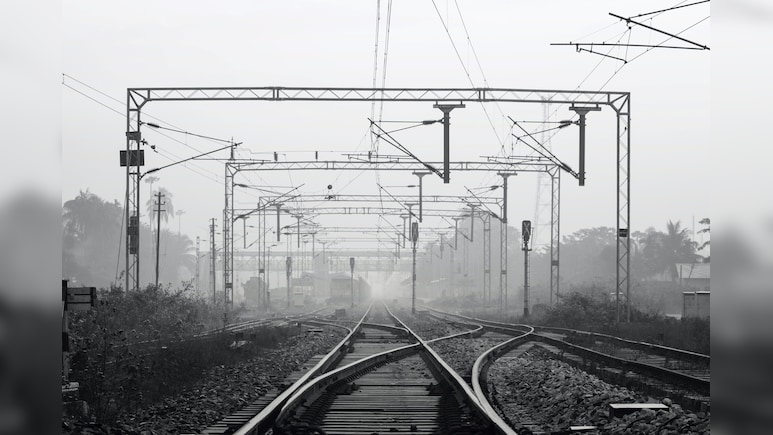
After shaping commuter movement for 113 years between present-day Parel and Prabhadevi in central Mumbai, the Elphinstone Road Overbridge became history on Sunday as workers dismantled its last remaining girders.
With this, the Central Railway has so far razed five British-era road overbridges (ROBs) as part of infrastructure upgrades and suburban rail corridor expansion works on the busy CSMT-Kurla stretch in the metropolis, officials said.
The last remaining girders of the Elphinstone bridge were pulled down during a special night traffic and power block between Chhatrapati Shivaji Maharaj Terminus (CSMT) and Dadar, ensuring minimal disruption to suburban services, which resumed at 7.30 am, said CR's Chief Public Relations Officer Swapnil Nila.
Also Read | Layoffs Are Rising In Tech, But These Skills Are Helping People Unlock Better Pay
He said the bridge, also known as Prabhadevi ROB, had outlived its utility and is being replaced with a double-decker ROB as part of the Worli-Sewree elevated corridor project. The new east-west connector will come up in a couple of years, said officials.
“With the dismantling of the Elphinstone ROB, space has been created for two additional suburban lines between Kurla and Parel,” he said. The lines will be extended up to CSMT in a later phase under the Mumbai Urban Transport Project.
Officials said the Elphinstone ROB, constructed in 1913, had a 37-metre span over the Central Railway section and a total width of 13.53 metres. It comprised “steel semi-through girders and eight panels supported by cross girders and an arch trough system”, they said.
The dismantling was carried out in a phased manner as the ROB ran over Mumbai's busy rail lines. Nearly 20 corridor blocks were utilised for preparatory works to remove the deck slab, pipelines, cables and footpath structures. Subsequently, six major traffic and power blocks were undertaken, during which panels were dismantled in stages and overhead equipment (OHE) shifted, Nila said.
During the final mega block on the night of April 4-5, the remaining longitudinal beams and the two main girders were dismantled using heavy-duty cranes of up to 800-tonne capacity positioned outside the railway boundary, he said.
The operation involved extensive coordination among engineering, traffic and traction departments, with 95 personnel deployed for OHE modifications, he said.
Officials said the exercise posed several challenges, including restricted space due to nearby high-rise buildings, narrow access points, corroded structural components and the inherent risks in handling a century-old structure.
Nila said five east-west connecting British-era bridges, including Masjid ROB, Hancock ROB, Carnac ROB, Sion ROB and Elphinstone ROB, have so far been removed between CSMT and Kurla as part of ongoing capacity enhancement works.
While a new overpass has already become operational where the original Carnac ROB once stood, work on the Sion ROB is still underway. The Masjid ROB was the first to be dismantled, followed by Hancock and Carnac bridges in subsequent phases.
As documented by Rajendra B Aklekar in his book ‘Halt Station India', the Elphinstone bridge traces its origins to the early 20th century, when rising rail traffic made level crossings increasingly unviable.
Around 1905, the Great Indian Peninsula Railway (GIPR) proposed constructing a road overbridge at Parel to replace a busy crossing. The Bombay Municipality and the neighbouring BB&CI Railway declined to share the cost, forcing GIPR to fund the project entirely, while the civic body constructed the approach roads, as per the book.
The bridge was eventually completed in 1913, featuring imported steel girders and stone plaques bearing the name “Parel Bridge” along with contractor details.
Aklekar notes that the bridge was also referred to in records as “Carroll Bridge”, possibly after E.B. Carroll, a locomotive superintendent associated with the BB&CI Railway who contributed to coach design and lighting systems.
Over the decades, the structure became a key east–west connector serving Mumbai's erstwhile mill district, linking present-day Parel and Prabhadevi and shaping commuter movement for over a century.
Aklekar said the bridge had two plaques from the construction era, which have been preserved by the executing agencies and will be incorporated into the new structure.
These include stone engravings naming the contractor -- “GIPR, Parel Bridge, 1913, Contractor Bomanji Rustomji” -- and metal seals on the girders reading “P&W Maclellan Limited, Clutha Works, Glasgow, 1911”.
CR officials said the replacement of these ageing structures is aimed at improving rail operations, augmenting capacity, easing road traffic congestion and enhancing overall commuter safety on Mumbai's suburban network.
With the bridge now completely dismantled on April 5, 2026, officials said it marks the end of an era.
Essential Business Intelligence, Sharp Market Insights, Practical Personal Finance Advice, Daily Fuel, Gold and Silver Prices and Latest Stories — On NDTV Profit.