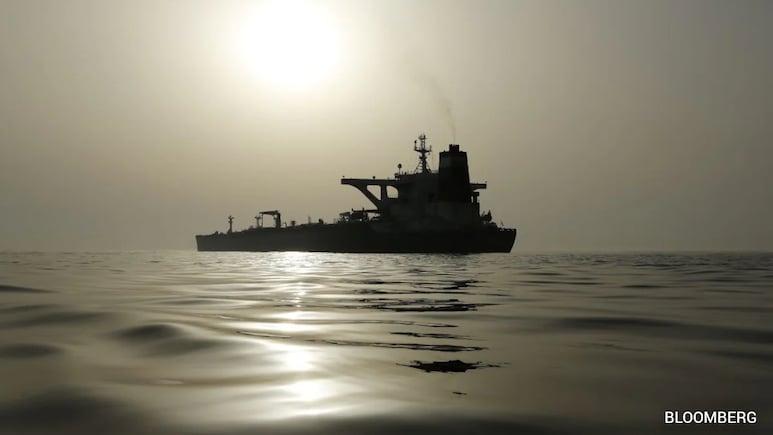
The escalating conflict in the Middle East following US and Israeli strikes on Iran has heightened concerns over the Strait of Hormuz, a critical maritime route for global oil and gas shipments. As per reports, India imports around 90% of its crude oil, and the developments have put its oil supply at risk
On Saturday, Feb. 28, the United States and Israel launched attacks on Iranian targets, prompting Tehran to retaliate against other Gulf countries hosting American military facilities. Later on the same day, Iran's Islamic Revolutionary Guards Corps (IRGC) reportedly sent messages to vessels claiming that the strait had been closed, although no official declaration to this effect came from Tehran.
Global oil markets have reacted sharply. The BBC reports that oil prices surged after at least three ships were attacked near the Strait of Hormuz, as Iran continues its strikes across the region. Meanwhile, insurers, trading houses and shipping companies have reportedly suspended operations, with hundreds of tankers anchored in the Gulf amid uncertainty.
Also Read | Layoffs Are Rising In Tech, But These Skills Are Helping People Unlock Better Pay
Also Read | Dubai No More Safe? Why Iran Targeted The Gulf Arab City After US Strikes - Explained
Oil And Gas Flows Disrupted: Implications For India
The suspension or severe curtailment of oil and gas shipments through the Strait of Hormuz is bound to impact global energy markets, including India, according to The Indian Express. Citing experts, the report states that while the impact will worsen the longer the disruption lasts, it is unlikely to be prolonged. India is reportedly well positioned to stave off a major short-term supply shock when it comes to oil imports as it has alternative sources of supply.
However, higher energy prices are inevitable. Liquefied petroleum gas (LPG) and liquefied natural gas (LNG) supplies, where India's reliance on the strait is comparatively greater, could face increased challenges.
The Times of India, citing commodity analytics firm Kpler, highlights the near-term risks. It states that any escalation would likely push up prices, freight and insurance costs. It could even lead to a temporary supply disruption, though the probability of a significant reduction in production remains low, according to Sumit Ritolia, an analyst at Kpler.
Kpler emphasises that temporary disruptions are possible, but a prolonged full blockade remains a low-probability scenario.
Strategic Importance Of The Strait Of Hormuz
The Strait of Hormuz, lying between Oman and Iran, is a narrow but vital maritime corridor, responsible for 20% to 25% of global crude oil transit, according to the Times of India. The strait links the Persian Gulf to the Gulf of Oman and the Arabian Sea. At its narrowest point, the strait is 33 km wide, with shipping lanes only three km wide in each direction. Around one-fifth of the world's oil consumption passes through this critical passage, reported Reuters.
Citing data from analytics firm Vortexa, the Reuters report states that more than 20 million barrels of crude, condensate and fuels moved through the strait daily on average in 2025. Most crude exports from OPEC members, such as Saudi Arabia, Iran, the United Arab Emirates, Kuwait and Iraq, pass through this route, primarily to Asia. Qatar, one of the world's largest exporters of LNG, sends nearly all of its LNG shipments through the strait.
India's Near-Term Options
India, the world's third-largest crude consumer, is heavily dependent on imports for both oil and gas. The Indian Express notes that Indian refiners currently hold over 10 days' worth of crude and about a week's fuel stocks. To manage potential shortfalls, the country could tap strategic petroleum reserves, accelerate spot purchases from non-Hormuz regions, and expand contracts with alternative suppliers.
Diversification options include sourcing from Russia, US, West Africa and Latin America. Russian cargoes remain accessible in the Indian Ocean and Arabian Sea, including volumes in floating storage.
According to the Indian Express, Ritolia points out that if Middle Eastern imports face constraints or disruptions, Indian refiners could quickly turn to Russian cargoes. He adds that this flexibility offers India an added buffer against short-term geopolitical shocks.
Essential Business Intelligence, Sharp Market Insights, Practical Personal Finance Advice, Daily Fuel, Gold and Silver Prices and Latest Stories — On NDTV Profit.