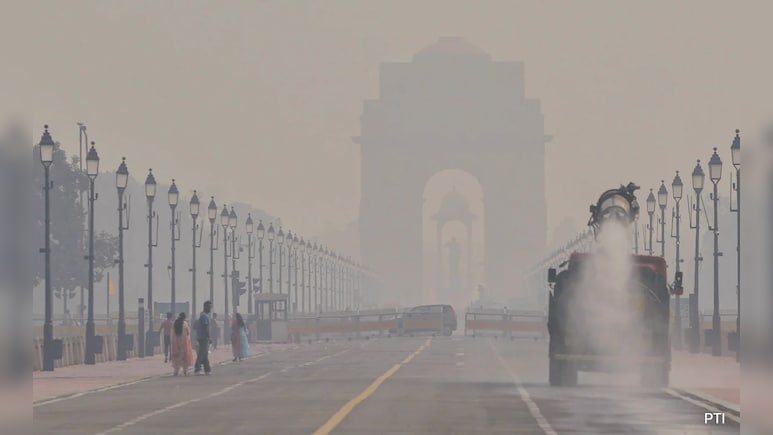
The Commission for Air Quality Management (CAQM) has ordered a ban on dust-generating construction and demolition across the National Capital Region (NCR), and 50% work from home in parts of the region, from November 5 to 20.
The order, dated October 30, aims to cut emissions before pollution typically peaks.
What The Order Says
Issued under Section 12 of the CAQM Act, 2021, the order directs NCR state governments and the Delhi government to implement two measures.
Also Read | Layoffs Are Rising In Tech, But These Skills Are Helping People Unlock Better Pay

-
 Indian Markets Turning Corner After Two Tough Years, Says Sandeep Tandon
-
 NDTV Profit Ignite 2026: Experts See Opportunity In Equities, Stay Bullish For Long-Term
-
 Buy Right, Sit Tight Does Not Work for Individual Stocks, Says Dinshaw Irani
-
 'Worst Is Behind': Quant MF Sees Market Bottom, Flags 'Extreme Euphoria' In Midcaps
-
 India's Mutual Fund Industry Could Become A $1 Trillion Opportunity, Say Fund Managers
-
 'Foreign Investors Are Baraatis': Raamdeo Agrawal's Take On LTCG Tax
-
 Stay Invested Through Market Cycles: Raamdeo Agrawal at NDTV Profit Ignite
-
 Ramesh Damani Remains Bullish On India For Next 20-30 Years, Sees Bargains Amid Market Weakness
-
 CAS Came After A Long Consultation Process: SEBI Chairman Tuhin Kanta Pandey AT NDTV PROFIT IGNITE
-
 Aim To Cut FPI Onboarding Time From Mth To Five Days: SEBI Chairman Tuhin Kanta Pandey AT NDTV PROFI
First, dust-generating demolition and outdoor construction must stop across the entire NCR. Exemptions cover projects linked to railways, metro services, airports, inter-state bus terminals, hospitals, water supply and sanitation, national security and defence, and projects of national importance.
The restriction also covers linear public projects such as highways, roads, flyovers, overbridges, power transmission, pipelines and telecommunication.
Second, state government and private offices in Delhi and in Gurugram, Faridabad, Sonipat, Ghaziabad and Gautam Buddha Nagar must operate with up to 50% of staff attending physically, with the rest working from home.
Industrial establishments and essential services where this is not feasible are exempt.
ALSO READ | Delhi Weather Sees First Fog Conditions of Winter at IGI Airport and Safdarjung
Why Now
The CAQM said its analysis of daily Air Quality Index (AQI) data for November 2018 to 2025 shows a recurring pattern of high pollution in early to mid-November, with AQI reaching "Severe" and "Severe+" on some days.
It said local emissions and the burning of crop residue and biomass add to the load, while low wind speeds, a shallow atmospheric boundary layer and reduced vertical mixing limit dispersal.
The order calls the measures "preventive in nature" and limited in time and area. It says the exemptions are meant to ensure that essential and unavoidable activities are not disrupted. The aim is to cut emissions at source and limit the build-up of pollutants.
ALSO READ | Delhi AQI Nears 200; Bengaluru, Chennai In Unhealthy Category As Kolkata Breathes Easier
How This Differs From GRAP
The order refers to the revised Graded Response Action Plan (GRAP), dated September 29, 2026. GRAP curbs normally take effect when the AQI crosses set thresholds.
These measures are fixed to dates and apply regardless of the day's AQI.
There is a recent precedent. Last November, the Delhi government mandated 50% work from home in government and private offices under GRAP Stage III. This year's order brings similar steps forward.
Current Air Quality
Delhi's air has been unusually clean in recent days. The AQI was 60 on Friday, the city's cleanest October day in four years, before rising to 95 on Saturday morning.
The CAQM order is meant to keep that gain from being lost as the season turns.
Essential Business Intelligence, Sharp Market Insights, Practical Personal Finance Advice, Daily Fuel, Gold and Silver Prices and Latest Stories — On NDTV Profit.