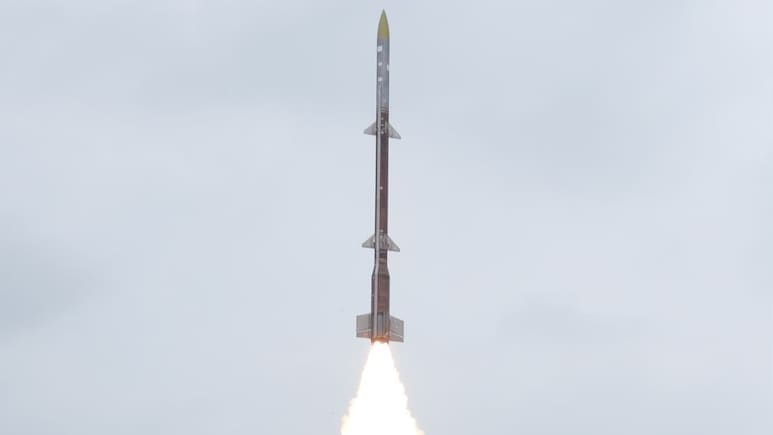
The Defence Research and Development Organisation successfully carried out the long-range surface-to-air missile Kusha's first flight test from the APJ Abdul Kalam Island off the coast of Odisha.
Kusha missile system is capable of neutralising wide variety of aerial threats including fighter jets, missiles, unmanned aerial vehicles and large enemy aircrafts within a wide range and altitude envelope, Defence Minister Rajnath Singh said on Thursday.
The successful test flight of Kusha marks an important milestone in Indian defence research and development. The capability in developing a long-range surface-to-air missile system is possessed only by a handful of nations, according to the defence minister.
"This will also eliminate the import dependency for such systems and signifies a giant leap in air defence capability of the nation," he posted on X. "I congratulate DRDO and other stakeholders for this achievement."
The @DRDO_India has successfully conducted the maiden flight test of Long-Range Surface-to-Air Missile Kusha today from the APJ Abdul Kalam Island off the coast of Odisha.
— Rajnath Singh (@rajnathsingh) July 23, 2026
Kusha missile system is capable of neutralising wide variety of aerial threats including fighter jets,… pic.twitter.com/EceUgGM1HR
The successful test is a significant milestone in the development of Project Kusha, India's own long-range air defence program, which aspires to compete with systems like the US MIM-104 Patriot and Russia's S-400 Triumf.
The DRDO is working on Project Kusha, which will serve as the foundation for India's long-range air defence system in the future. M1, M2, and M3 interceptor missiles with engagement ranges of roughly 150 km, 250 km, and up to 350-400 km, respectively, are part of the system's intended three-tier architecture.
Fighter planes, stealth platforms, drones, cruise missiles, precision-guided weapons, and some types of ballistic missile threats can all be intercepted by the missile shield once it is operational.
With the help of sophisticated radars, fire control systems, and network-centric command infrastructure, the interceptors are anticipated to reach speeds of about Mach 5.5.
In September 2023, the Defence Acquisition Council issued an Acceptance of Necessity (AoN) for the purchase of five Project Kusha squadrons for the Indian Air Force. The main industrial partner for radar systems and overall integration is Bharat Electronics Limited (BEL).
By integrating with the Indian Air Force's Integrated Air Command and Control System (IACCS), the domestic system is anticipated to lessen India's reliance on imported strategic air defence systems while enabling real-time tracking and engagement of various aerial threats.
The proposed Mission Sudarshan Chakra, which aims to create a multi-layered national air and missile defence shield by 2035 by combining long-range interceptors with quick-reaction surface-to-air missiles, very short-range air defence systems, directed energy weapons, and domestic ballistic missile defence capabilities, also heavily relies on Project Kusha.
ALSO READ: Adani Defence, DRDO Ink Deal For IAF's Next-Gen Airborne Surveillance Programme
Essential Business Intelligence, Sharp Market Insights, Practical Personal Finance Advice, Daily Fuel, Gold and Silver Prices and Latest Stories — On NDTV Profit.