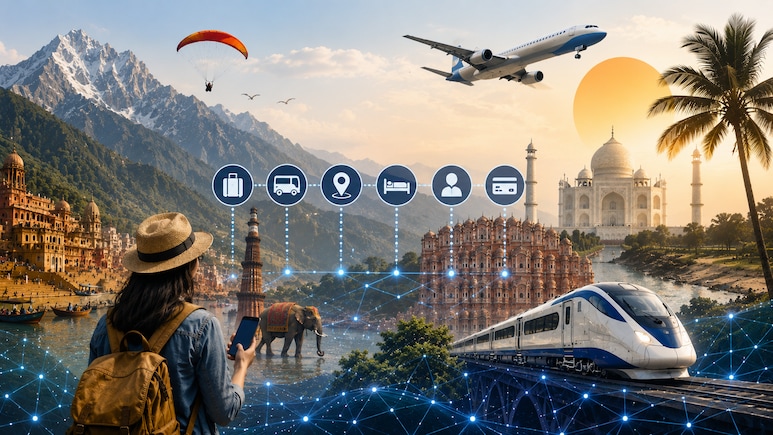
India's digital public infrastructure has already changed how people pay, establish identity and access public services. Its success has shown what becomes possible when fragmented systems are connected through common digital rails. Tourism, one of India's most diverse and decentralised sectors, could be the next significant frontier for this model.
The case is economic as much as technological. Tourism contributed Rs 15.73 lakh crore to India's GDP in 2023–24, accounting for 5.22% of the economy. It also supported 36.90 million direct jobs and 47.72 million indirect jobs, together making up 13.34% of total employment, according to the India Tourism Data Compendium 2025 . International tourist arrivals reached 20.57 million in 2024, exceeding the pre-pandemic figure of 17.91 million recorded in 2019 . These numbers show the scale of the sector. They also show why India needs better tools to understand how tourism demand is changing.
At present, the industry still lacks a clear, real-time view of demand. Existing data largely tells us where travellers have already stayed or visited. It reveals far less about where interest is building, who these travellers are, how long they want to stay, what kind of experiences they are seeking and what kind of accommodation a destination can sustainably support.
Also Read | Layoffs Are Rising In Tech, But These Skills Are Helping People Unlock Better Pay
India has begun addressing this information gap. The Union Budget 2026–27 has also proposed a National Destination Digital Knowledge Grid to digitally document cultural, spiritual and heritage sites and support planning, destination visibility and better tourism management .
The next step should be a national tourism data grid that captures demand as it develops.
Built around privacy, consent and open standards, such a grid could combine anonymised signals from destination searches, accommodation bookings, mobility networks, digital payments, event calendars and seasonal visitor flows. It could show where family travel is rising, where young travellers are extending their stays, which destinations are attracting remote workers, where wellness-led travel is growing and where demand is beginning to overwhelm local capacity.
That intelligence would improve the quality of tourism investment.
A market attracting solo travellers may need a social hostel format. Another may support a premium boutique property, wellness retreat, family or low-density eco-lodge. Reliable demand signals would help hospitality companies choose the appropriate format while allowing governments to plan transport, public facilities, safety systems, waste management and environmental safeguards before visitor numbers become difficult to manage.
This is particularly relevant for hospitality brands operating across formats. Our experience across destinations such as Rishikesh, Nainital and Udaipur shows that demand within the same market is rarely uniform. One destination may simultaneously attract backpackers, families, wellness travellers, workation guests and visitors seeking premium experiences. Better data can help identify these segments early and determine the mix of accommodation a market can sustainably support.
The need for this intelligence is especially visible in Himachal Pradesh and Uttarakhand. Tourism supports livelihoods and local businesses across both states, but heavy seasonal footfall also places pressure on roads, parking, water, sanitation, waste management and fragile ecosystems . Better data could help authorities anticipate peak flows, distribute visitors across seasons and lesser-known destinations, and invest in local capacity before congestion begins to affect residents as well as travellers.
A tourism DPI should also widen opportunity for smaller operators. The FICCI–ONDC partnership is already aimed at improving digital participation across travel, tourism and hospitality. ONDC's mobility framework has also moved into areas such as metro ticketing and public transport use cases, showing how open networks can connect fragmented services through common standards . A shared tourism layer could give homestays, local guides, transport providers, food operators and independent experience curators direct discoverability across participating applications
Vietnam offers an instructive example. Its national tourism data platform, Visit Vietnam, is being developed as a unified system for government agencies, businesses and travellers. The platform includes a real-time tourism data map that can help monitor destination capacity, regulate visitor flows, identify operational risks and support market analysis for businesses.
India now has an opportunity to build tourism infrastructure that can see demand before concrete is poured. The real value of a tourism DPI will lie in helping capital, communities and travellers make better choices. Done well, it can distribute tourism more intelligently, bring overlooked destinations into view, support smaller businesses and ensure that hospitality supply grows in step with the journeys Indians increasingly want to take.
ALSO READ: UK Travel Rules: ETA Fee Up 25%; Indians Must Hold A Visa Too
About the author: Deepak Agarwal is the Co-Founder and Director at Moustache Group of Hotels.
Essential Business Intelligence, Sharp Market Insights, Practical Personal Finance Advice, Daily Fuel, Gold and Silver Prices and Latest Stories — On NDTV Profit.