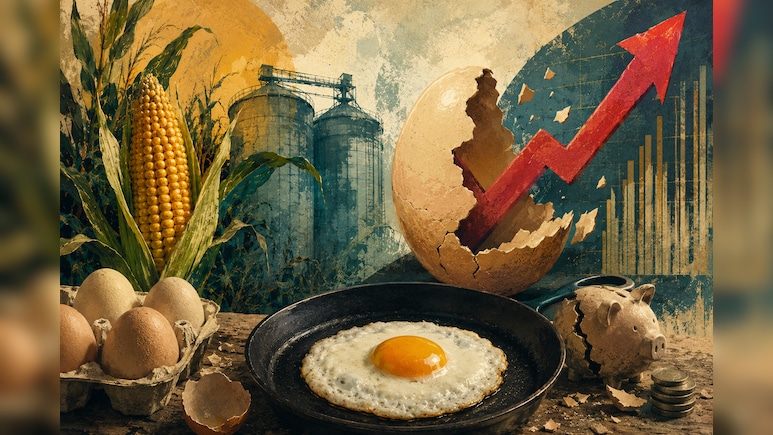
- Egg prices in India rose nearly 40% over the past year due to maize cost increases
- Maize demand is split between poultry feed and ethanol production causing price pressure
- 62% of households reported egg price hikes of 10-50%, 48% reduced purchase frequency
Boiled, scrambled, or thrown into a curry, the trusty egg carton is usually the last thing an average Indian household cuts from its grocery list. For a growing number, that is no longer holding true. Prices have risen nearly 40% over the past year as per recent data, and Abhi Eggs, a branded egg producer, expects a further 15-20% rise in input costs by December.
The reason traces back to maize, a commodity now being pulled in two directions at once: poultry feed and ethanol. CA Aditya Sesh, a member of the Expert Committee on eNWRs at the Ministry of Agriculture & Farmers Welfare, Government of India, says fixing the problem means rethinking how India manages maize as a commodity, not restricting ethanol output.
This issue is not unique to a few handful of regions either. A LocalCircles survey of over 67,000 households across 287 districts found 62% reporting egg prices up by 10-50% or more over the past six months, and 48% cutting the quantity or frequency of their purchases in response.
Also Read | Layoffs Are Rising In Tech, But These Skills Are Helping People Unlock Better Pay
The View From The Farm Gate
Abhi Eggs says that it has not passed on the full rise in feed costs to consumers. Instead, co-founder S.V.V. Dora Reddy told NDTV Profit, the company has scaled back promotional discounts and offers to manage the impact, keeping the sticker-price increase to 6-7% even as input costs have risen faster.
Maize prices have moved from around Rs 22/kg to nearly Rs 30/kg in parts of the market, Sesh said, an increase that lands directly on an input that already makes up 65-70% of poultry production costs. Separately reported industry data puts the price at about Rs 26,500 a tonne, against roughly Rs 14,000 three years ago.
Even so, the company is also holding the line on its feed formula despite the pressure, saying that they are not shifting to cheaper alternatives such as broken rice, wheat or soymeal, calling its existing formula central to product quality and consumer trust.
Reddy said the company's pan-India vendor network has largely spared it from regional shortages, though rising prices remain a challenge on their own. Some long-standing vendor contracts, he added, are not always being fully honoured amid the pressure, even as the company works to maintain continuity of supply.
The Policy Fix
That kind of contract slippage is exactly what Sesh wants policy to address. He said that despite maize having a minimum support price, what is missing is government procurement at the same scale. An earlier inter-ministerial recommendation had proposed assured maize procurement at MSP, with ethanol distilleries supporting farmers directly, and Sesh said the idea is worth revisiting, though he favours an MSP-linked market assurance mechanism over a full FCI-style procurement system, one that would let poultry companies contract directly with farmers and FPOs.
ALSO READ: Egg Prices Rise Up To 50%, Nearly Half Of Households Cut Purchases: Survey
Sesh rejects the idea that India's ethanol policy is fundamentally at odds with food security. Grain-based ethanol already makes up roughly two-thirds of the country's ethanol supply, he said, with maize the largest single grain feedstock, a shift the original E20 roadmap itself anticipated when it estimated close to 16.5 million tonnes of foodgrains could eventually be needed for ethanol production.
On whether ethanol distilleries' maize offtake should simply be capped, Sesh favours calibration instead, pointing to how sugarcane diversion to ethanol is already adjusted seasonally when domestic sugar supply tightens.
His central recommendation goes further: an annual maize balance sheet from the government, tracking production, stocks and demand across poultry, cattle feed, starch, food, exports and ethanol. Without that unified view, Sesh said, one policy arm can keep pushing ethanol demand while another deals with feed or food inflation months later, even when no individual decision is wrong in isolation.
"The objective should be more maize, higher farmer income, predictable feed prices and secure domestic energy," Sesh said, "all supported by transparent markets rather than competing ministries reacting after prices rise."
Essential Business Intelligence, Sharp Market Insights, Practical Personal Finance Advice, Daily Fuel, Gold and Silver Prices and Latest Stories — On NDTV Profit.












.jpeg?im=FeatureCrop,algorithm=dnn,width=350,height=197)