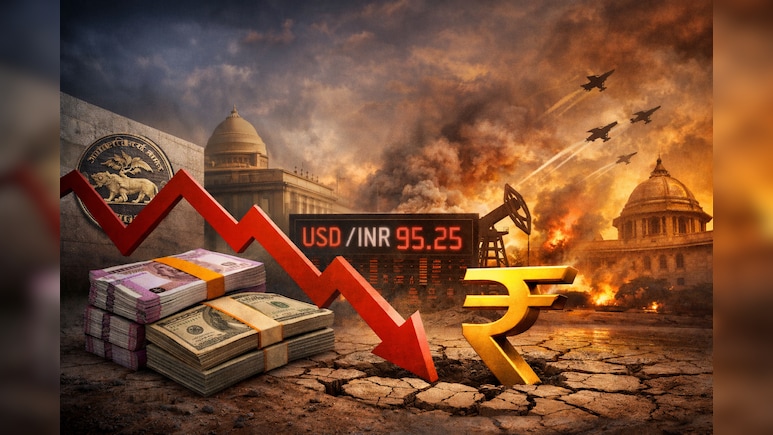
When Uday Kotak - founder of one of India's most respected banking institutions - takes to X (formerly Twitter) to raise the alarm, financial markets and policymakers listen. On March 29, 2026, with the Indian rupee in freefall and the geopolitical temperature rising, Kotak posted what many in North Block and Mint Street already knew but had not yet said out loud:
"The Middle East situation is now in uncharted territory. That leads to unconventional policy actions. A move on sharp reduction of Indian bank's open FX positions in a short period seems to be in that category. Reminds me of Bimal Jalan's playbook as RBI Governor in 1998 when the rupee was depreciating sharply post the Asian crisis. If things get worse geo-politically, is there an opportunity for a new version of FCNR(B) scheme?"
The very next day - March 30, 2026 - the rupee breached 95 to the US dollar for the first time in its history. The landmark number was not just a psychological watermark; it was a declaration that conventional policy had reached the edge of its comfort zone.
Also Read | Layoffs Are Rising In Tech, But These Skills Are Helping People Unlock Better Pay
India's rupee has depreciated by more than 10% in the current financial year - a staggering move for the currency of approximately $4 trillion economy - with more than 5% of that decline compressed into the last quarter alone. The proximate causes are familiar: crude oil above $100 per barrel, a resurgent US dollar amid a widening conflict in West Asia, and relentless FII outflows from Indian equities. But the underlying vulnerability is structural, and it demands a structural response.
Kotak's suggestion to consider "a new version of the FCNR(B) scheme" points in the right direction. But it is the opening line of a much longer policy conversation - not the concluding chapter. This article argues for a multi-lever, credibility-anchored framework that combines Kotak's proposed emergency tools with durable structural reforms.
ALSO READ: RBI Criticizes Banks' Rupee Arbitrage Trades
The Anatomy Of The Fall
Understanding the slide requires separating its cyclical triggers from its structural underpinnings.
Cyclically, three forces have converged in a toxic triangle this quarter:
The oil shock: India imports more than 85% of its crude oil needs. With Brent persistently elevated, every $10/barrel rise in oil prices widens India's current account deficit by approximately 0.35-0.50% of GDP, accelerating dollar demand from importers.
The strong-dollar environment: The US Federal Reserve's "higher for longer" stance and the dollar's safe-haven status amid the US-Iran conflict have propelled the Dollar Index (DXY) higher, weakening nearly every emerging market currency.
FII outflows: Foreign institutional investors have pulled billions out of Indian equities amid global risk aversion, increasing dollar demand in India's domestic foreign-exchange market and putting additional pressure on the rupee.
Structurally, the rupee remains exposed on three flanks: persistently high oil-import intensity in growth, a current account that turns meaningfully negative during commodity upcycles, and a forex reserve buffer that - while large at around $700 billion - has been eroding as the RBI defends the currency.
The Reserve Bank of India's most recent move - directing authorised dealer banks to cap their net open positions in the onshore rupee at $100 million at the end of each business day, with a deadline of April 10 - is drawn from Jalan's 1998 crisis playbook. In 1998, Jalan tightened domestic liquidity, imposed strict FX-position limits on banks, and communicated an unmistakable determination to defend the rupee's external value. That combination of bold signalling and institutional resolve ultimately arrested the slide. The question is whether a 2026 version of the same playbook will be adequate - and sufficient.
FCNR(B) 2.0: The Emergency Buffer
The Foreign Currency Non-Resident (Bank) scheme - introduced in 1993, replacing the older FCNR(A) scheme of 1975 - allows NRIs to open fixed deposits in foreign currencies (USD, GBP, EUR, JPY) with Indian banks. It brings foreign capital into India, strengthens forex reserves and supports the rupee without adding to rupee-denominated sovereign debt.
Its most consequential deployment came in September 2013. When the rupee was in near-freefall after the US Federal Reserve's "taper tantrum", then-RBI Governor Raghuram Rajan launched a special FCNR(B) deposit window with a concessional swap facility - allowing banks to borrow in foreign currency cheaply and lend at attractive rates to NRIs. The scheme mobilised a remarkable $26 billion, and the rupee rebounded from 68 to around 62 to the dollar.
A "FCNR(B) 2.0" for 2026 could incorporate several design improvements:
A time-bound, well-calibrated mobilisation window: A four- to six-month FCNR(B) window, with quantum aligned to market conditions, can quickly attract dollar inflows without turning the instrument into a structural dependency. The rate incentive should be sufficiently attractive to crowd in NRI deposits, but not so generous that it creates a lasting quasi-fiscal burden. The RBI can further structure the swap facility so that the cost of forward cover is partially internalised within the scheme, rather than fully absorbed on its balance sheet - ensuring both effectiveness and fiscal prudence.
Sweetened but sustainable rates: Offer NRIs a spread of 50-100 bps above the current RBI ceiling (which was already raised to ARR + 400-500 bps in December 2024) during the crisis window - attractive enough to crowd in flows, but not so distortionary that it creates lasting market imbalances.
Digital-first NRI onboarding: Partner with global custodians and fintech platforms to reduce KYC friction for diaspora depositors, broadening participation beyond the traditional NRI banking base.
Transparent communication of temporariness: Frame the scheme explicitly as a "crisis bridge" - to be wound down once the rupee stabilises - so markets read it as a credibility-building measure, not a sign of panic or structural dependence on diaspora flows.
The critical caveat: the FCNR(B) scheme buys time; it does not change underlying fundamentals. Which is precisely why it must be embedded within a broader framework.
A Four-Lever Framework to Arrest the Slide
Lever 1 - Refined FX Management and Transparent Communication
The RBI's net-open-position cap for banks is a useful first tool, but its design can be made more dynamic. Instead of a static $100 million limit, the cap could be calibrated to a daily volatility band - tightened when USD/INR moves exceed 0.75% intraday, relaxed when conditions stabilise. Announcing this calibration methodology openly would signal institutional sophistication rather than ad hoc crisis management.
Equally important is communicating the RBI's "reaction function" more clearly. When market participants understand the conditions under which the central bank will and will not intervene, one-way speculative bets become less attractive. The RBI can also make greater use of USD/INR forward swaps and options to smooth the depreciation path - allowing the rupee to adjust gradually rather than defending a specific level until reserves are exhausted, then conceding in a disorderly manner.
Lever 2 - Diaspora Mobilisation Beyond FCNR(B)
The Indian diaspora - over 35 million strong, one of the world's largest - is an underused pillar of India's external financing architecture. Beyond the traditional FCNR(B) route, policymakers could consider:
- Rupee-Linked NRI Bonds: Dollar-denominated bonds issued through authorised banks, with a coupon that includes a rupee-appreciation kicker (for example, base rate plus 40% of any INR appreciation over the bond's life), creating a natural incentive to hold long term.
- Sovereign "Bharat NRI Bonds" via NSSF: A GoI-backed instrument - similar in spirit to the Resurgent India Bonds of 1998 or the India Millennium Deposits of 2000 - that mobilises diaspora savings for defined infrastructure projects, combining patriotic appeal with market-linked returns.
- Streamlined repatriation rules: Clear, rule-based guidelines on repatriation of NRI deposits and bond proceeds, reducing the regulatory uncertainty that currently deters a segment of high-net-worth NRI investors.
Lever 3 - Structural Reduction of the Current Account Vulnerability
No FX-management tool or diaspora-mobilisation scheme can substitute for reducing the underlying dollar demand that drives rupee weakness. India's current account deficit widens most sharply when oil prices spike and FII outflows coincide. Addressing this structurally requires:
- Accelerating the energy transition: The government's renewable energy targets (500 GW by 2030) must be matched by execution on the ground. Every percentage point reduction in oil-import dependence reduces structural dollar demand and makes the rupee more resilient to commodity-price shocks.
- Rupee-denominated trade invoicing: India has made strides in bilateral trade settlement in rupees, particularly with Russia. Extending this architecture to West Asian oil suppliers and ASEAN trade partners would reduce the dollar intensity of India's trade flows.
- Export-sector deepening: India's merchandise export growth has lagged potential. Targeted incentive schemes (RoDTEP, PLI) need to be front-loaded in sectors with high foreign-exchange earning potential - electronics, specialty chemicals, defence equipment and high-value engineering goods - to structurally expand the credit side of the current account.
- Services surplus management: India's services surplus, reinforcing India's position as a global hub for technology and business services - at $188.80 billion in FY2025 - is the single largest cushion in the current account. Policy must ensure that USD earnings from software exports are efficiently brought onshore through streamlined FEMA provisions and hedging facilitation for mid-sized IT exporters.
Lever 4 - Monetary-Fiscal Credibility as the Ultimate Anchor
The most powerful tool in any currency-defence toolkit is credibility - and credibility is earned through consistency in monetary and fiscal management. For India, this means:
- Reaffirming the inflation-targeting framework: The RBI must resist calls to cut rates aggressively simply to spur growth if doing so risks inflation re-ignition. A central bank seen to prioritise currency stability and price anchoring will always face lower speculative pressure on its currency.
- Fiscal discipline in a populist-pressure year: With state elections looming, the temptation to loosen spending will be real. But fiscal slippage sends a powerful negative signal to FII investors, amplifying capital outflows and rupee weakness. Adhering to the fiscal consolidation glide path - even modestly - will matter enormously for capital-flow stability.
- Synchronised messaging from RBI and MoF: Mixed signals between North Block and Mint Street - on the acceptable level of the rupee, on capital-account liberalisation, on the pace of rate easing - are themselves a source of currency volatility. A shared communication protocol for crisis periods would reduce uncertainty premia in the FX market.
The 1998 Lesson, Updated for 2026
Jalan's 1998 success in defending the rupee rested on three pillars: decisive action (liquidity tightening, FX-position limits), institutional credibility (the RBI was seen as willing to act), and an underlying economy that was fundamentally sound. Unconventional tools work when they are embedded in a credible framework; deployed in isolation, they can become expensive exercises in futility.
In 2026, India's underlying economy is stronger than in 1998 - GDP growth is positive, the banking system is well capitalised, and forex reserves remain substantial. The risk is not a balance-of-payments crisis but a confidence deficit: a creeping sense among foreign investors that India's external account management is reactive rather than proactive, episodic rather than strategic.
A revived FCNR(B) scheme, calibrated FX-management tools, a broader diaspora-mobilisation architecture, structural current-account reforms, and unambiguous monetary-fiscal communication - taken together, these constitute a credible, coherent response to the rupee's slide that is far more than the sum of its parts.
The Bottom Line
The rupee at 95 is not just a number. It is a signal - from global markets, from geopolitics, and from India's own structural vulnerabilities - that the time for incremental, comfort-zone policy is over. The call for "unconventional policy actions" is, at its core, a call for strategic clarity: a clear articulation of what India stands for as a macroeconomic entity, backed by instruments that are both visible and credible.
FCNR(B) 2.0 may well be part of that story. But only if it is the opening act of a longer, better-choreographed policy response, one that restores confidence among markets, investors and institutions alike.
FCNR(B) 2.0 may buy time. But only a coherent, credibility-led framework will deliver stability.
Because currencies are not defended by reserves alone - they are sustained by confidence.
ALSO READ: Rupee Under Pressure: Is 95/$ The New Normal? Experts Weigh In
Disclaimer: The views expressed in this article are solely those of the author and do not necessarily reflect the opinion of NDTV Profit or its affiliates. Readers are advised to conduct their own research or consult a qualified professional before making any investment or business decisions. NDTV Profit does not guarantee the accuracy, completeness, or reliability of the information presented in this article.
Essential Business Intelligence, Sharp Market Insights, Practical Personal Finance Advice, Daily Fuel, Gold and Silver Prices and Latest Stories — On NDTV Profit.