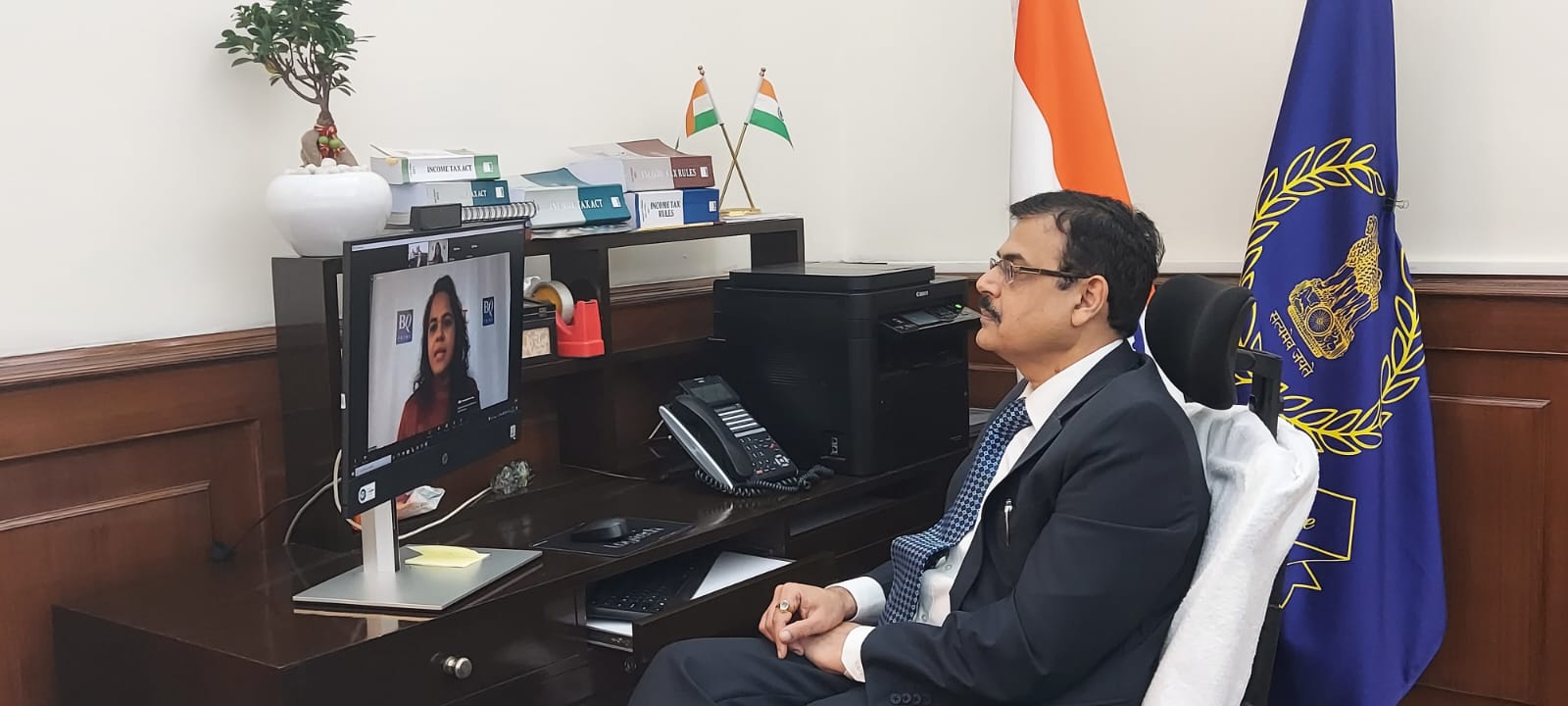
The government will look at the language of some of the provisions of the Finance Bill, 2023, that have caused concerns among industry, said Nitin Gupta, chairman of the Central Board of Direct Taxes.
The first concern relates to the proposal in the Bill to integrate two sections, 241A and 245, under the Income Tax Act, 1961.
Section 241A deals with withholding of a taxpayer's refund until completion of a pending assessment. And, Section 245 allows the tax department to set off the refund against an outstanding demand against the taxpayer.
There are two issues that the industry has on this.
First, that when there is a stay on the demand itself, why is the tax department adjusting the refund in such cases, and also denying the taxpayer any opportunity to be heard before a decision to withhold or set off the refund is taken.
On this, the CBDT chairman told BQ Prime that the latter is an operational issue but acknowledged the industry's concern in stay of demand cases.
Wherever the stay of demand is already there, ideally, to that extent, the refund should not be withheld. And prior intimation, yes, it goes. It's mandated; so the assessee should get an intimation on account of adjustment of refund.Nitin Gupta, Chairman, CBDT
The second concern emanates from the Finance Bill's proposal to amend the existing position to say a taxpayer won't get the additional interest of 3% for the period when refund was withheld because of some pending assessment or reassessment.
To elaborate, as of today, if a taxpayer becomes entitled to a refund, the assessing officer has to issue an order to that effect. If the department issues this order within three months, the taxpayer is entitled to receive the refund with 6% interest. If it's beyond three months, then an additional 3% becomes payable to the taxpayer.
It's this additional 3% interest that the Finance Bill, 2023 is proposing to do away with.
Let us examine it if it is the way you are putting it up. We will examine it if people are feeling it is harsh.Nitin Gupta, Chairman, CBDT
The Perquisite Problem
Gupta also asked the industry to make representations to the department if they are aggrieved by the Tax Deducted at Source provision on benefits or perquisites.
Under the income tax law, an individual is supposed to declare and pay tax on benefits or perquisites like gift, travel facility, hospitality, or monetary grant. Noting that there are leakages in this reporting, last year, the government amended the income tax law to say that the entity paying the perquisite should deduct 10% TDS if the aggregate value of such benefits exceeds Rs 20,000 during the financial year. Later, the CBDT clarified that the provision won't apply to waiver of loan, which is a benefit, by banks and financial institutions.
Now, the Finance Bill, 2023 has sought to clarify that TDS will be applicable on both cash and kind. It is proposed to clarify that TDS is applicable "to benefit or perquisite whether in cash or in kind or partly in cash and partly in kind", the Bill says.
Experts that BQ Prime spoke with said that the Bill doesn't clarify the issue around writing-off of trading debts.
For instance, take a company which has not been paid for the service or goods it has provided, and written off the debt due to irrecoverability from the debtor. The company may write it off, which according to the existing language of the provision, equals to a benefit. In such a case, the company is expected to deduct TDS on bad debt write-off of trading debt, and will need to shell out TDS from its own pocket.
We issued two circulars on this last year. Most of the concerns were taken care of at that stage. If there is a genuine concern, it can be referred to us and we will examine it and pass an appropriate instructional circular. You may advise them to submit a presentation. So, we will examine that. We are open to positions.Nitin Gupta, Chairman, CBDT
Payment To MSMEs: Deduction Confusion
The CBDT chairman also clarified on the Finance Bill, 2023 proposal relating to deductions on payments to micro and small enterprises.
The income tax law provides a list of expenses allowed as deduction. It lists some expenses that can be claimed as deduction from the business income only in the year of actual payment.
To promote timely payment, the Finance Bill, 2023 has proposed to include payment to MSMEs under this provision. The deduction, it says, beyond the period provided in the MSME Act will only be available on actual payment.
The MSME Act says small businesses must be paid within the time period provided in the written agreement, which cannot be more than 45 days. If there's no time period specified, it has to be within 15 days.
The language of the Finance Bill, 2023 has led to some confusion as to whether the deduction will be available only up to 45 days or even after that as long as the payment is made within the same financial year.
The language, Gupta agreed, can lead to several interpretations. "It says that the corresponding expenditure will be allowed when the payment is made. The purpose is that it doesn't elongate beyond the particular period of time."
The Act is saying that the payment which is made within the time limits prescribed in the MSME Act, will be allowed as deduction. Beyond that, if you want to make a claim it is an expenditure because it's a purchase or a service or anything, it can be allowed only on actual payment basis. Until it is not paid, it will not be allowed as a deduction. So, the intent is to not allow deduction on an accrual basis.Nitin Gupta, Chairman, CBDT
As of now, even if you don't make the payment for two years, deduction is allowed, he explained.
So, for instance, if the invoice is raised on April 10, and the payment is made after six months, which is exceeding the 45-day limit, will the deduction be allowed?
Gupta answered this question in the affirmative.
The CBDT chairman also clarified on the angel tax provisions which will now be applicable to non-residents, the distinction the Finance Bill, 2023 creates between online and offline games; new tax for investors in REITs, InVITs; and the increase in Tax Collected at Source rate for foreign holidays and investments.
Watch the full interview here:
Essential Business Intelligence, Sharp Market Insights, Practical Personal Finance Advice, Daily Fuel, Gold and Silver Prices and Latest Stories — On NDTV Profit.