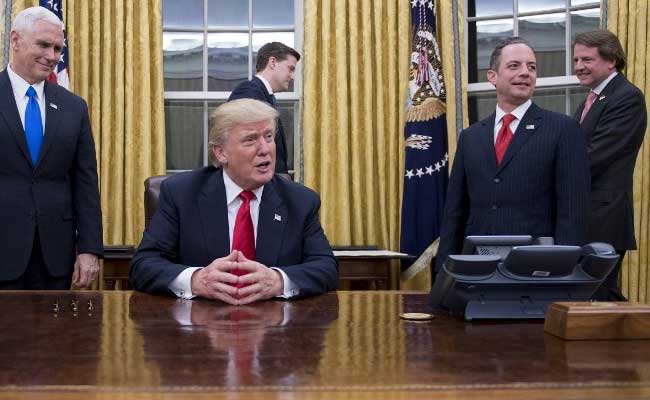
Washington: True to his campaign promise, President Trump ordered a federal hiring freeze on Monday. His Contract with the American Voter said a freeze would be part of his "100-day action plan to Make America Great Again," but Trump issued it on the first Monday of his presidency.
What does this mean for federal employees? Here are a few questions and answers:
Q. Are all federal employees affected?
A. No. During the campaign, Trump said he would exclude those in "military, public safety, and public health" positions. As he signed the document in the Oval Office, however, he only mentioned the military.
So far those haven't been defined, but if by "military" he means civilian employees of the Defense Department supporting the military, that alone would exclude about a third of the workforce.
Exempting public safety and health positions could wall off much of other large agencies such as the Veterans Affairs Department and Department of Homeland Security, as well as parts of other agencies that deal with such issues. The Congressional Budget Office recently estimated that a freeze exempting such occupations would exclude about two-thirds of the federal workforce.
But again, that is to be defined.
Q. Why did he freeze federal hiring?
The contract says it is one of six measures "to clean up the corruption and special interest collusion in Washington, DC."
Q. How will the freeze clean up corruption and collusion when it would apply to job applicants who don't yet have federal jobs?
A. Trump's contract didn't say.
Q. How would a freeze be implemented?
A. Trump's contract said the freeze would be achieved through attrition of the federal workforce. That could be done in the form of slowing hiring.
For example, two new employees could be hired for every three who leave government until the workforce was cut by 10 percent, as a bipartisan commission on fiscal responsibility suggested in 2010. House Republicans endorsed a 10 percent cut over three years in their 2012 fiscal year budget.
Q. What have we learned from previous hiring freezes?
A. In 1982, the Government Accountability Office said freezes under former president Ronald Reagan and Jimmy Carter were "ineffective in managing federal employment." That report said the previous freezes "disrupted agency operations, and in some cases, increased costs to the Government."
Q. Would a freeze on federal employment mean agencies would hire more government contractors?
A. Federal labor leaders fear that could be the case.
American Federation of Government Employees President J. David Cox Sr. said "President Trump's federal hiring freeze will result in more government waste as agencies are forced to hire high-priced contractors to do the work that federal employees can and should be doing."
Q. Has federal employment grown over the years?
A. While the absolute number of federal employees has increased, the per capita number has decreased. There are fewer federal staffers now compared to the size of the population they serve. "Since the 1960s, the U.S. population increased by 67 percent, the private sector workforce increased by 136 percent," according to President Obama's fiscal 2017 budget document, "while the size of the Federal workforce rose about 10 percent."
Q. Trump said the freeze would use attrition to cut jobs. How much turnover is there in federal jobs?
A. Government data show that turnover has averaged about 210,000 jobs a year over the last five years, out of a workforce of just under 2.1 million. There are various ways of counting federal employment, and thus, turnover. Those figures include executive branch employees outside the U.S. Postal Service and intelligence agencies, but they include part-time, seasonal and temporary employees.
Of those who leave each year, about 75,000 on average quit, another 65,000 retire and another 55,000 leave because their appointments expire, which is common among temporary employees. About 10,000 are fired and the other separations are due to various reasons, including layoffs and deaths.
© 2017 The Washington Post
(Except for the headline, this story has not been edited by NDTV staff and is published from a syndicated feed.)
Essential Business Intelligence, Continuous LIVE TV, Sharp Market Insights, Practical Personal Finance Advice and Latest Stories — On NDTV Profit.















%20India%20Aviation,%20aeroplane,%20aircraft%20(6).jpeg?im=FeatureCrop,algorithm=dnn,width=350,height=197)