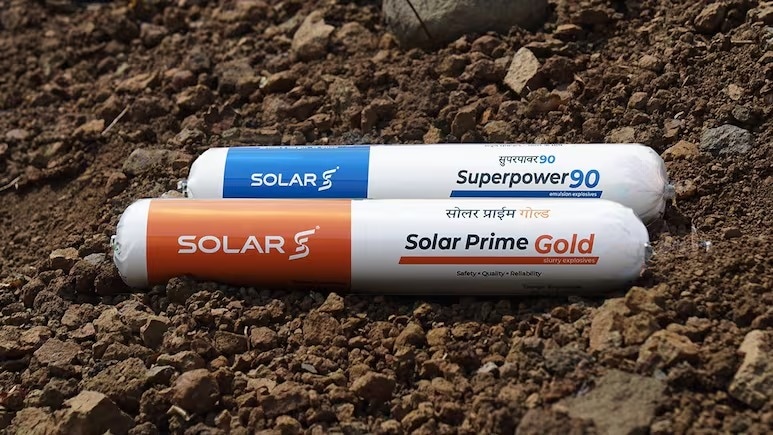
Solar Industries manufactures and supplies industrial explosives, military ammunition and initiating systems. The company holds 24% of the domestic explosives market. Over the past three decades, it has expanded from supplying mining explosives to developing defence solutions and entering the space and aerospace segment.
The Great Pivot: From Mining to Missiles
The product portfolio has two segments: Industrial Explosives and Defence and Aerospace. Defence accounted for 28% of the portfolio in FY25, up from 16% in FY24. Explosives contributed 59% and Initiating Systems 13%. The change shows the rising share of defence in the business mix.
The company expanded capacity, entered advanced ammunition systems early and aligned with India's push for indigenous defence production. Its defence portfolio includes high-energy materials such as HMX and RDX systems, including the Pinaka platform.
In 9MFY26, defence revenue rose 76% year-on-year to Rs 1,626 crore and formed 24% of sales. In FY25, defence revenue grew 162% to Rs 1,355 crore from Rs 517 crore in FY24. The increase reflects both higher growth rates and scale. Order visibility remains in place.
The Export Engine: Scaling Beyond India
As of Q3FY26, the order book stood at Rs 21,000 crore, with over Rs 18,000 crore from defence. Of this, Rs 6,500-7,000 crore came from India and about Rs 11,000 crore from exports. The mix spreads exposure across markets and offers about two years of revenue visibility.
The NATO Play: Solving the Global 155mm Shell Crisis
Solar is expanding into medium- and high-calibre ammunition to meet demand. Industry reports point to a global shortage of 155mm ammunition, with demand expected to stay firm for six to seven years due to replenishment needs.
The 155mm calibre is standard for NATO field artillery. Solar's presence in T~CHECK~rkiye, a NATO ally, gives access to European markets. The company has worked on 155mm ammunition over the past year. Its Nagpur facility is the world's largest single-location cartridge plant and supports scale production.
The company expects to start commercial production of 155mm artillery shells in Q4FY26 after final qualification approval. It expects revenue ramp-up from FY27. It is also participating in long-term requests for proposal from the Ministry of Defence for 23mm and 30mm ammunition programmes, with order awards expected over the next year.
Pinaka: A Rs 6,000 Crore Revenue Moat for 2030
Solar became the first Indian company to test-fire the Pinaka multiple rocket launcher system. It secured a Rs 6,084 crore contract from the Ministry of Defence to supply Pinaka Enhanced Range rockets and Area Denial Munitions.
After completion of trials, commercial dispatches are scheduled for Q4FY26. Management expects this to support defence revenue and help achieve annual defence revenue guidance of Rs 3,000 crore. The contract runs for seven to 10 years and provides long-term revenue visibility.
The company plans to add variants to the Pinaka series to expand the product range. It also participates in national programmes such as the Man-Portable Anti-Tank Guided Missile and the Kusha air defence system. If secured, these programmes can add to the order pipeline.
UAVs and Runways: The High-Tech Frontier
Solar is expanding into Medium Altitude Long Endurance unmanned aerial vehicles. This aligns with its move into aerial platforms and unmanned systems. It recently inaugurated India's first private-sector military drone-testing runway.
ALSO READ: US Sets Initial Duties On Indian Solar Imports At 126%
The Rs 12,700 Crore Defence and Aerospace Capex
These initiatives remain in development and reflect the company's focus on emerging defence technologies. It signed a memorandum of understanding with the Maharashtra government to set up a defence and aerospace project in Nagpur, with planned capex of Rs 12,700 crore over 10 years.
The investment aims to build integrated manufacturing capabilities. Solar targets annualised revenue growth of 20% or more over the next three to five years. A higher share of defence revenue may support margin and profitability.
Management expects margins in the 27-28% range over the next three to five years. Ebitda margin was 27.7% in 9MFY26, compared with about 27.8% a year earlier. Net sales rose 26% year-on-year to Rs 6,785 crore in 9MFY26, with Rs 2,809 crore, or 41%, from exports. Net profit increased 25% to Rs 1,181 crore.
Is the Growth Already Priced In?
At Rs 13,146 a share, Solar trades at 82 times price-to-equity, above its five-year median of 69 times. The Pinaka pipeline, entry into 155mm ammunition and rising defence share support revenue visibility. Current valuation reflects these factors, making execution the key variable to monitor.
ALSO READ: Midwest: Meet the Granite King Powering India's EV, Solar, and Chip Pivot
Disclaimer: The views expressed in this article are solely those of the author and do not necessarily reflect the opinion of NDTV Profit or its affiliates. Readers are advised to conduct their own research or consult a qualified professional before making any investment or business decisions. NDTV Profit does not guarantee the accuracy, completeness, or reliability of the information presented in this article.
Essential Business Intelligence, Sharp Market Insights, Practical Personal Finance Advice, Daily Fuel, Gold and Silver Prices and Latest Stories — On NDTV Profit.