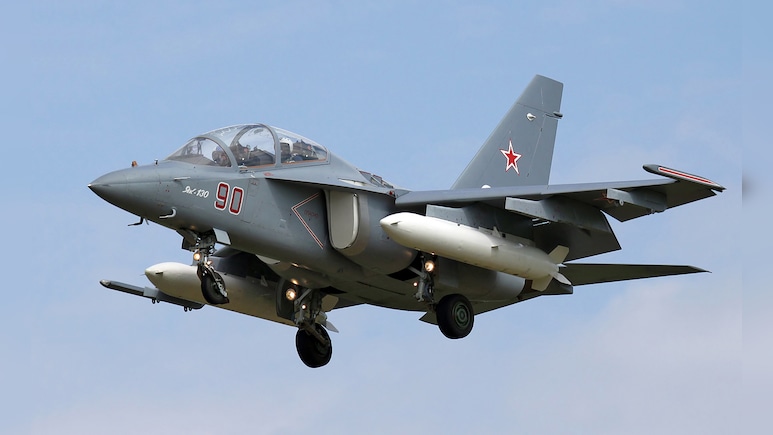
Israel Defense Forces (IDF) on Wednesday said an Israeli F-35I Adir fighter jet shot down an Iranian Yakovlev Yak-130 aircraft, describing it as the first confirmed fighter-to-fighter aerial engagement of the ongoing Israel-Iran conflict.
According to the IDF, the Russian-made Yak-130, operated by the Iranian Air Force, was intercepted during an active aerial encounter involving Iranian patrol aircraft. The military did not disclose the exact location but confirmed the jet was destroyed amid continuing operations.
The development comes as both sides escalate the use of combat aviation following days of strikes targeting air bases, aircraft and broader military infrastructure. Israeli forces have stepped up efforts to suppress Iran's aerial capabilities, while Iranian aircraft have increasingly flown patrol missions to counter drones and other airborne threats near key cities, including Tehran.
Why Was Iran Using the Yak-130?
Earlier this week, observers reported Yak-130 jets flying air patrol missions over Tehran, reportedly alongside MiG-29 interceptors. The aircraft were said to be armed with short-range air-to-air missiles and tasked with engaging unmanned aerial vehicles operating at low and medium altitudes.
Iran's deployment of the Yak-130 in an operational patrol role follows earlier Israeli strikes that, according to Israeli military statements, targeted Iranian fighter jets just before take-off. Those strikes formed part of a broader campaign aimed at limiting Iran's ability to deploy combat aviation during the early phase of hostilities.
What Is The Yak-130?
The Yak-130 is a Russian-developed advanced jet trainer designed by the Yakovlev Design Bureau in the 1990s. It was conceived primarily as a training platform to prepare pilots transitioning to modern Russian combat aircraft such as the Su-30, Su-35 and Su-57.
Although built as a trainer, the Yak-130 is capable of performing light combat missions. It features nine external hardpoints that allow it to carry guided bombs, rockets and short-range air-to-air missiles, enabling it to undertake close air support, limited air defence and counter-drone operations.
The twin-seat aircraft places the trainee pilot in the front cockpit and the instructor behind. Both positions are equipped with full glass cockpit displays. A digital fly-by-wire (FBW) flight control system allows either occupant to assume control at any time.
A key feature of the Yak-130 is its programmable FBW system. Rather than relying on traditional mechanical linkages, pilot inputs are processed electronically. This system can be reconfigured to simulate the handling characteristics of different combat aircraft, offering trainees a realistic transition experience whether preparing to fly agile fighters or heavier ground-attack jets.
Powering the aircraft are two Ivchenko-Progress AI-222-25 turbofan engines, managed by a Full Authority Digital Engine Control (FADEC) system that digitally regulates thrust, diagnostics and engine performance.
Despite its training roots, the Yak-130 can be configured for live combat roles. For air-to-ground missions, it can carry unguided bombs weighing up to 500 kg, including FAB-series munitions, some of which can be fitted with glide-guidance kits. It is also compatible with guided bombs such as the KAB-500Kr. Rocket pods for S-8, S-13 or S-25 rockets can be mounted, and a centreline SNPU-130 gun pod housing a 23-mm GSh-23L autocannon can be installed.
In air-to-air roles, the aircraft can deploy R-73 short-range missiles. When paired with a helmet-mounted targeting system, pilots can lock on to targets even when they are not directly ahead, thanks to high off-boresight capability.
The Yak-130 also carries chaff and flare dispensers for self-protection and can mount electronic countermeasure pods, targeting pods and auxiliary fuel tanks to enhance range and survivability.
Also Read: Iran Fires Ballistic Missiles Towards Turkey; NATO Shoots Down
Aviation enthusiasts often note the Yak-130's striking resemblance to the Italian M-346 Master. The similarity stems from a joint development programme between Yakovlev and Italy's Alenia Aermacchi in the 1990s.
After the collapse of the Soviet Union strained Yakovlev's finances, Alenia partnered in the project, providing funding and technical input. The collaboration ended in 1999, with Alenia reportedly paying $77 million for technical documentation rights.
The split resulted in two separate aircraft lines derived from the same design. Yakovlev continued production of the Yak-130, primarily marketing it to Russia and allied states, while Aermacchi developed the M-346 Master for NATO and Western-aligned countries.
Essential Business Intelligence, Sharp Market Insights, Practical Personal Finance Advice, Daily Fuel, Gold and Silver Prices and Latest Stories — On NDTV Profit.