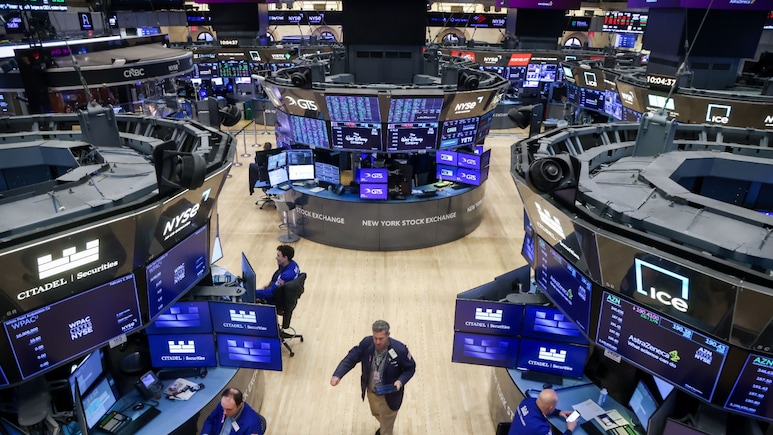
The comeback in US equities from last week's artificial intelligence jitters stalled early Thursday as geopolitical headlines put traders on edge.
The S&P 500 Index slumped 0.3% as of 9:33 a.m. in New York, while the technology-heavy Nasdaq 100 Index declined 0.4%. The head of the United Nations nuclear watchdog warned that Iran's window to reach a diplomatic agreement over its atomic activities is at risk of closing.
“While there might be some initial volatility from conflict in Iran, we think the markets would look past it pretty quickly,” said Dennis Follmer, chief investment officer at Montis Financial, in an email. “Given the likelihood of a diplomatic solution and that the resulting volatility from an actual armed conflict would be fairly contained, we think any portfolio changes are unwarranted.”
Lingering worries about AI also continue to weigh on sentiment, with two coalescing fears gripping Wall Street. On one hand, investors have been worried that robust spending by American technology behemoths will fail to deliver the profits necessary to justify the investments, while there's also concern AI could make a number of industries obsolete.
Market watchers parsed a bevy of economic data Thursday morning. Applications for US unemployment benefits fell by the most since November, adding to evidence of stabilization in the labor market. The US trade deficit widened in December, capping a turbulent year of erratic tariff policy.
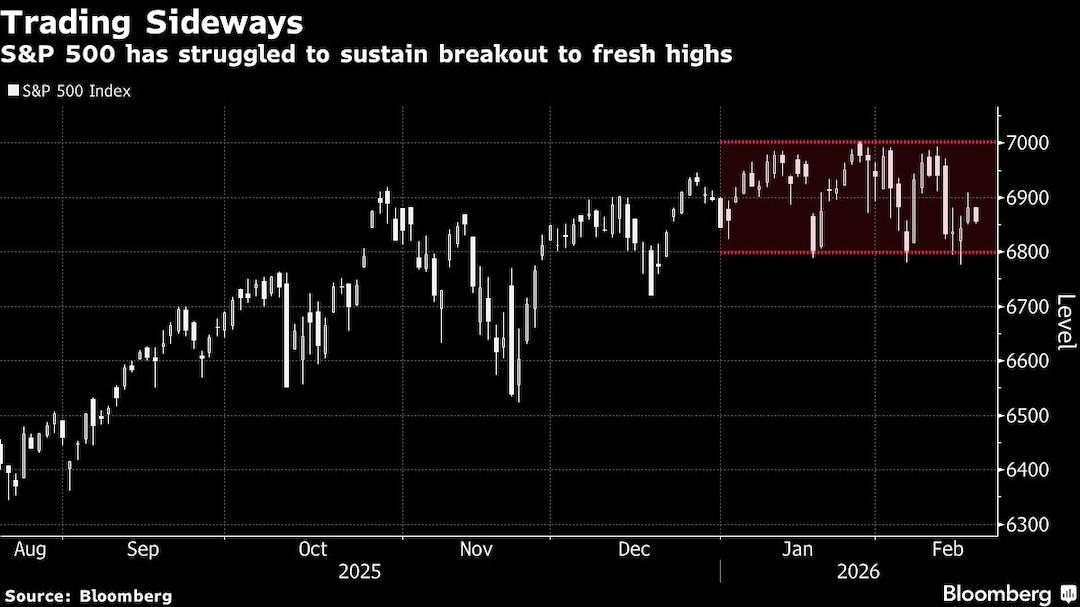
The S&P 500 has shown signs of a market under pressure, recently trading in a tight range roughly from 6,800 to just under 7,000. Investors have reduced their equity exposure to the lowest level since July, as measured by the National Association of Active Investment Managers' poll of active money managers.
Meantime, the equal-weighted version of the guage is up nearly 6% year-to-date as investors seek opportunities beyond large-cap tech stocks. Morgan Stanley's chief investment officer and chief US equity strategist, Mike Wilson said that market broadening is happening now as the US economy and market begins a new cycle.
“There have been many parts of the economy that have been sort of mired in a recession for the last three years or so, and they're just now starting to emerge,” he said in an interview with Bloomberg Television.
Walmart Inc., a bellwether for the US consumer, issued a forecast for full-year earnings that missed higher expectations, flagging the unpredictable state of trade and labor market conditions.
At the end of the fourth quarter, mega-cap tech stocks were the most under-owned relative to their weightings in the S&P 500 in 17 years, according to Morgan Stanley analysis citing 13-F filings. Elsewhere, a separate analysis from Goldman Sachs Group Inc. found roughly 57% of large-cap mutual funds are outperforming their benchmarks year-to-date, the highest percentage since 2007.
In individual movers, Deere & Co. shares jumped as the world's largest farm-machinery maker boosted its annual profit outlook, anticipating a long-awaited upturn in the agriculture economy. Carvana Co. suffered from some growing pains in its push for rapid growth as the company's higher costs hit margins in the latest quarter and sent shares tumbling.
ALSO READ: US Jobless Claims Drop By The Most Since November To 206,000
(This story has not been edited by NDTV staff and is auto-generated from a syndicated feed.)
Essential Business Intelligence, Continuous LIVE TV, Sharp Market Insights, Practical Personal Finance Advice and Latest Stories — On NDTV Profit.