US President Donald Trump on Thursday hosted the first meeting of his much-publicised 'Board of Peace' in Washington, positioning it as a new global platform to oversee peace efforts in Gaza and potentially beyond. But the initiative begins under a cloud, with several major European allies opting not to join.
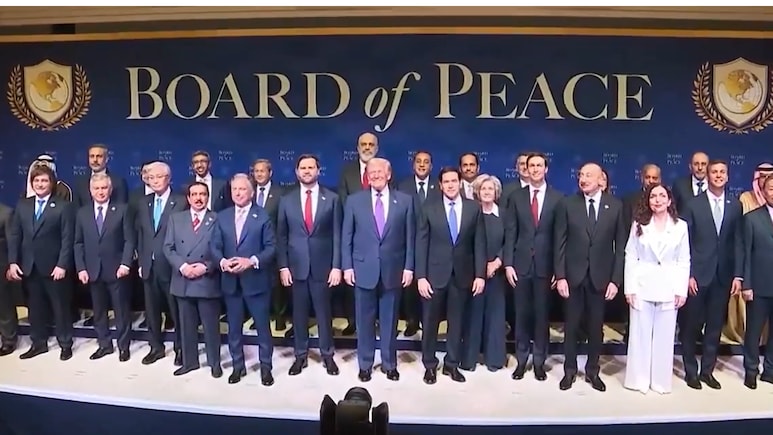
Trump joined fellow world leaders and founding members of the board for a group photo.
.@POTUS joins fellow world leaders — and founding members of the @BoardOfPeace — for a group photo this morning at the Donald J. Trump Institute of Peace pic.twitter.com/SSkk70OabK
— Rapid Response 47 (@RapidResponse47) February 19, 2026
"Today, it's a tremendous honor to welcome you all to the United States Institute of Peace for the inaugural meeting of the Board Of Peace. I believe it's the most consequential board... There's never been anything close because these are the greatest world leaders," Trump said in inaugural remarks.
He added that what they are doing is very simple — peace. "We've been doing a really good job. We've had a great relationship, and I appreciate you being here."
Also Read | Layoffs Are Rising In Tech, But These Skills Are Helping People Unlock Better Pay
"We settled 8 wars, 9th to come, it turned out to be a tougher one," added Trump reiterating his claim.
A senior US official told NBC news that the meeting will include updates on “all the lines of effort," including humanitarian assistance, the National Committee for the Administration of Gaza, and the International Stabilization Force.
A New Forum — Or a UN Alternative?
The summit brings together representatives from at least 40 countries, including several heads of state. Among those attending are Hungarian Prime Minister Viktor Orbán and Argentine President Javier Milei, both seen as close to Trump.
The White House said that discussions will focus on the next phase of the fragile Gaza ceasefire, humanitarian assistance, and plans for a long-term stabilization mechanism in the Palestinian territory.
Trump is also expected to unveil a multi-billion-dollar reconstruction plan for Gaza. He has claimed that more than $5 billion in pledges have already been secured, though details of contributing countries remain unclear.
In addition, Washington is preparing to outline proposals for a United Nations-authorised international stabilization force in Gaza. According to US officials, several countries may commit thousands of troops to the initiative.
Key Allies Stay Away
However, the absence of several major US allies has raised questions about the board's credibility. The UK, France, Norway, Sweden and Slovenia have declined to join, reportedly citing concerns that the body's charter does not explicitly prioritise Gaza and could undermine the role of the United Nations.
Pope Leo XIV also declined the invitation, with the Vatican reiterating that the UN remains the primary authority for managing global crises.
The European Union and Italy will attend only as observers. Italian Foreign Minister Antonio Tajani has said Rome is willing to help train police forces in Gaza but stopped short of formally endorsing the initiative.
Russia was invited but has not committed to participating in the first summit.
Palestinian Concerns
The board has drawn criticism for limited Palestinian representation. While a separate technocratic body made up of Palestinians is expected to handle day-to-day governance in Gaza, key Palestinian leaders have expressed reservations.
Advisers to Palestinian President Mahmoud Abbas have described the arrangement as unacceptable in principle, even if viewed by some as a “lesser of two evils” under current conditions.
Israeli Prime Minister Benjamin Netanyahu confirmed Israel's participation last week following talks with Trump in Washington — a move likely to intensify scrutiny over how Palestinian interests will be safeguarded.
High Stakes Amid Fragile Truce
The Gaza ceasefire has largely held, though sporadic violence continues. Major challenges remain, including the demilitarisation of Hamas, reconstruction of devastated infrastructure, and the return of displaced civilians.
Trump has signalled that the Board of Peace could evolve into a broader conflict-resolution body, working “in conjunction with” — but potentially independently of — the United Nations.
Whether the initiative becomes a serious diplomatic platform or faces resistance from traditional allies will depend on its ability to deliver tangible progress in Gaza — and reassure sceptics that it complements rather than competes with existing global institutions.
Essential Business Intelligence, Sharp Market Insights, Practical Personal Finance Advice, Daily Fuel, Gold and Silver Prices and Latest Stories — On NDTV Profit.