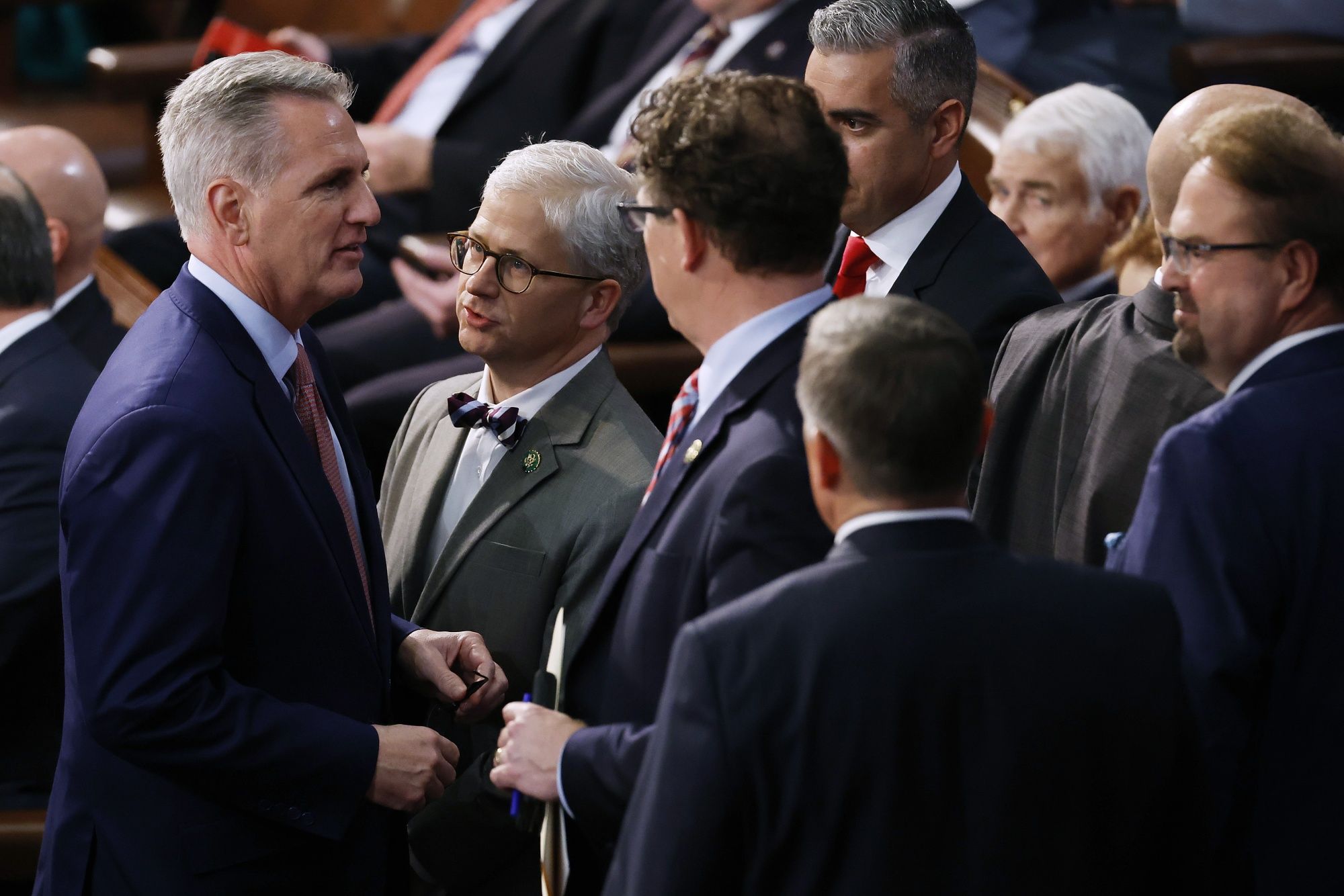
(Bloomberg Opinion) -- House Republicans, who ended their last session in the majority four years ago with a government shutdown, have now failed to elect a speaker on the first day of their new majority.
They aren't very good at this.
Even if Republicans wind up resolving their leadership situation quickly, it's clear that the party remains extremely dysfunctional. Yes, Kevin McCarthy's bid to be elected House speaker has been made tough by Republicans' slender margin in the chamber. It also hasn't helped that plenty of McCarthy's supporters probably believe he would be a mediocre House leader. But John Boehner, who served as speaker from 2011 to 2015, was an excellent House leader. A large group of House Republicans turned against him anyway.
The party has become so identified with opposition to compromise, and so cowed by its radical fringe, that it is hard to imagine how a Republican-led House will function over the next two years.
So where does the GOP go from here? How does it eventually govern, whomever its members choose as speaker?
There are two paths the GOP could take. In one, the radical faction wears down the rest of the conference and sees its preferred candidate elected speaker.
If that happens, expect them to learn from their victory. They will get the House rules that they want (they already have secured extraordinary concessions from McCarthy without agreeing to vote for him, although all bets are off about whether his pledges to them hold at this point). They will get the committee assignments they want. They will get whatever they want by repeatedly threatening to bring the House to a standstill.(1)
If the radical fringe gets its way, expect them to use their influence to disruptive, harmful ends. They will bring about government shutdowns when yearly funding bills expire in the fall, and force the government to default by not raising the debt limit.
While it will be far easier for them to carry out their agenda on issues like the debt ceiling, where mere inaction would make the difference, we should expect them to push hard for the House to impeach President Joe Biden over trivialities (or even outright fictions). They might succeed. Compromise will be out, even on relatively non-controversial items; confrontation would be the norm.
Yet there is another scenario where the bulk of the Republican caucus firmly rejects radicalism. That doesn't necessarily mean that McCarthy remains their candidate. Perhaps there is a compromise figure who could win back enough of the radical flank. Or perhaps Representatives Matt Gaetz, Lauren Boebert and others in their extremist faction eventually just give up.
It's even possible that Republicans could threaten to cut a deal with some Democrats to install a less conservative Republican as speaker, or even for some Democrats to vote for McCarthy or another mainstream conservative candidate in exchange for some set of concessions.(2)
And if that happens? The House majority would still be extremely conservative and would still practice aggressive oversight of the Biden administration. But it would be far more open to cutting deals with Democrats. That might well mean marginally more conservative policy overall, because it would entail Congress passing things that both parties could live with, instead of gridlock and stalemate.
If the majority in the Republican conference — the 202 Republicans who voted in the third round Monday to elect McCarthy speaker — come out on top, it would also be a first step in fighting back against the increased radicalization of the party overall, inside the House and out. If they demonstrated that they could take a high-profile stand against those claiming to be true conservatives and survive, those accused of being Republicans in Name Only could finally begin to show that they need not be afraid of that label.
Of course, quite a few of those House members who stood with McCarthy on Monday have been on the side of the radical group in plenty of other intraparty disagreements, including the votes over certifying President Joe Biden's election on Jan. 6, 2021. They might return to radicalism even if they do win this vote. But there is at least a chance that some of those who have feared the RINO label in the past might change.
For the last three decades, House Republican confrontations have often ended with mainstream conservatives caving to the radical fringe. That's how we got extended government shutdowns in 2013 and 2018-2019, and why we wound up with a mostly Democratic select committee investigating the Jan. 6 siege of the Capitol instead of a bipartisan commission.
So I suppose that's where the smart money would be right now. But it's certainly interesting that McCarthy reportedly blasted the extremist House Freedom Caucus during the Republicans' meeting Tuesday morning. “The gap between the vast majority of the House Republican Conference and the HFC is widening very fast. VERY VERY fast,” political journalist Jake Sherman tweeted before voting got under way Monday.
The Republican mainstream has been ducking an open confrontation with its most radical members for a long time. Speaker Boehner resigned, and his successor Paul Ryan retired, without forcing a fight. But it's certainly here now.
More From Bloomberg Opinion:
- Trump Lit the Fire That's Burning Down McCarthy's House: Joshua Green
- Trump's Tax Returns Are Only Part of the Picture: Timothy L. O'Brien
- Nancy Pelosi Is the Greatest Speaker in History: Jonathan Bernstein
(1) Procedurally, that would be insured by one of McCarthy's concessions to the radical right restoring the ability of any Republican to force a vote to depose the speaker at any time. That vote that would require only a simple majority, that is, all the Democrats and five or more Republicans, given the current makeup of the House. If the radicals win this fight and retain that rule, everyone would know that they had a credible threat they were willing to use.
(2) Among the possibilities? Allowing Democrats to offer more amendments on the House floor; more equal footing and staff funding for Democrats on committees; pledges to rein in some of the wilder "oversight" plans urged by the radicals.
This column does not necessarily reflect the opinion of the editorial board or Bloomberg LP and its owners.
Jonathan Bernstein is a Bloomberg Opinion columnist covering politics and policy. A former professor of political science at the University of Texas at San Antonio and DePauw University, he wrote A Plain Blog About Politics.
More stories like this are available on bloomberg.com/opinion
©2023 Bloomberg L.P.
Essential Business Intelligence, Sharp Market Insights, Practical Personal Finance Advice, Daily Fuel, Gold and Silver Prices and Latest Stories — On NDTV Profit.