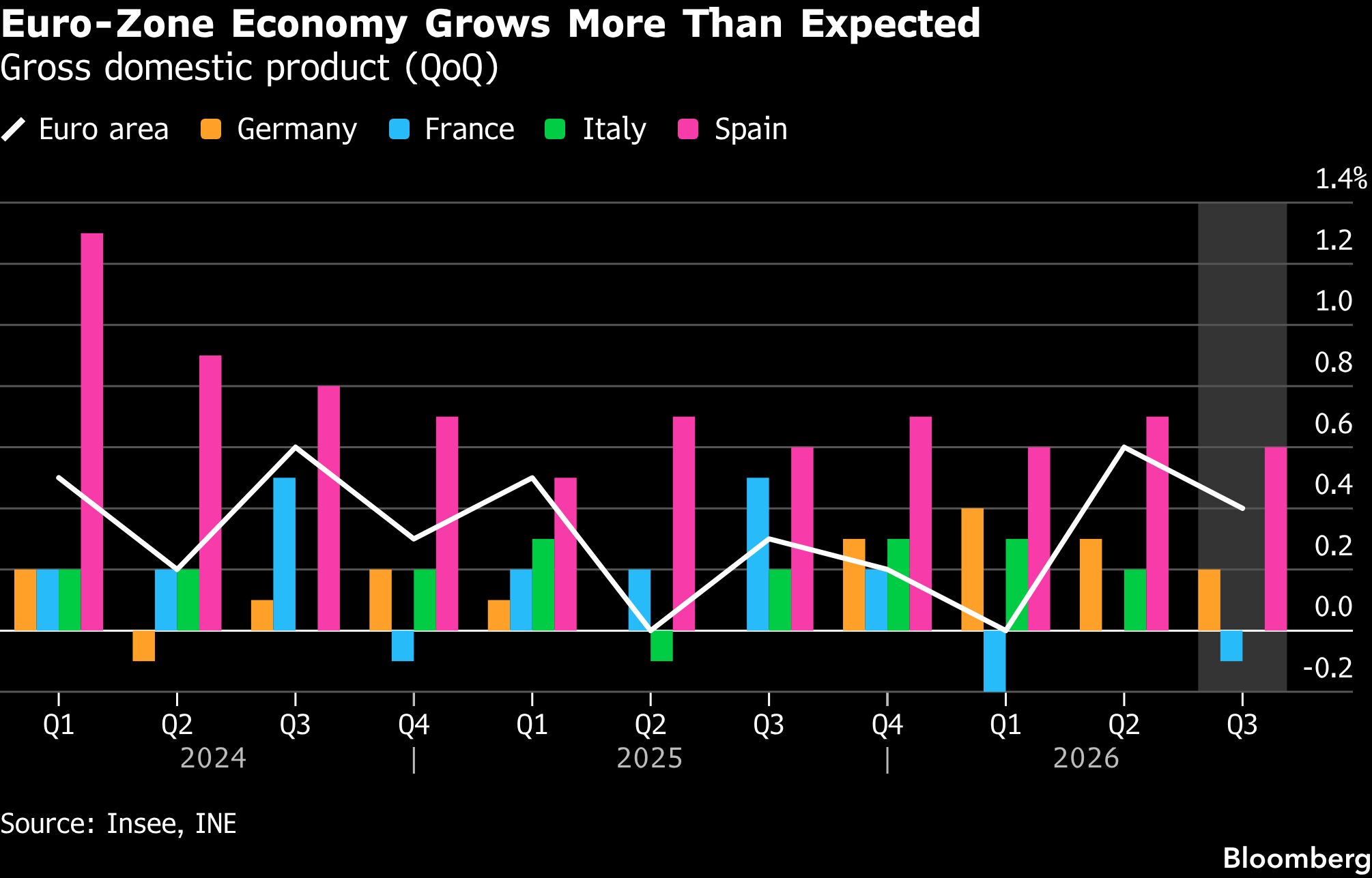
The euro-area economy surged in defiance of headwinds including elevated inflation and the selloff in bond markets, though France suffered an unexpected slump.
Gross domestic product across the 21-member currency bloc rose 0.4% in the third quarter, twice the pace analysts predicted. Performances were mixed among its biggest members as Germany and Spain grew, Italy stagnated and France shrank by 0.1%.

-
 Indian Markets Turning Corner After Two Tough Years, Says Sandeep Tandon
-
 NDTV Profit Ignite 2026: Experts See Opportunity In Equities, Stay Bullish For Long-Term
-
 Buy Right, Sit Tight Does Not Work for Individual Stocks, Says Dinshaw Irani
-
 'Worst Is Behind': Quant MF Sees Market Bottom, Flags 'Extreme Euphoria' In Midcaps
-
 India's Mutual Fund Industry Could Become A $1 Trillion Opportunity, Say Fund Managers
-
 'Foreign Investors Are Baraatis': Raamdeo Agrawal's Take On LTCG Tax
-
 Stay Invested Through Market Cycles: Raamdeo Agrawal at NDTV Profit Ignite
-
 Ramesh Damani Remains Bullish On India For Next 20-30 Years, Sees Bargains Amid Market Weakness
-
 CAS Came After A Long Consultation Process: SEBI Chairman Tuhin Kanta Pandey AT NDTV PROFIT IGNITE
-
 Aim To Cut FPI Onboarding Time From Mth To Five Days: SEBI Chairman Tuhin Kanta Pandey AT NDTV PROFI
The overall outcome highlights Europe's broader sturdiness, not just to the Iran war's inflationary impact but to the heat waves and droughts that marred much of the summer. Still, the European Central Bank has flagged downside risks and could yet hike interest rates for a third time in December after standing pat this week.
Also Read | Layoffs Are Rising In Tech, But These Skills Are Helping People Unlock Better Pay
While inflation hasn't spread beyond energy yet, policymakers in Frankfurt are wary. Separate data from France won't reassure them, with consumer prices jumping 3.8% in October, the highest level since late 2023. Inflation in Spain, despite easing a touch as anticipated, remained elevated at 4.9%.
The jump in global bond yields is another drag, with France's shaky fiscal and political position making it the region's focal point. Its economy was already the euro area's major laggard, only narrowly avoiding a recession in the first half amid soft domestic demand, falling investment and as hot weather hurt agriculture.
The outlook is bleak. Prime Minister Sebastien Lecornu is in the midst of another parliamentary showdown over austerity, against a backdrop of social and political upheaval before presidential elections in 2027 where the far right leads polls.
“France's economy is at a standstill due to a unprecedented convergence of external and domestic shocks,” Finance Minister Roland Lescure said Friday. “It needs to pick up. We need to restore confidence and for that having a budget is essential as that is what will allow us to bring down interest rates.”
Other Key GDP Numbers Across the Euro Area:
- Dutch GDP beat forecasts to jump by 0.6%
- Belgium's economy accelerated to 0.3% from 0.1% in the previous period
- Ireland's economy surged 5.5%, once again driven by the strength of multinational companies based in the country
- Austrian GDP rebounded to rise 0.2%, helped by investment and exports
- Portugal's economy gained 0.2%
- Finland's GDP indicator showed 0.5% growth
- Lithuania saw a 1% contraction
German GDP rose 0.2% despite factors including low water levels in the River Rhine. A public-spending spree on infrastructure and defense is generating optimism while carmakers may benefit from a European cap on Chinese hybrid-vehicle imports.
At the same time, Chancellor Friedrich Merz has made fresh efforts to perk up growth through social-welfare reforms and attempts to lure private capital.
Italy's government forecasts GDP will increase 1% in 2026, helping finance some of the tax cuts Prime Minister Giorgia Meloni has promised before elections next year.
She's also asked Brussels for extra leeway of about €28 billion ($31.3 billion) for energy and defense outlays. Any slowdown in growth would complicate other fiscal commitments, including getting the budget deficit below 3% of output.
Spain, whose latest GDP reading was driven by domestic demand and trade, has shown significant resilience, with the central bank listing private consumption, job creation and population growth among drivers.
It sees growth of 2.6% in 2026 and 2.2% in 2027, comfortably above the euro area's pace. It's largely shaken off political instability including Prime Minister Pedro Sanchez inability to pass a budget.
(This story has not been edited by NDTV staff and is auto-generated from a syndicated feed.)
Essential Business Intelligence, Sharp Market Insights, Practical Personal Finance Advice, Daily Fuel, Gold and Silver Prices and Latest Stories — On NDTV Profit.