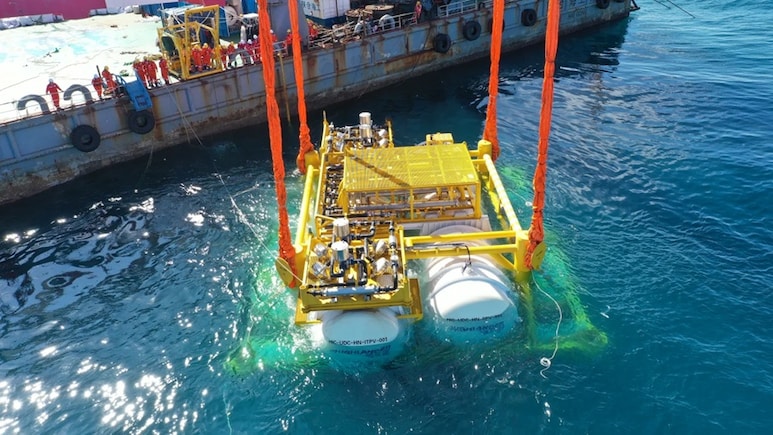
China has officially launched the world's first commercial offshore wind-powered underwater AI data centre near Shanghai's Lingang Special Area, marking a major step in the country's push toward sustainable artificial intelligence infrastructure.
The futuristic facility houses nearly 2,000 servers inside pressure-resistant underwater modules installed close to offshore wind turbines.
ALSO READ | US-Iran Deal MoU Soon? Tehran Media Suggests Asim Munir's Visit Crucial For Breakthrough
Designed for AI workloads, cloud computing, big data processing and domestic large language model development, the project combines renewable energy with natural seawater cooling to sharply reduce electricity consumption, land use and freshwater demand.
Developed through a partnership involving the Lingang Special Area Administrative Committee, Shanghai Lingang Special Area Investment Holding Group and Hi cloud Technology, the project reportedly cost around ¥1.6 billion (about $226 million).
Construction began in 2025, trial operations started earlier this year and full commercial operations officially commenced in May 2026.
The underwater data centre evolved from a smaller 2.3 MW pilot into a full-scale 24 MW commercial operation. China Telecom and local computing provider LinkWise have already deployed GPU clusters inside the subsea modules to support AI computing and data-intensive services.
Unlike conventional data centres that rely heavily on industrial air-conditioning systems, the Lingang facility uses seawater as a passive cooling mechanism.
ALSO READ | 'Uranium Must Stay In Iran': Supreme Leader Mojtaba Khamenei Rules Out Nuclear Compromise
According to HiCloud Technology, server heat converts refrigerant from liquid to gas inside copper pipes, after which surrounding seawater removes the heat through a heat exchanger before the refrigerant condenses and recirculates.
The facility reportedly maintains a Power Usage Effectiveness (PUE) rating of around 1.15 — significantly lower than many traditional data centres operating between 1.5 and 2.0. Developers claim the system cuts electricity consumption by 22.8%, eliminates freshwater usage and reduces land requirements by over 90%.
The project has drawn comparisons with Microsoft's experimental Project Natick, though China's facility has already entered large-scale commercial operation integrated directly with offshore renewable energy infrastructure.
Essential Business Intelligence, Sharp Market Insights, Practical Personal Finance Advice, Daily Fuel, Gold and Silver Prices and Latest Stories — On NDTV Profit.