- China’s software firms develop autonomous AI digital employees for full workflows
- Kingsoft’s WPS AI 4.0 and Sensetime’s Office Raccoon lead agentic workflow tools
- Beisen launches Mavens platform with 15 digital HR experts and a recruiting agent team
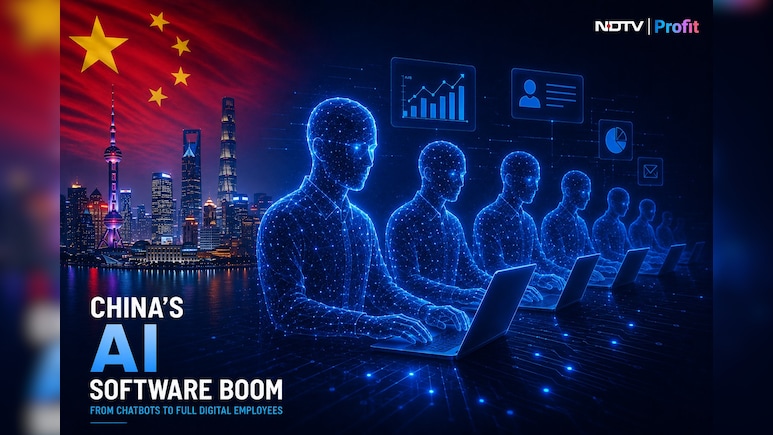
China's software industry is moving well past simple AI chatbots, with companies now racing to build autonomous "digital employees" capable of handling entire workflows without human prompting, according to a Goldman Sachs July product tracker.
The report, authored by analysts led by Allen Chang, reviewed new software launches across China's technology sector since early 2026 and found that momentum behind AI agents remains strong. The shift is being driven by improving training and inferencing efficiency, better price-to-performance ratios, and increasingly competitive open-source models.
Kingsoft's WPS has rolled out WPS AI 4.0, enabling agentic workflows across document creation, spreadsheet analysis and presentation building through natural language commands. Sensetime's Office Raccoon has been upgraded into a desktop agent capable of local file processing and browser interaction. Yonyou's YonClaw, pitched as an enterprise "super agent," covers HR, finance and supply chain functions and was among the first agents to clear a national security assessment for enterprise-grade AI tools in China.
Also Read | Layoffs Are Rising In Tech, But These Skills Are Helping People Unlock Better Pay
ALSO READ: China's New AI Crackdown on Virtual Companions Leaves Heartbreak Behind
Beisen has gone furthest on the labour substitution theme, launching Mavens, a platform offering 15 digital HR experts alongside a recruiting agent team, backed by a Rmb 1 billion research and development pledge.
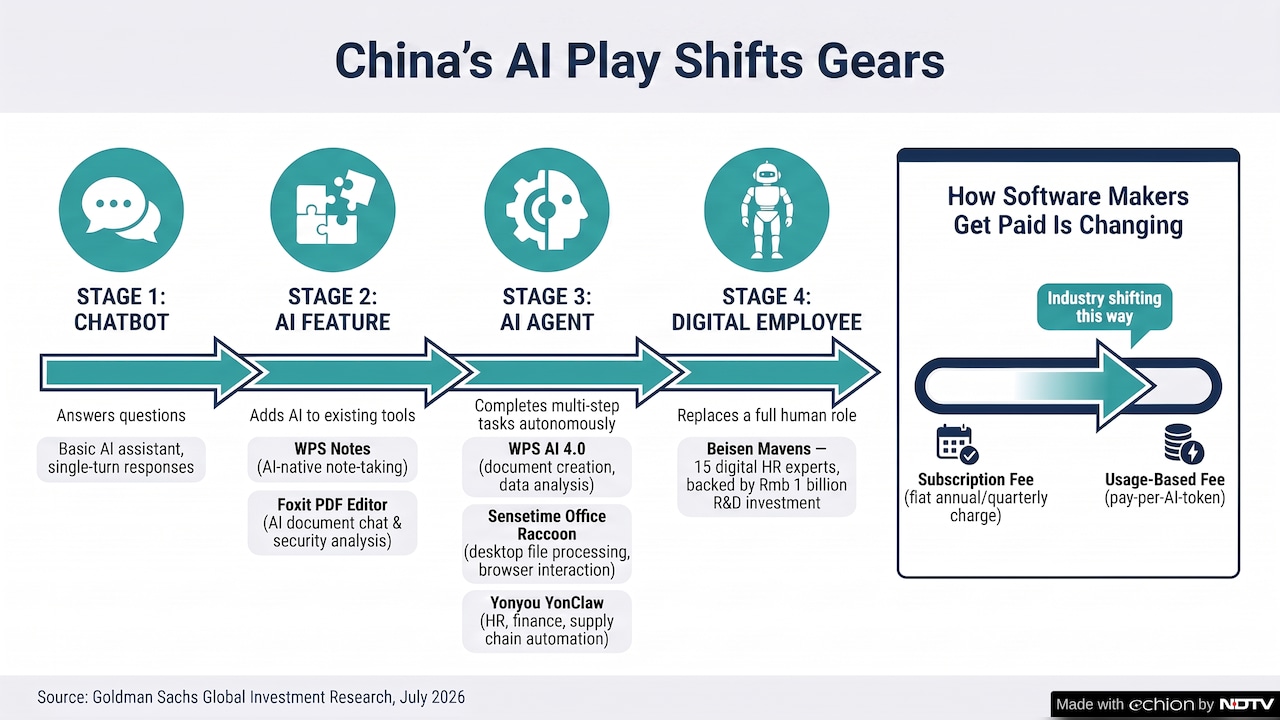
China is shifting gears in its artificial intelligence playbook
Photo Credit: NDTV Profit
A Three Pronged Approach
Goldman Sachs grouped the wave of launches into three categories: comprehensive desktop AI assistants, AI or digital employees designed to eliminate repetitive back-office tasks, and industry-specific applications spanning construction, cybersecurity and image and video generation. The brokerage noted that recent agent launches focus on "desktop AI with comprehensive features" as well as digital employees built to minimise repetitive work.
Consumer-facing AI is also expanding alongside the enterprise push. Meitu has introduced Artflo for creative ideation and MVLand, a multi-agent tool that generates music videos from prompts, with management flagging rising average revenue per user. Foxit has added AI-native document chat and security analysis features to its PDF editor, while WPS Notes now supports voice, image and text capture with connections to external AI tools such as Cursor and Claude.
ALSO READ: How China's New Outbound Investment Rules Reshape India Partnerships
On monetisation, Goldman Sachs pointed to a structural change in how software vendors charge users. It expects a gradual migration from subscription fees toward usage-based token fees, even as annual and quarterly plans continue to cover the bulk of baseline revenue.
The brokerage remains buy-rated on Sensetime and Meitu within AI, Hundsun in finance software, and Tuya in IoT software. It holds a sell rating on construction software maker Glodon, even as the company expands its own AI agent lineup for site management and cost estimation.
The report points to a broader pivot in China's software economy, from AI as a feature bolted onto existing products, to AI as the operating layer replacing entire categories of routine human work.
ALSO READ: India Uses AI To Stress-Test Nearly 500 Government Apps For Cyber Vulnerabilities
Essential Business Intelligence, Sharp Market Insights, Practical Personal Finance Advice, Daily Fuel, Gold and Silver Prices and Latest Stories — On NDTV Profit.