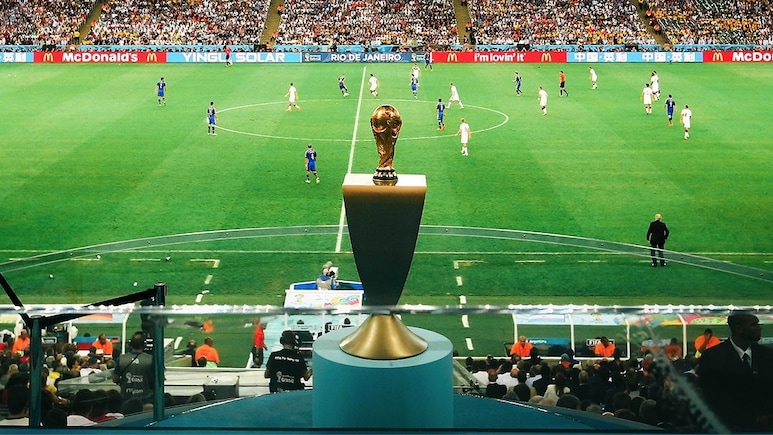
FIFA have introduced one of the most significant rule overhauls in modern football ahead of the 2026 World Cup, with a series of changes designed to speed up matches, strengthen disciplinary measures and expand the powers of the video assistant referee.
Approved by the International Football Association Board, the amendments will make their debut at the World Cup in the United States, Mexico and Canada. The common thread running through the changes is FIFA's desire to keep the ball in play more often while reducing incidents that can damage the sport's image.
Among the headline measures are stricter punishments for time-wasting, new sanctions aimed at combating discriminatory behaviour and updates to VAR protocols that address several long-standing grey areas.
Also Read | Layoffs Are Rising In Tech, But These Skills Are Helping People Unlock Better Pay
"The IFAB approved a set of landmark changes to the Laws of the Game and the FIFA World Cup 2026 will be the first major tournament to use them," FIFA Chief Refereeing Officer Pierluigi Collina said. "These amendments aim to tackle discrimination, cut time-wasting, enhance match tempo and improve both the player and fan experience."
ALSO READ | FIFA World Cup 2026: Prize Money Up Nearly 49% From Qatar 2022 — Check Full Comparison
One of the most notable additions is a new red-card offence for players who cover their mouth during confrontational situations. The rule follows the case involving Benfica's Gianluca Prestianni, who was accused of directing discriminatory remarks while shielding his mouth with his jersey. FIFA clarified that the sanction applies only during confrontations and not to routine or friendly conversations between players.
Time-wasting has also come under renewed scrutiny. Rather than relying solely on lengthy stoppage-time additions, FIFA is introducing direct penalties for delaying restarts. Referees will issue a visible five-second countdown for throw-ins and goal-kicks, with teams risking the loss of possession or even conceding a corner if they fail to restart play in time. Goalkeepers will also be limited to holding the ball for a maximum of eight seconds.
Substitution procedures have been tightened as well. Players leaving the pitch after being substituted must do so within 10 seconds and exit via the nearest boundary line. Teams that fail to comply will be forced to play temporarily with 10 men for a minimum of one minute of play.
The governing body has also targeted stoppages caused by treatment. Outfield players who receive medical attention on the pitch will have to remain off the field for one minute after play resumes.
VAR is another area receiving significant attention. Collina said the system, first introduced in FIFA competitions in 2017, required updating after years of practical experience. "We started using VAR in FIFA competitions in 2017. So, we think it is the time to reconsider the protocol which was written when there was very limited experience," he said.
Under the revised framework, VAR can now intervene in cases involving an incorrect second yellow card, mistaken identity, certain incorrect corner-kick decisions and fouls committed before a set-piece is taken.
Key Rule Changes Explained
- Red card for mouth-covering during confrontations: Players who cover their mouth with a hand, arm or shirt during confrontations with opponents or officials can be sent off.
- Red cards for walk-off protests: Players who leave the field to protest refereeing decisions risk dismissal. Teams responsible for abandoning matches will forfeit the game.
- Five-second countdowns on restarts: Referees will visually count down throw-ins and goal-kicks. Delays can result in loss of possession or a corner being awarded to the opposition.
- Eight-second goalkeeper rule: If a goalkeeper holds the ball for more than eight seconds, the referee will award a corner kick to the opposing team. The corner is taken from the side of the field nearest to the goalkeeper's position when the infraction occurred.
- New substitution protocol: Substituted players must leave the field within 10 seconds and use the nearest exit point. If they fail to do so, their incoming player is forced to wait until the first stoppage after one minute has elapsed.
- One-minute off-field treatment requirement: Outfield players treated on the pitch must generally remain off the field for at least one minute after play resumes.
- No tactical huddles during goalkeeper treatment: Players will not be allowed to leave the field and receive coaching instructions while a goalkeeper is being treated.
- Expanded VAR powers: VAR can now review incorrect second yellow cards, mistaken identity cases, corner-kick decisions and fouls committed before set-piece restarts.
- Mandatory hydration breaks: Matches will include a three-minute hydration break in each half, generally around the midpoint of the period.
ALSO READ | Who Is Ritinha? The Shark Predicting Brazil's Opening World Cup 2026 Match
Essential Business Intelligence, Sharp Market Insights, Practical Personal Finance Advice, Daily Fuel, Gold and Silver Prices and Latest Stories — On NDTV Profit.