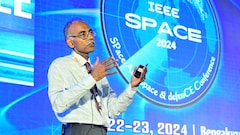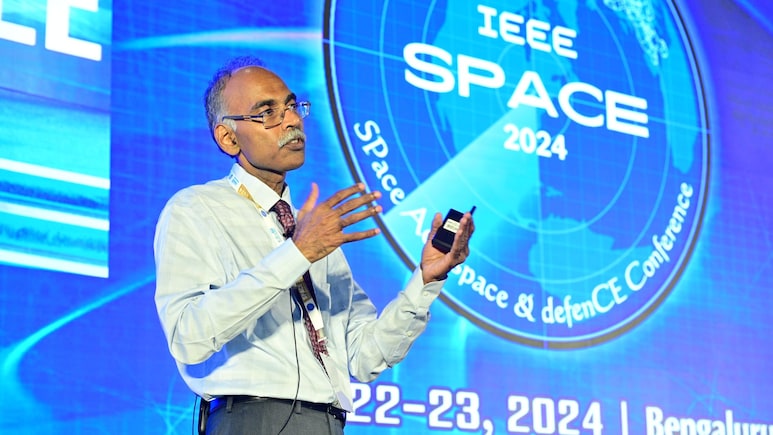
Maruthi R Akella is an Indian-origin aerospace scientist and control systems engineer, whose research contributed to the onboard guidance algorithms used by Intuitive Machines' IM-1 Lunar Lander. He is a professor at the University of Texas at Austin and an alumnus of the Indian Institute of Science (IISc), Bengaluru.
On November 6, IISc announced Akella's name as one of the five recipients of its Distinguished Alumnus/Alumna Awards for 2026. According to IISc's announcement, the awards recognise alumni who have made exceptional contributions to their professions, society and the institute. The awardees will be facilitated on December 19 at the JN Tata Auditorium on the IISc campus.
ALSO READ: 'Killer' Electrons Surge 5,000 Times As 2024 Solar Storm Breaches Earth's Radiation Barrier
Also Read | Layoffs Are Rising In Tech, But These Skills Are Helping People Unlock Better Pay
Who Is Maruthi R Akella?
Maruthi R Akella is an aerospace scientist and control systems engineer who holds the Cockrell Family Chair in Engineering at the University of Texas at Austin, United States.
He specialises in spacecraft attitude estimation, adaptive control, vision-guided robotics and orbital mechanics. His research focuses on developing mathematical models and algorithms that enable complex aerospace systems to navigate, make decisions and respond to changing conditions.
According to his official University of Texas profile, Akella has been a member of the university's faculty since 1999. He leads the Controls Group for Distributed and Uncertain Systems and is affiliated with the university's Center for Space Research.
He is also the founding director of the Center for Autonomous Air Mobility at UT Austin and serves as the Editor-in-Chief of 'The Journal of the Astronautical Sciences.'
Educational Background
Akella's academic journey began with mechanical engineering before he moved into aerospace research.
He completed his Bachelor of Technology (BTech) in Mechanical Engineering from the National Institute of Technology (NIT), Calicut, in 1988. He subsequently pursued a Masters of Engineering (ME) degree in Aerospace Engineering at IISc, Bengaluru, graduating in 1994. He later obtained a PhD in Aerospace Engineering from Texas A&M University.
In an interview published by IISc on October 16, 2024, Akella spoke about his early beginnings in rural Andhra Pradesh and his interest in mathematics and physics. He also recalled how his time at IISc helped shape his academic and research career.
How Did Akella's Algorithms Guide The IM-1 Lunar Lander?
One of Akella's most notable contributions to space exploration came through his research group's involvement in the IM-1 lunar mission conducted by Houston-based space company Intuitive Machines.
The company's Nova-C Lunar Lander, named Odysseus, carried scientific and technological payloads to the Moon as part of NASA's Commercial Lunar Payload Services (CLPS) initiative.
According to the University of Texas at Austin's Department of Aerospace Engineering and Engineering Mechanics, Akella's research group contributed to the onboard guidance algorithm for the mission. The algorithm was designed to help the spacecraft maintain the required orientation and accurately guide its movement during critical stages of the lunar mission.
Spacecraft guidance and control systems are essential during a lunar landing because a lander must constantly manage its position, direction and movement while approaching the surface. Akella's research focuses on controlling complex systems affected by uncertainties and changing operating conditions. Such systems use onboard information and mathematical algorithms to make adjustments without relying entirely on continuous instructions from ground-based operators.
The University of Texas has highlighted his team's contribution as an example of how research in guidance, navigation and control can be translated into practical spaceflight technology. The university's official profile also notes that his research group contributed to the onboard guidance algorithm for IM-1, which achieved the first soft US Moon landing in more than 50 years since the Apollo era.
What Was The IM-1 Lunar Mission?
The IM-1 mission was conducted by Intuitive Machines in February 2024. Its spacecraft, Odysseus, was a Nova-C lunar lander designed to transport payloads to the lunar surface. The mission was launched aboard a SpaceX Falcon 9 rocket on February 15, 2024. Odysseus successfully landed on the Moon on February 22, 2024.
The landing was historic for two reasons. It marked the first US lunar landing since the Apollo 17 mission in 1972 and the first successful soft landing on the Moon by a privately developed spacecraft.
The mission was part of NASA's Commercial Lunar Payload Services programme, through which the American space agency partners with commercial companies to transport scientific instruments and technology demonstrations to the lunar surface.
The achievement represented an important milestone for commercial space exploration and future lunar missions.
Minor Planet 5376 Named 'Maruthiakella' After Akella
Apart from his contributions to aerospace engineering, Akella received an astronomical honour.
In October 2024, the International Astronomical Union (IAU) designated minor planet 5376 as 'Maruthiakella' in recognition of his contributions to astrodynamics and space systems control. According to IISc's alumni profile, the minor planet is located in the main asteroid belt between Mars and Jupiter and takes approximately 3.75 years to orbit the Sun.
The naming recognises Akella's research and its applications in understanding and controlling the movement of objects in space.
In his IISc interview, Akella described the recognition as a humbling experience. He reflected on the impermanence of individuals and how sustained contributions to science and research can receive recognition.
What Is Maruthi R Akella's Research Focus?
Akella's research extends beyond lunar missions. His work focuses on control systems, autonomy and decision-making in complex aerospace and robotic environments.
Some of his major research areas include:
- Spacecraft attitude estimation: Determining the orientation of a spacecraft and helping it maintain the correct direction during flight.
- Adaptive control: Developing systems that can adjust their behaviour in response to changing operating conditions.
- Vision-guided robotics: Enabling robots to use visual information to navigate and perform tasks.
- Orbital mechanics: Studying the movement of spacecraft and other objects under the influence of gravitational forces.
- Autonomous systems: Developing technologies that allow vehicles and spacecraft to make certain decisions independently.
- Cooperative control: Creating algorithms that allow multiple autonomous vehicles or robots to coordinate their actions.
His research is particularly relevant to missions involving long distances, where communication delays can make continuous instructions from Earth difficult.
Akella's recognition highlights the global impact of IISc alumni, with his research contributing to technologies that helped guide a spacecraft during one of the most challenging stages of a lunar mission.
ALSO READ: In Major Public Health Triumph, WHO Says Barbados Has Eliminated Mother-To-Child HIV Transmission
Essential Business Intelligence, Sharp Market Insights, Practical Personal Finance Advice, Daily Fuel, Gold and Silver Prices and Latest Stories — On NDTV Profit.