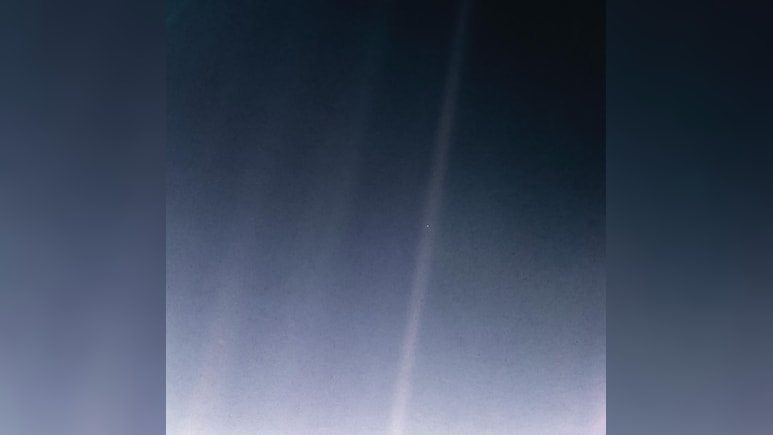
NASA has marked Voyager 1's arrival at one light-day from Earth by recirculating the "Pale Blue Dot" image the spacecraft captured before its cameras were switched off in 1990. Voyager 1 is the first human-made object to reach that distance.
In a post on X on Thursday, NASA Earth said Voyager 1 took the picture "just 34 minutes before its cameras were turned off". It called the image an "iconic view of Earth" and described the spacecraft as "a little piece of our planet journeying through interstellar space".
Just 34 minutes before its cameras were turned off in 1990, Voyager 1 captured this iconic view of Earth – a pale blue dot in the vastness of space. Today, Voyager 1 is one light-day away from Earth. A little piece of our planet journeying through interstellar space. 🌎💙 https://t.co/HOlmoKK4P6
Also Read | Layoffs Are Rising In Tech, But These Skills Are Helping People Unlock Better Pay
— NASA Earth (@NASAEarth) November 18, 2026
Voyager 1 crossed the one-light-day mark at 10:16:07 UTC on 18 November, about 25.9 billion km from Earth. That is 3:46 p.m. IST.
At that distance, even the simplest round-trip communication takes 48 hours. Voyager project scientist Linda Spilker said, "The Earth and Voyager are exactly 24 hours apart at the speed of light."
ALSO READ | Voyager 1 Is Now One Light-Day From Earth: A Timeline Of NASA Probe's 49-Year Journey
The Image
The Pale Blue Dot was taken on 14 February 1990 from roughly 6 billion km away. It shows Earth as a tiny speck, less than a pixel wide, caught in a band of scattered sunlight.
The astronomer Carl Sagan had pushed for the picture, and it later inspired his book of the same name. It was part of a "family portrait" of the solar system, after which the cameras were shut down to save power.
ALSO READ | Ozone Hole Over Antarctica Expands To Largest Size In 10 Years: What's Behind The Surge?
A Journey Of Nearly Five Decades
Voyager 1 launched on 5 September 1977, visited Jupiter and Saturn, and crossed the heliopause, the edge of the sun's influence, in 2012. It took 49 years, 2 months and 11 days to travel one light-day. The probe is still sending scientific data back to Earth.
NASA says its twin, Voyager 2, will not reach one light-day until November 2035.
Essential Business Intelligence, Sharp Market Insights, Practical Personal Finance Advice, Daily Fuel, Gold and Silver Prices and Latest Stories — On NDTV Profit.