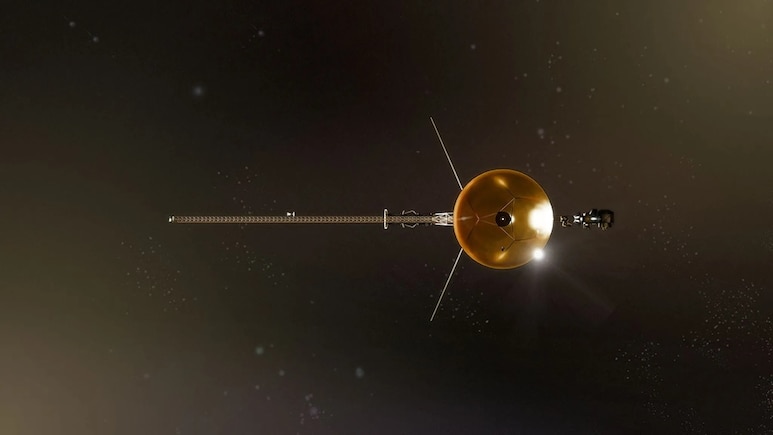
NASA's Voyager 1 has travelled so far from home that light itself now needs a full day to reach it. No human-made object has ever been this far from Earth.
The spacecraft passed the one light-day mark shortly after 5.16 am ET on Wednesday. It is now around 26 billion km (16 billion miles) away. Any command NASA sends takes 24 hours to arrive, and the probe's response needs another 24 hours to make the return trip.
“It's never happened before, and it may never happen again - it's that kind of extraordinary,” said Kareem Badaruddin, who manages the Voyager mission at NASA's Jet Propulsion Laboratory.
Also Read | Layoffs Are Rising In Tech, But These Skills Are Helping People Unlock Better Pay
Nov. 18, 2026, 5:16am EST The Voyager 1 spacecraft has reached a distance of one light-day from Earth.
— NASA Solar System (@NASASolarSystem) November 18, 2026
ALSO READ | SpaceX Launches NASA's Dark Energy-Hunting Space Telescope
Here is a look at how it got there.
1977: The Launch
Voyager 1 left Earth in September 1977, and its twin, Voyager 2, also launched that year. NASA expected the pair to work for only five years, long enough to visit Jupiter and Saturn.
1979: Volcanoes On Io
Voyager 1 photographed Jupiter's Great Red Spot in 1979. During their visits to the two giant planets, the twin probes discovered new moons, recorded volcanoes erupting on Jupiter's moon Io and studied the atmosphere of Titan, the biggest moon of Saturn.
1990: The ‘Pale Blue Dot'
On February 14, 1990, while around 6 billion km from the Sun, Voyager 1 looked back and captured Earth as a faint dot. That photo, the “Pale Blue Dot”, is one of the most famous images in history. Later the same year, the probe's cameras were turned off for good.
1998: Farthest From Home
In 1998, Voyager 1 passed another NASA spacecraft, Pioneer 10, and has been the most distant human-made object ever since.
2012: Leaving The Sun's Bubble
The probe crossed out of the heliosphere, the protective bubble formed by the Sun's magnetic field, in 2012. It has been exploring interstellar space ever since, moving at roughly 61,155 kmph.
This Year: Fighting To Stay Alive
Voyager 1 gets its electricity from plutonium-powered generators. At launch, they gave it 470 watts. Losing around 4 watts every year, they are now down to about 210 watts. Just two of the probe's 10 scientific instruments are still sending back data.
Over the summer, engineers made a bold change to how power is shared on board, which they nicknamed the “Big Bang”. It freed up 10 watts, enough for roughly two and a half more years. Then, in late October, the probe stopped responding for 48 hours before the link came back on its own.
The Road Ahead
The probe carries the Golden Record, a gold-plated copper disc with images, music, natural sounds and greetings in 55 languages, including Hindi and Bengali. It also holds Indian classical music, the sounds of rain, a kiss and a baby crying.
How long Voyager 1 will keep working is hard to say. For decades, mission managers have estimated it has three to five years left. Even once it goes quiet, it will keep heading towards the star Gliese 445, passing closest to it in about 40,000 years.
Its twin, Voyager 2, is expected to reach the one light-day mark in 2035.
Essential Business Intelligence, Sharp Market Insights, Practical Personal Finance Advice, Daily Fuel, Gold and Silver Prices and Latest Stories — On NDTV Profit.