- India's space economy is valued at $9 billion with plans to grow to $44 billion by 2035
- Private investment in Indian space startups grew six-fold from 2021-22 to 2026
- The Department of Space budget for FY27 is Rs 13,705.63 crore, up from the current year
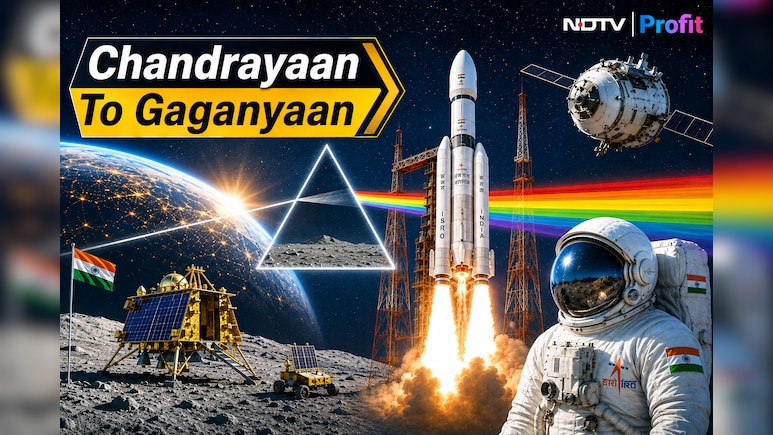
Three years ago, on August 23, 2023, when Chandrayaan-3's Vikram lander eased down near the Moon's south pole, India became the first country to touch down in that stretch of lunar terrain, ringed by craters that have stayed in shadow for billions of years and may never once catch sunlight.
It is the kind of image Pink Floyd built an entire album around: darkness on the Moon not as a fixed geography, but as a matter of where the light simply doesn't reach. At the lunar south pole, inside craters where the Sun has never risen, that idea is about as literal as astrophysics gets.
Three years on, as India marks National Space Day, that landing looks less like a one-off moment of national pride and more like the opening chapter of something bigger: a space economy that is growing quickly, still small by global standards, but with a government roadmap that now stretches all the way to 2035.
Also Read | Layoffs Are Rising In Tech, But These Skills Are Helping People Unlock Better Pay
A $9 Billion Economy With $44 Billion Ambitions
Start with the money. India's space ecosystem is currently valued at $9 billion, according to a Press Information Bureau and IN-SPACe factsheet released on August 14 to mark this year's National Space Day. The stated ambition, per the same document, is to more than quadruple that, to somewhere between $40 billion and $45 billion, within a decade. It is not a small leap, but it tracks the trajectory the sector has been on since ISRO's near-monopoly over space activity formally ended in 2020, when the government set up IN-SPACe as the sector's regulator.
Private investment tells the same story from a different angle. Funding into Indian space startups has grown roughly six-fold in four years, from $100.5 million in 2021-22 to a cumulative $618.5 million by March 31, 2026, with $187 million of that arriving in 2026 alone, Minister of State Jitendra Singh told the Rajya Sabha in a written reply in July. The number of registered space-tech startups has climbed alongside it, from a single company in 2014 to about 440 today on the DPIIT Startup India Portal, per the same reply, most of them clustered around satellite services, launch systems, and ground infrastructure.
What The Government Is Spending
The state's own contribution comes through the Department of Space, allocated Rs 13,705.63 crore for FY27 under the Union Budget 2026-27, a modest step up from the Rs 12,448.60 crore revised estimate for the current year, per the department's Demand for Grants.
Space Applications, the segment covering satellite-based services and downstream uses, gets the biggest bump within that: from Rs 9,601.98 crore to Rs 10,397.06 crore, budget documents show.
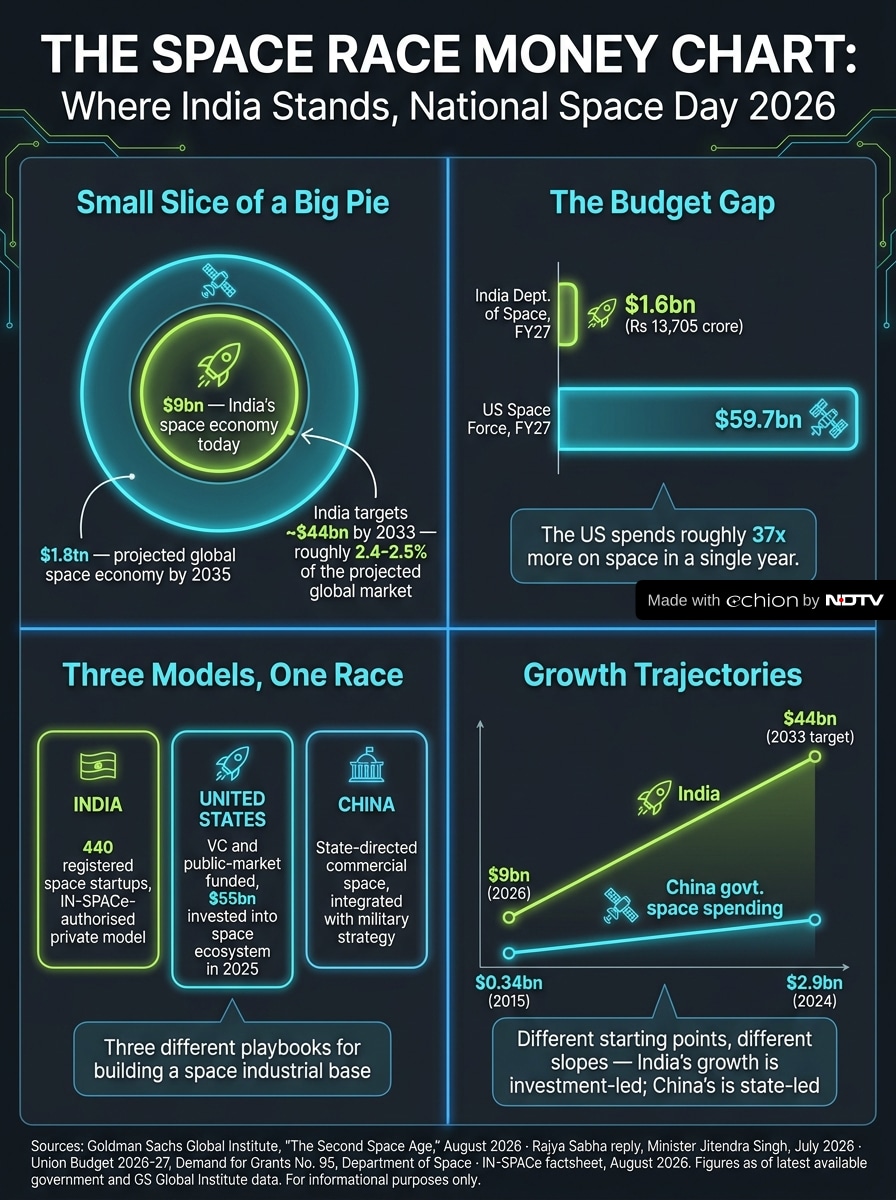
Where India stands in the space race versus China and US.
Photo Credit: NDTV Profit
Not every rupee earmarked gets spent in the year it is budgeted for. A comparison of budget documents across years shows the department has carried forward unspent allocations against its own revised estimates since 2020, adding up to more than Rs 12,000 crore over that period, close to a full year's worth of funding. That gap is not unusual for a programme scaling up this fast. Big-ticket missions like Chandrayaan-4, the Venus Orbiter, and the Next Generation Launch Vehicle typically take years to move from sanction to full spend.
India Is Everyone Else's Launchpad
One place the growth shows up clearly is in who is queuing up to use Indian rockets. Foreign satellite launches from Indian soil have grown roughly 11-fold since 2014, from 35 launches before that year to 399 as of January this year, per the IN-SPACe factsheet, largely routed through NewSpace India Limited and Antrix, ISRO's commercial arms.
On the regulatory side, IN-SPACe, the nodal body set up in 2020 to authorise and supervise private space activity, has issued 113 authorisations to 52 non-government entities, the same factsheet shows, spanning satellite operations, payload development, and launch services. That is the machinery behind the Indian Space Policy 2023 and the liberalised FDI regime that followed it, doing its job of turning policy intent into actual licences.
The Private Sector's Early Stars
A handful of startups have already turned that policy shift into global capital. Skyroot Aerospace became the country's first space-tech unicorn. Pixxel, which builds Earth-imaging satellites, counts Alphabet among its investors. Digantara, which tracks objects in orbit, has raised $50 million from international backers, according to company disclosures and IN-SPACe records.
Next Decade's Big Bets: Gaganyaan, A Station, And Venus
The most ambitious items sit further out. Gaganyaan's first uncrewed test flight, carrying the half-humanoid robot Vyommitra, is targeted for the final quarter of this year, with a crewed mission to follow in 2027, per ISRO's stated mission schedule. Bharatiya Antariksh Station, India's own orbital outpost, has its first module, BAS-01, slated for launch in 2028, with the full five-module station meant to be operational by 2035, according to the IN-SPACe factsheet. A Venus orbiter mission is pencilled in for March 2028.
Taken together, it is a programme trying to do two things at once: build a space economy that behaves like an industry, with startups, capital, and exports, while still running the kind of flagship government missions that put a country on the map in the first place. Two years after Vikram found its footing in craters that have never seen daylight, India's space story is no longer just about how far it can reach. It is about how much of an economy it can build once it gets there.
ALSO READ: Elon Musk: Starlink Would Help The 'Least Served' In India
Essential Business Intelligence, Sharp Market Insights, Practical Personal Finance Advice, Daily Fuel, Gold and Silver Prices and Latest Stories — On NDTV Profit.