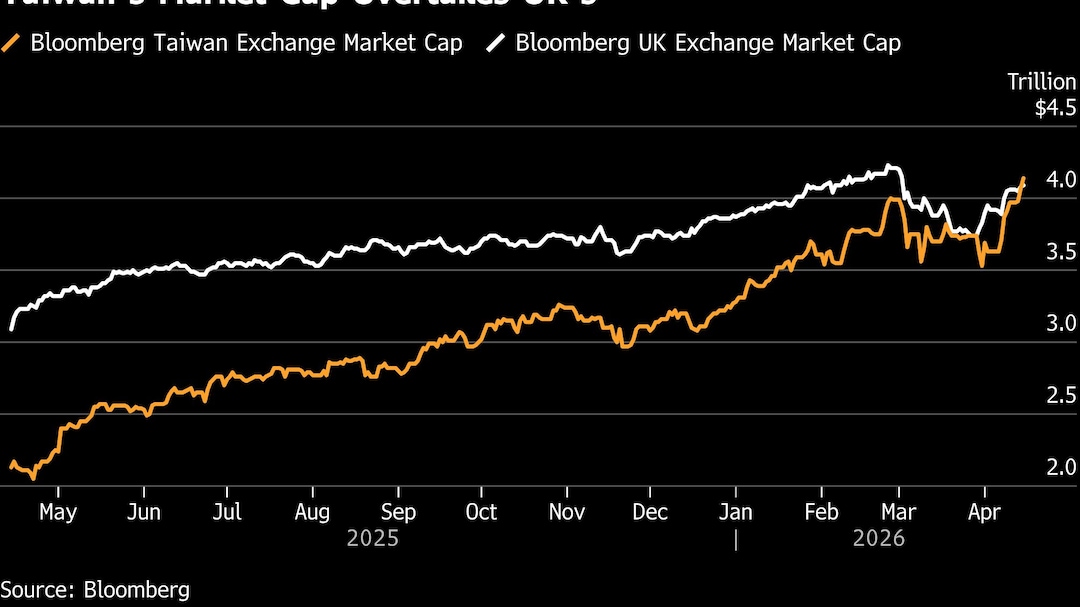
- Taiwan's market value rose to $4.14 trillion, surpassing the UK's $4.09 trillion
- Taiwan Semiconductor Manufacturing Co. hit a record high, boosting market gains
- Taiwan's stock index rose 16% this month, marking an eight-session winning streak
Taiwan overtook the UK in stock market value as the island's tech firms regained favor amid hopes for further de-escalation in the Iran war.
Taiwan's market capitalization rose to $4.14 trillion as of Wednesday, making it the world's seventh largest, according to data compiled by Bloomberg showing the combined value of companies with a primary listing on the island. The UK's market was valued at around $4.09 trillion.
The feat comes after the Taiex Index recouped all losses driven by the Iran war — one of the first major markets to do so — to reach a record high. Heavyweight Taiwan Semiconductor Manufacturing Co. — which accounts for more than 40% of the local market value — also renewed its all-time high.
Also Read | Layoffs Are Rising In Tech, But These Skills Are Helping People Unlock Better Pay
TSMC was buoyed by strong revenue growth that underscores its key role in the global artificial intelligence supply chain. Sales are expected to grow by above 30% in dollar terms this year, the company said at a briefing in Taipei.
“Taiwan continues to be treated as an AI hardware proxy,” said Yoon Ng, head of APAC asset management growth solutions at Broadridge Financial Solutions. “As long as AI capex momentum holds, flows should remain supportive.”
While the size of Taiwan's $977 billion economy trails the UK's $4.3 trillion, according to the International Monetary Fund's 2026 estimates, roaring export of AI-related products is boosting growth expectations for the island.
The Taiex gauge has risen 16% so far this month. It gained as much as 0.7% on Thursday, extending its rally to an eighth straight session — the longest winning streak since 2025.
Foreigners bought a net $8.9 billion of Taiwanese shares in April, putting the market on track for its biggest monthly inflow ever after a record $28.7 billion outflow in March.
Meanwhile, the UK's FTSE 100 Index is up less than 4% this month, held back by lingering concerns over sticky inflation and interest rates that are higher than in the rest of Europe. While Britain's economy grew faster than expected before the war began, the conflict threatens to hit the UK harder than any other major advanced economy, pushing up borrowing costs and increasing pressure on the struggling government.
According to Goldman Sachs Group Inc. strategists led by Sharon Bell, there has been a shift in ownership in the UK equity market. They noted especially under-participation by domestic investors – who tend to allocate to low-return, low-risk assets. That's led to 68% of UK equity being owned outside the country, compared with 17% in 1994.
“Shifts in regulation and/or government policies would be needed to encourage more domestic allocation with a focus on DC pension funds and household allocation,” the Goldman team wrote.
Still, equities in the UK are luring back investors amid geopolitical uncertainty, boosted by the London market's significant exposure to energy and defensive sectors. A flurry of strategists including at Barclays Plc, Citigroup Inc. and HSBC Holdings Plc favor the FTSE 100 either as a geopolitical hedge or as a preferred exposure in the current environment.
“The commodity-based sectors of energy and basic materials, which could benefit from elevated energy and metal prices, represent nearly a fifth of the UK market cap,” said HSBC strategists including Duncan Toms. “In 2022, the UK stood out as one of the best markets in a backdrop of global stagflation.”
A Bank of America Corp. survey in April showed the UK is the second-most favored market in Europe after Switzerland, a similar position to last month's survey. It was the second least-preferred in February. Still, a net 16% of global fund managers are underweight British stocks, compared with 15% last month.
(This story has not been edited by NDTV staff and is auto-generated from a syndicated feed.)
Essential Business Intelligence, Sharp Market Insights, Practical Personal Finance Advice, Daily Fuel, Gold and Silver Prices and Latest Stories — On NDTV Profit.