- SpaceX targets a $2 trillion IPO valuation, exceeding India's entire stock market value
- The company reported a $4.28 billion loss in Q1 2026, with a $41.3 billion accumulated deficit
- Starlink leads revenue with 10.3 million subscribers and strong growth in connectivity income
At $2 trillion, SpaceX's targeted IPO valuation is larger than India's entire stock market. The Elon Musk-led rocket and satellite maker filed its S-1 registration statement — the mandatory disclosure document companies must submit to US regulators before they can sell shares to the public — with the US Securities and Exchange Commission on Tuesday, applying to list its Class A common stock on Nasdaq under the symbol SPCX in what could be the largest initial public offering in history. The prospectus discloses a $41.3 billion accumulated deficit alongside future revenue lines that include asteroid mining, lunar energy production, and Mars passenger transport.
Here are five things to know about the SpaceX IPO:
1. Massive Loss Of $4.28 billion
Also Read | Layoffs Are Rising In Tech, But These Skills Are Helping People Unlock Better Pay
The SpaceX filing discloses a loss of $4.28 billion on revenue of $4.69 billion in the first quarter of 2026. In the full-year 2025, SpaceX reported a loss of $4.94 billion, with accumulated deficit on the balance sheet now standing at $41.3 billion. The primary driver is the consolidation of xAI, which recorded a $6.35 billion operating loss in 2025 on revenue of $3.2 billion. The xAI merger was completed on February 2, 2026, and SpaceX's financials have been retrospectively recast to include xAI's results for all periods presented.
ALSO READ: SpaceX Filing Reveals $4.28 Billion Loss, Musk's Tight Grip
2. Elon Musk's Grip Explained
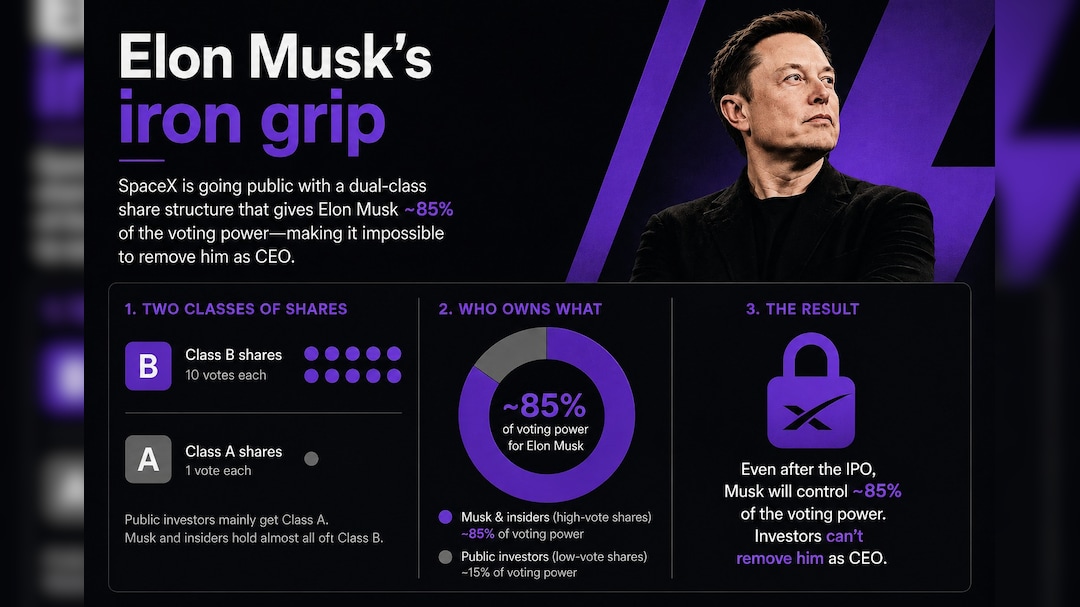
The filing revealed a dual-class share structure in which Class B shares carry 10 votes each against one for Class A shares that will be offered to the public. According to a Wall Street Journal estimate, Musk will hold roughly 85.1% of voting power post-IPO, with insiders owning approximately 20% of Class A shares and 96% of Class B shares, giving them around 86% of combined voting power. The S-1 notes the exact percentage post-offering remains to be determined based on final offering size and pricing. The filing states SpaceX will operate as a "controlled company" under Nasdaq corporate governance rules as a result of the structure.
Musk and the SpaceX IPO
Photo Credit: NDTV Profit
3. Starlink Is The Real Star
The filing shows Starlink as the primary revenue generator. The service's subscriber count has crossed 10.3 million across 164 countries by March 2026, with Connectivity segment revenue growing almost 50% year-on-year in 2025, while operating income rose 120%.
Starlink's average revenue per user (ARPU) has fallen from $99 per month in 2023 to $66 per month by March 2026, a drop of 33% in roughly two years. The filing attributes the decline to expansion into emerging markets, including India, where lower price points are required to grow subscriber volumes.
4. Capex Of $20.7 Billion And Rising Debt
SpaceX spent $20.7 billion in capex in 2025, with $12.7 billion of that going to the AI segment. Q1 2026 capex was already $10.1 billion. Long-term debt at end-March 2026 stood at $29.1 billion, and the filing references a fresh SpaceX Bridge Loan and an amended credit facility increasing borrowing capacity. The S-1's risk factors flag "substantial indebtedness" as a material risk.
5. Markets That Don't Exist, For Now
SpaceX pegs its total addressable market at $28.5 trillion, of which $26.5 trillion is attributed to AI, $1.6 trillion to connectivity, and $370 billion to space. The filing's future markets section lists revenue lines that do not currently exist, including asteroid mining, in-orbit manufacturing, passenger transport to Mars, and energy production on the Moon. The S-1's own risk factors note the timeline for these "may be difficult or impossible to determine." The prospectus also references Kardashev Type II civilisation status — defined in the filing's glossary as a civilisation that harnesses the full energy output of its local star — as part of the company's long-term thesis.
ALSO READ: The Road To $1 Trillion: How A SpaceX IPO Could Supercharge Elon Musk's Wealth
Essential Business Intelligence, Sharp Market Insights, Practical Personal Finance Advice, Daily Fuel, Gold and Silver Prices and Latest Stories — On NDTV Profit.