The Insurance Regulatory and Development Authority of India (IRDAI) has issued a sweeping two-part consultation paper on distribution regulations and Expense of Management (EoM) caps, sending shockwaves across the financial services landscape. The proposals seek to clamp down on inflated distributor payouts, reduce friction costs for end-policyholders, and transition the industry from an aggressive "push" model to an effort-based and pull-oriented distribution ecosystem.
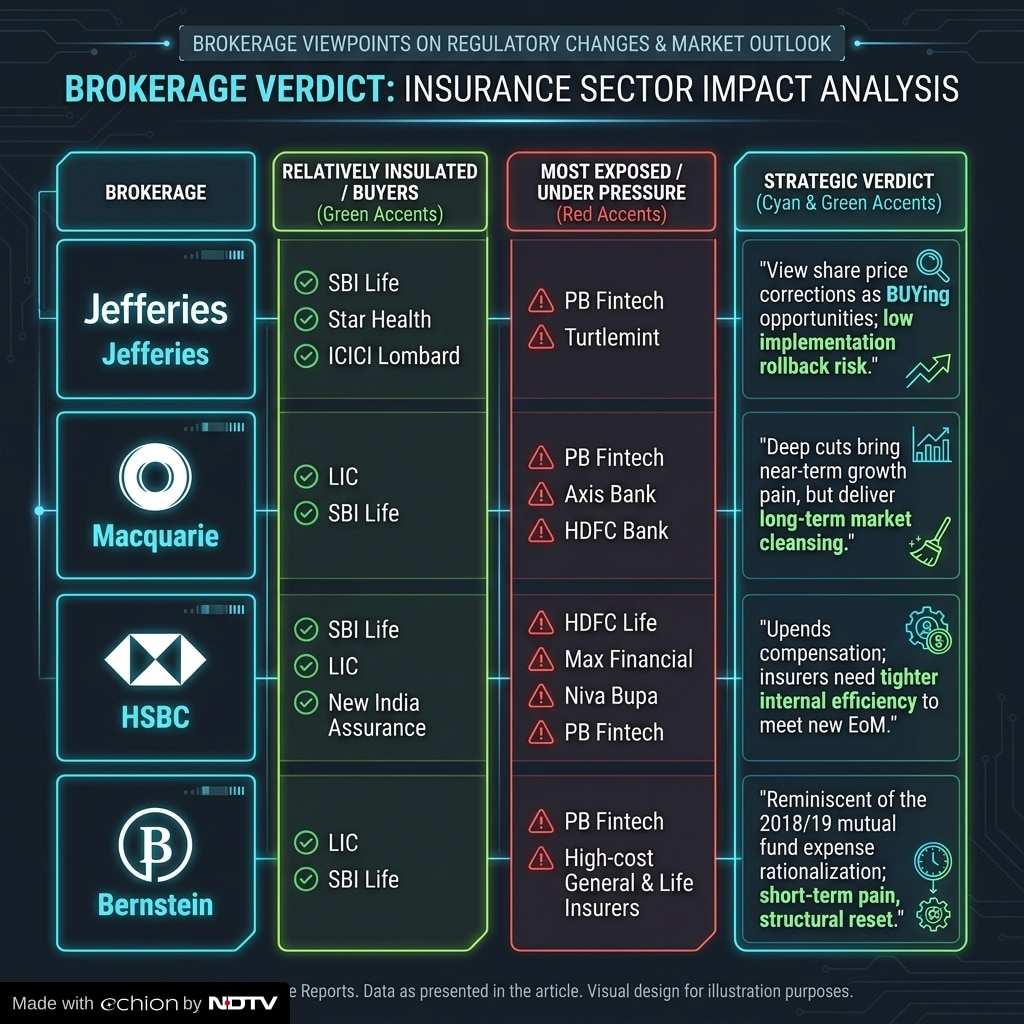
Brokerage assessments from Jefferies, Macquarie, Bernstein, and HSBC indicate the proposed measures will deliver a significant near-term hit to distributor unit economics-most notably for PB Fintech (Policybazaar)-while leaving low-cost, agency-backed underwriters like Life Insurance Corporation of India (LIC) and SBI Life relatively insulated.
The Proposed Regulatory Overhaul
Also Read | Layoffs Are Rising In Tech, But These Skills Are Helping People Unlock Better Pay
The regulator's paper proposes several systemic modifications slated for implementation from FY28, with public and stakeholder feedback open until October 25, 2026:
Tighter EoM Limits: For life insurers, the EoM ceiling is set to tighten from current levels (where peers range between 10% and 39%) to 15% within two years and 12.5% within five years. Players already operating below this benchmark will be expected to glide down to 10%. For general insurers, the current 30% Gross Written Premium (GWP) limit shifts to domestic Gross Direct Premium Income (GDPI), gliding down to 25% within two years and 20% within five years. Reinsurance inward is excluded, and crop insurance will be counted at only one-third of gross premiums.
Deep Commission Slashes: Pure-term first-year life commissions are proposed to be capped at 25% for open distribution entities (banks, brokers, aggregators) and 30% for agents, down from an industry average of 51%. New-business health commissions would fall to 15-20% (down from >30%), while health renewal commissions are halved to 5-10%. In motor own damage (OD), commissions drop to 5-10%, while new-vehicle motor third-party (TP) payouts are proposed at zero to 2.5%.
Shift to Effort-Based Remuneration: Distribution channels are consolidated into Insurance Distribution Entities (IDEs), Insurance Distribution Persons (IDPs), and Market Infrastructure Institutions (MIIs, such as Bima Sugam). Traditional tied agents receive higher commission caps than open-architecture corporate entities to reward direct selling effort over corporate leverage.
Plugging Loopholes and Banning Coercion: All forms of compensation-including marketing support, brand fees, rewards, and travel-will be subsumed directly under statutory commission caps. The framework explicitly bans compulsory bundling of insurance with credit facilities and outlaws "dark patterns" like requiring customer phone numbers merely to view digital quotes.
Web Aggregators and Open Brokers Bear the Brunt
Global research desks view digital aggregators and corporate intermediaries as the primary casualties of the draft framework.
Bernstein offered a stark critique, writing: "The proposed cuts are ugly, and we were wrong... PB Fin's unit-economics unravels at the proposed take-rate caps." Bernstein noted that Policybazaar's call-center-heavy cost model cannot easily survive halved health take-rates, deep deferrals in pure-term payouts, and zeroed-out third-party motor commissions. The proposed ban on collecting customer contact details prior to quoting strikes directly at digital acquisition funnels.
Macquarie highlighted that PB Fintech appears the most exposed company under coverage, calculating that a 200 bps compression in take-rates could erode EBITDA by roughly 25%, all else equal. Jefferies reiterated this downside vulnerability, stating that a 10% cut in new business commission rates translates into a 10% to 12% drop in earnings for PB Fintech and peer Turtlemint, leaving limited leeway for insurers to cushion the blow via operating expenses.
Lenders and corporate agents reliant on lucrative group credit-life tie-ups also face significant fee contraction. Macquarie and HSBC flagged that private lenders such as Axis Bank and HDFC Bank-where insurance fee income forms a material share of non-interest revenue and PBT-are noticeably more vulnerable than State Bank of India (SBI), ICICI Bank, or Kotak Mahindra Bank. Non-banking financial corporate agents like L&T Finance could also see pressure from the 2.5% cap proposed on loan-bundled credit life policies, where historical effective payouts hovered much higher.
Global brokerages assess IRDAI's paper on insurance aggregators
Photo Credit: Echion
Divergence Among Underwriters: Low-Cost Incumbents Shielded
While near-term sales velocity may face headwinds as intermediaries lose aggressive selling incentives, underwriters with lean operating expense structures and high proprietary agency networks are positioned to gain market share.
SBI Life and LIC emerge as consensus defensives across all four brokerages. Both operate with EoM ratios already near or below the proposed 10-12.5% five-year glide path (SBI Life at 10.6% and LIC at 11.9%). Furthermore, LIC's massive traditional tied-agency base benefits from preferential regulatory caps relative to corporate aggregators.
General and Standalone Health Insurers: Jefferies and HSBC note that Star Health is shielded by its 85% agency network mix, while lower renewal commission ceilings provide margin relief. For multi-line general insurers like ICICI Lombard and Go Digit, motor own-damage volumes may see transient friction, but lower overall acquisition expenses should eventually stabilize underwriting margins and temper irrational price competition.
The Road Ahead: Structural Maturation
Analysts drew direct parallels between IRDAI's proposed shift and the Securities and Exchange Board of India's (SEBI) 2018-2019 mutual fund expense ratio overhauls, which eliminated upfront commissions in favor of trail models. The transition is expected to cause near-term dislocation in premium growth as distribution partners lose high-margin push incentives.
However, the structural intent is clear that the ower friction costs, enhanced pricing transparency, and the elimination of commission-driven mis-selling. With substantial supporting data published alongside the IRDAI draft, global brokerages caution that the likelihood of a material regulatory rollback remains low.
Essential Business Intelligence, Sharp Market Insights, Practical Personal Finance Advice, Daily Fuel, Gold and Silver Prices and Latest Stories — On NDTV Profit.