- Jefferies' Greed & Fear notes that the Middle East ceasefire eased market tensions but risks remain high
- Brent crude near $96 per barrel keeps pressure on India's import bill and inflation
- India's recent underperformance narrows valuation gap with broader Asian markets
The two-week ceasefire in the Middle East has brought a measure of calm to global markets, but the sense of relief may prove premature for India. Brent crude, while off its recent highs, is still trading close to $96 a barrel—well above pre-war levels. For an economy that remains structurally dependent on imported energy, that price alone is reason enough for policymakers and investors to stay alert.
Jefferies' latest Greed & Fear note argues that the easing of immediate geopolitical tensions has postponed, rather than eliminated, the risks. The Strait of Hormuz remains only partially secure, oil still carries a clear risk premium, and any renewed escalation could quickly feed back into inflation, the current account and market sentiment in India.
Things Indian Markets Need To Watch Out For
Also Read | Layoffs Are Rising In Tech, But These Skills Are Helping People Unlock Better Pay
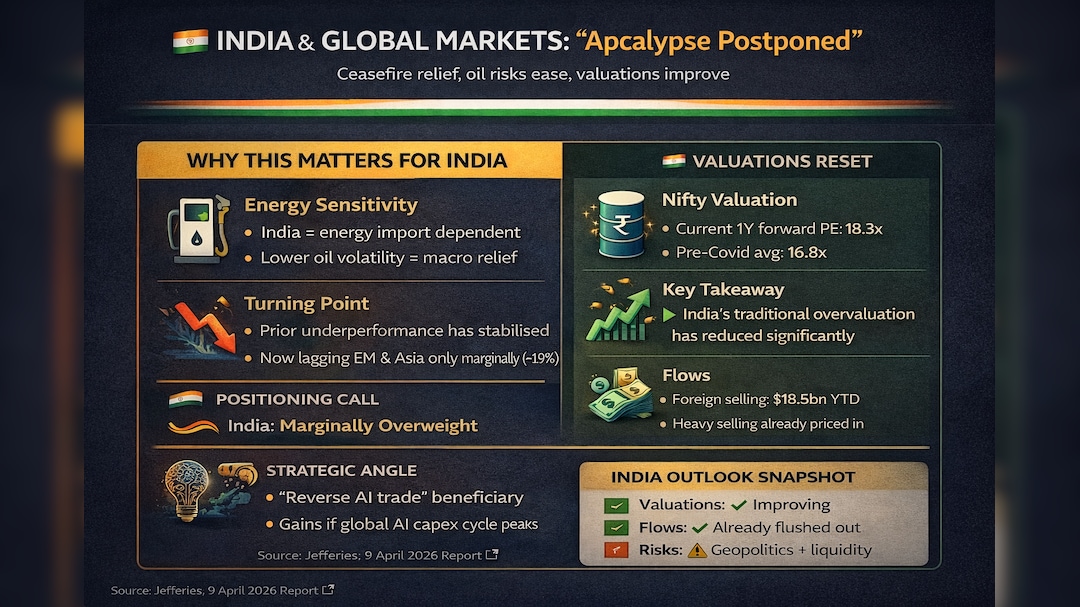
Energy is the most obvious vulnerability, according to the note. Even after the pullback, crude prices are nearly 40% higher than pre-conflict levels, keeping pressure on India's import bill and fiscal arithmetic. A fresh spike could complicate the Reserve Bank of India's policy outlook just as inflation appears to be moderating.
ALSO READ: 'Interest Has Died Out': Nithin Kamath Explains Why FPIs Are Deserting India
Capital flows are the second flashpoint. Foreign investors have already sold around $18.5 billion of Indian equities this year, according to the Jefferies note. While that selling has driven valuations lower, it also makes the market sensitive to any shock that triggers a renewed risk-off move globally. Domestic mutual fund inflows have been the anchor so far; any slowdown there would quickly expose the downside.
Finally, geopolitics has not disappeared—it has merely paused. A breakdown of the ceasefire, or persistent uncertainty around shipping lanes and energy infrastructure, would hit Asia's energy-importing economies first. India is no exception.
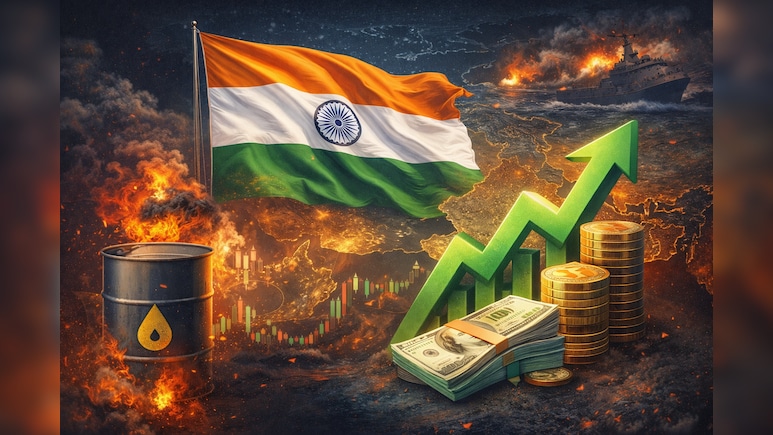
Jefferies Greed & Fear on India
Photo Credit: ChatGPT
India vs Asia: Cheap Is Relative
In a regional context, India's recent underperformance stands out. The first quarter of 2026 marked another difficult period, making India one of Asia's weakest markets alongside Indonesia. However, that very underperformance is now narrowing the gap with peers.
Since the onset of the Iran conflict, Indian equities have stopped meaningfully lagging broader Asia and emerging markets. In contrast to Korea's speculative retail-led surge or China's policy-driven rerating, India's recent moves have been valuation-led rather than euphoric. Cheap, however, remains a relative concept—India is no bargain basement, but it is no longer egregiously expensive either.
India Now At Attractive Valuations?
That is the central shift highlighted by Jefferies. The Nifty's one-year forward price-to-earnings multiple has fallen to around 18x, close to its pre-Covid long-term average. Much of India's traditional valuation premium has been eroded by foreign selling rather than deteriorating fundamentals.
India could also benefit if global AI capital expenditure peaks this year. As a “reverse AI trade”, its market is less exposed to stretched tech valuations that dominate the US. Still, the downside risks are real: oil, geopolitics and domestic flows remain the key fault lines.
For now, Brent at $96 is a reminder that while the apocalypse may be postponed, it has not been cancelled. For India, this is no time to relax.
ALSO READ: Bull Market Coming: Morgan Stanley's Sensex Target At 95,000 by Dec 2026, A 22% Upside
Essential Business Intelligence, Sharp Market Insights, Practical Personal Finance Advice, Daily Fuel, Gold and Silver Prices and Latest Stories — On NDTV Profit.