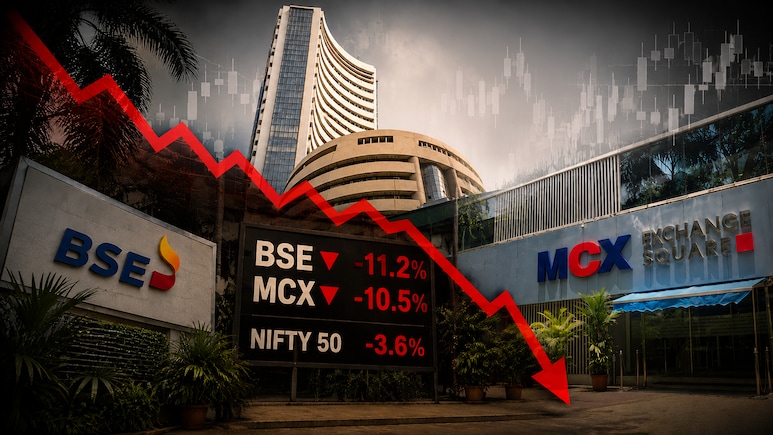
BSE Ltd. and Multi Commodity Exchange of India Ltd. have underperformed the broader market since June as a sharp fall in derivatives premium turnover triggered concerns over trading activity and exchange revenues following the Reserve Bank of India's new funding framework.
BSE shares have declined 11.2% since June, while MCX has fallen 10.5%, compared with a 3.6% decline in the Nifty 50. The weakness follows a drop in premium turnover after the RBI's framework became effective on July 1.
The framework barred banks from funding proprietary trading desks of brokers and introduced a requirement for 100% collateral against exposures. The changes tightened liquidity in the system, forcing algorithmic and high-frequency traders to reduce leverage, which in turn weighed on derivatives trading volumes.
The decline in trading activity has become a key concern because derivatives account for a large share of exchange revenues. According to a Jefferies note released on Tuesday, derivatives contributed about 70% of operating revenue for Indian exchanges in FY26, making transaction volumes a critical earnings driver.
Premium Turnover Weakens After July 1
Expiry-day premium turnover on BSE declined 11.4% in July from June to Rs 54,702 crore from Rs 61,729 crore. Compared with the Q1 FY27 average of Rs 69,411 crore, July turnover was down 21.2%.
On NSE, expiry-day premium turnover fell 14.3% month-on-month to Rs 33,309 crore from Rs 38,873 crore in June.
The weakness was also visible during the first week of July.
BSE's first-week premium turnover fell 10% from June levels and was down 20% from the Q1 average. NSE recorded declines of 24% and 27%, respectively, while MCX posted the steepest fall, with premium turnover down 43% from June and 39% from the Q1 average.
Why The Market Is Watching Exchange Stocks
The latest slowdown comes as investors assess how lower derivatives activity could affect listed exchanges, whose earnings are closely linked to transaction charges.
"Derivatives accounted for around 70% of operating revenues for Indian exchanges," Jefferies said in its report, adding that exchange revenues have become increasingly tied to options trading activity rather than market direction.
The brokerage also said India's options market has expanded rapidly over recent years, making derivatives the dominant revenue source for exchanges. However, recent regulatory measures have already slowed growth in index options activity, and fresh liquidity constraints could add to the pressure.
ALSO READ: BSE, MCX Shares Tumble 5% As Jefferies Says NSE Listing Threatens Market Positions
What Changed On July 1
The RBI's framework that took effect on July 1 introduced three key changes:
Banks can no longer fund broker proprietary trading desks.
Exposures now require 100% collateral.
The changes reduced liquidity available for leveraged trading, prompting algorithmic and high-frequency traders to cut positions.
The resulting decline in leverage has weighed on derivatives premium turnover, raising concerns over transaction revenue growth for listed exchanges such as BSE and MCX.
Essential Business Intelligence, Sharp Market Insights, Practical Personal Finance Advice, Daily Fuel, Gold and Silver Prices and Latest Stories — On NDTV Profit.