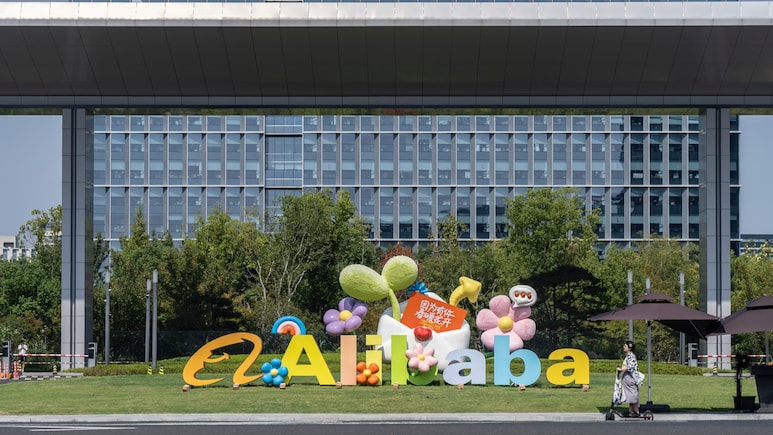
Alibaba Group Holding Ltd.'s profit plunged more than 75% after China's e-commerce leader ratcheted up AI spending while grappling with a broad Chinese consumption slowdown.
The online retail giant-turned-AI lab reported a 9% jump in revenue, in line with estimates and reflecting torrid growth in demand for the computing capacity its cloud division provides. But net income tumbled three-quarters to 10.5 billion yuan ($1.6 billion) and it registered a free-cash outflow of more than $6.6 billion, reflecting the rising cost of AI projects and computing infrastructure. Alibaba's US shares fell 4% in pre-market trading.
China's e-commerce leader this year cemented its status as a global AI player, after its flagship Qwen offering became the world's most popular model family and the company spent tens of billions of dollars on everything from chips to data centers and agentic artificial intelligence. But the Hangzhou-based company's effort to challenge Anthropic PBC and OpenAI is eroding margins, while anemic Chinese consumption dogs its mainstay online retail business.
Under Chief Executive Officer Eddie Wu, Alibaba is increasingly betting on its AI and cloud businesses to drive future growth. The company has merged most of AI-related research and product teams under Alibaba Token Hub, a new business unit directly led by Wu. It has also been divesting non-core assets in the past two years, including selling its gaming unit Lingxi Games earlier this month.
Also Read | Layoffs Are Rising In Tech, But These Skills Are Helping People Unlock Better Pay
ALSO READ: Alibaba Tops Chinese Tech Stocks This Quarter on AI Resurgence
The pivot has led Alibaba to become one of China's biggest spenders on AI infrastructure. Wu has said his company will prioritize AI growth over short-term bottom-line considerations. He'll steer investment in AI well beyond a previously disclosed budget of 380 billion yuan over three years — in the hope of quintupling cloud and AI revenue to $100 billion over five years.
Yet Chinese AI powerhouses have faced growing pressure from investors to translate AI expenditure into returns, while still mostly offering models for free or very low fees compared with US peers. Alibaba seemed to intensify its own monetization efforts earlier this year, but it's back to a race for users over profit by making its latest flagship model, the Qwen 3.8 Max, open-weight. That marks the first time it's released the values that help AI systems make decisions for its largest model class.
Alibaba's AI lead over peers should become easier to quantify into 2027 if the rising return per yuan of AI spending revealed in May holds up. A cooling delivery war should lift operating cash flow, but record capital spending may absorb much of the gains as Alibaba builds out everything from its own chip production to AI apps.
Alibaba is seeking to boost monetization by targeting paying subscribers with its coding and agentic platforms, hoping to chip away at a burgeoning market dominated by rivals such as Tencent Holdings Ltd. and ByteDance Ltd.
ByteDance's Doubao, currently China's most popular AI app, introduced a subscription plan this year. Alibaba also operates the Qwen app, an all-in-one AI assistant handling daily tasks like shopping and payments. It'll go head to head with a new AI agent on Tencent's WeChat platform in coming quarters.
ALSO READ: How Alibaba's Qwen Overtook Meta And Google In The Open AI Race
(This story has not been edited by NDTV staff and is auto-generated from a syndicated feed.)
Essential Business Intelligence, Sharp Market Insights, Practical Personal Finance Advice, Daily Fuel, Gold and Silver Prices and Latest Stories — On NDTV Profit.