- India’s rupee is under pressure due to rising US-Iran tensions and global energy crisis
- Widening current account deficit driven by crude prices strains the rupee’s value
- India faces a $100 billion capital inflow gap to stabilize its economy in FY27
As the ongoing US-Iran war-led global geopolitical tensions trigger a worldwide energy crisis, India's macroeconomic indicators are showing a stark divergence, pushing the Indian Rupee (INR) under immense pressure against the US dollar. Historical data shows that since the 2008 Global Financial Crisis, the USD/INR exchange rate has consistently breached major ten-rupee thresholds every few years. Market analysts now warn that the latest USD/INR acceleration appears unsustainable.
The rupee's underperformance will be a key challenge for the government and the fiscal policy will be prioritised to stablise the domestic currency, believes Tanvee Gupta Jain, Chief India Economist, UBS Securities India Pvt Ltd. In an exclusive interview with NDTV Profit on Thursday, May 21, Jain flagged the depreciation of the local unit and highlighted the limits of the central bank's policy interventions. The UBS expert also warned that India faces a deficit of $100 billion in capital inflows to stablise the economy.
ALSO READ: Fuel Prices To Jump By Rs 10/Litre? Experts Warn Of Cumulative Hikes In FY27 Amid War-Led Inflation
Also Read | Layoffs Are Rising In Tech, But These Skills Are Helping People Unlock Better Pay
Rupee vs. Dollar Outlook: A $100 Billion Funding Gap
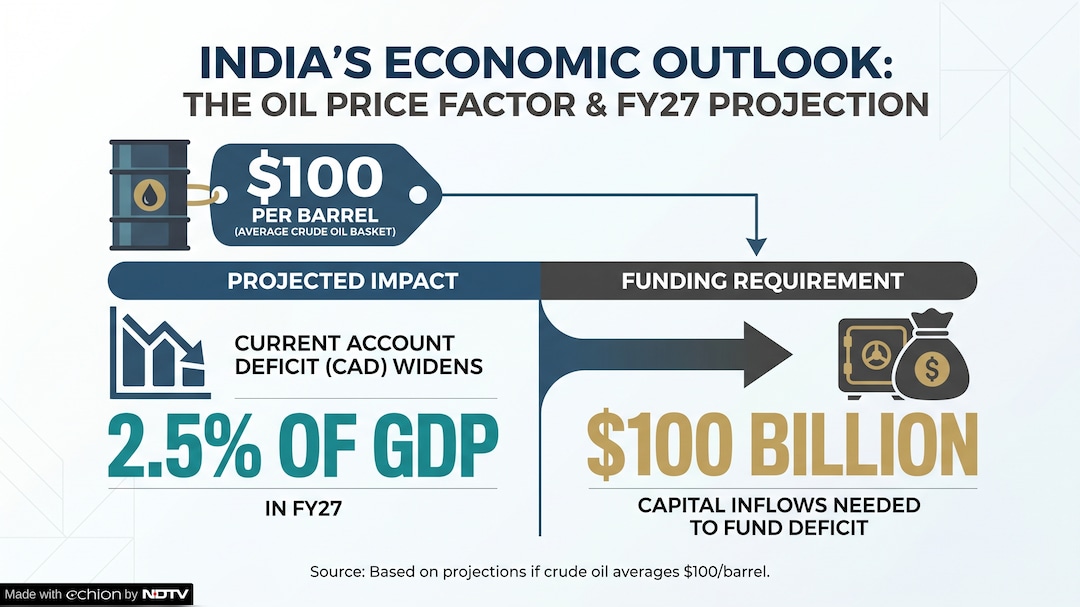
According to Jain, the primary pressure on the Indian rupee stems from a widening current account deficit (CAD) fueled by the elevated global crude oil prices. India, along with China, has been a net importer of crude oil to fuel its domestic requirements. If India's imported crude oil basket averages around $100 per barrel, the country's CAD is projected to widen to 2.5% of GDP in FY27. ''This scenario would require roughly $100 billion in capital inflows to fund the deficit,'' she said.
While a 2.5% deficit has been manageable in the past years when the economy was smaller, it translates today to a massive $100 billion required in capital inflows just to bridge the gap. However, with current flows being negligible, the rupee is facing intense depreciation pressure against the dollar, according to the economist. The downside scenario assumes an extended energy shock.
Notably, India struggles to attract inflows currently. Foreign institutional investor (FII) equity outflows have already crossed $22 billion since March. Concurrently, foreign direct investment (FDI) remains weak at less than $10 billion, and FII debt remains entirely muted. With negligible incoming capital, the rupee faces sustained downward pressure against the dollar.
ALSO READ: Rupee One-Year Forward Rate Crosses 100 Per US Dollar For The First Time, Spot Price Recovers
Global investors are becoming increasingly cautious because the continuous depreciation of the rupee is erasing gains, resulting in zero to negative dollar-adjusted returns despite positive domestic equity performance. Even if global conflicts quickly de-escalate, analysts expect crude prices to settle around $80 to $85 per barrel. At this level, India will still face a substantial current account deficit that requires structural funding, according to analysts at UBS Securities.
The UBS expert also warned that India faces a deficit of $100 billion in capital inflows to stablise the economy.
Photo Credit: Echion/NDTV Profit
RBI's $5 Billion Swap: A Cushion, Not A Cure
The baseline GDP growth forecast for FY27 is set at 6.2%. In case of a geopolitical de-escalation, growth could lift to 6.5%. However, if crude oil stays higher for longer, averaging over $120 per barrel for the rest of the year, growth could decelerate significantly between 5% and 5.5%, according to Jain. This means that the Indian economy may see a slowdown of 5-5.5%. High-frequency data from the UBS India composite economic indicator shows that while domestic consumer demand is steady, industrial activity indicators like PMIs and core sector growth are already pointing toward a visible slowdown.
ALSO READ: OMCs Cheer Cooling Crude Oil: IOC, BPCL, HPCL Shares Up 2% As Brent Trades Near Weekly Low
To counter the currency slide, the Reserve Bank of India (RBI) announced a $5 billion rupee/FX swap to ease the volatility and absorb the heavy dollar demand from oil importers. Jain highlighted that while the FX swap is a step in the right direction and can help stablise the ruppe in the short-term, it cannot fundamentally alter or reverse the rupee's downward trajectory.
Experts note that the policy action is aimed purely at currency smoothing and curbing speculative plays rather than enforcing outright monetary tightening. The swap functions by absorbing a portion of the immediate dollar demand generated by oil importers. The ultimate stabilization of the rupee will only happen when India successfully compresses CAD or foreign capital inflows increase significantly, she added.
Essential Business Intelligence, Sharp Market Insights, Practical Personal Finance Advice, Daily Fuel, Gold and Silver Prices and Latest Stories — On NDTV Profit.