- Indian equity markets showed resilience amid global risk retreat during Operation Roaring Lion
- Nifty 50 and Sensex declined due to Rupee hitting record lows, not domestic economic issues
- Wall Street faced its longest losing streak since 2022, led by tech and inflation concerns
As "Operation Roaring Lion" completes its first 30 days, the Indian equity markets have emerged as a focal point of global resilience despite a sharp correction. Since the escalation began on Feb. 28, 2026, Nifty 50 and BSE Sensex have mirrored a worldwide retreat from risk, yet they continue to maintain structural integrity amidst the most significant geopolitical stress test of the decade.
Equity Performance: A Global Retraction
In the 30-day window ending March 27, 2026, the Indian markets tracked a similar trajectory to Wall Street, as Foreign Institutional Investors (FIIs) sought the safety of the US Dollar. According to provisional data from the NSE and BSE, over Rs 40 lakh crore in market capitalisation was erased during this period.
Also Read | Layoffs Are Rising In Tech, But These Skills Are Helping People Unlock Better Pay
ALSO READ: Stock Market Crash: Nifty, Sensex Register Longest Weekly Losing Streak In Over Seven Months
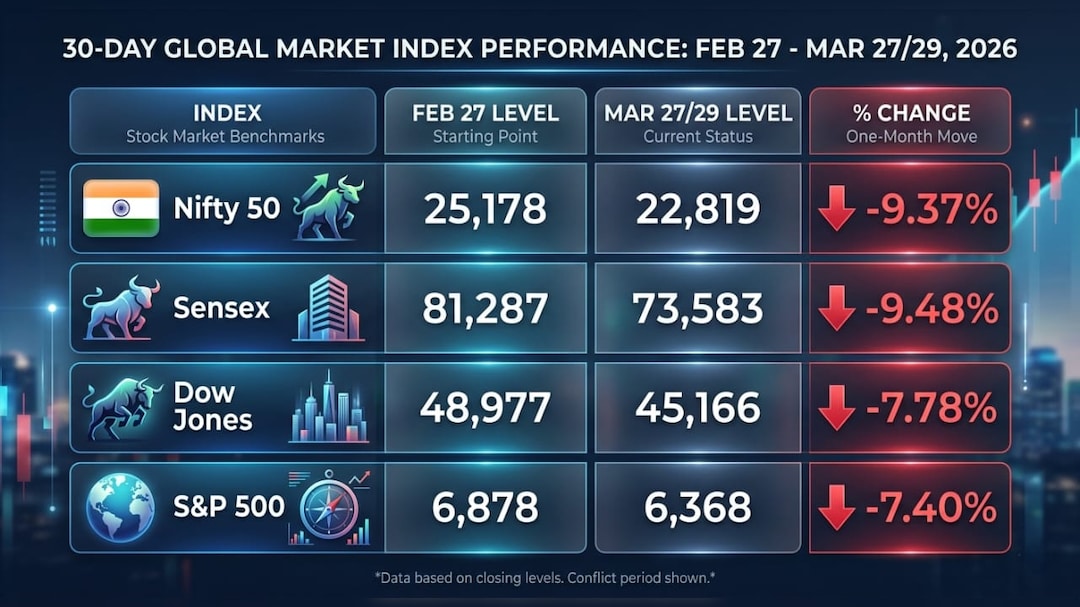
30 day global market performance
Photo Credit: NDTV Profit
Market observers, according to Bloomberg, note that while India's headline indices fell slightly more than the Dow, the decline was primarily driven by the Rupee hitting a record low, rather than domestic economic failings.
Wall Street, Peers Under Pressure
Wall Street: US markets marked their fifth straight losing week on March 27, the longest such streak since 2022. While energy stocks provided some cushion, tech and AI sectors led the decline due to rising yields and inflation fears.
Asian markets like the KOSPI (South Korea) saw even more drastic single-day crashes (down 6.5% on March 23) as they are heavily dependent on Middle Eastern oil.
The 'Hormuz Premium'-led Energy Shock
The blockade of the Strait of Hormuz remains the primary catalyst for market anxiety. Brent Crude has undergone a vertical move, surging from approximately $73-77 at the end of February to a stabilised range of $108-113 per barrel. Prices briefly touched a harrowing peak of $119 on March 9, according to Bloomberg energy trackers.
ALSO READ: Precious Metal Prices See-Saw: Silver Plunges 5%, Gold Declines By Rs 1,900 Per Kg
The Gold Paradox: Liquidity Over Safety
In a move that has defied traditional market wisdom, precious metals failed to serve as a hedge. Instead of surging, gold and silver became "liquidity donors" for institutional investors facing margin calls in the equity crash.
Global Gold: Fell 14% to $4,494/oz.
India Gold (MCX): Corrected from Rs 1,60,500 to Rs 1,43,720 per 10g.
Essential Business Intelligence, Sharp Market Insights, Practical Personal Finance Advice, Daily Fuel, Gold and Silver Prices and Latest Stories — On NDTV Profit.