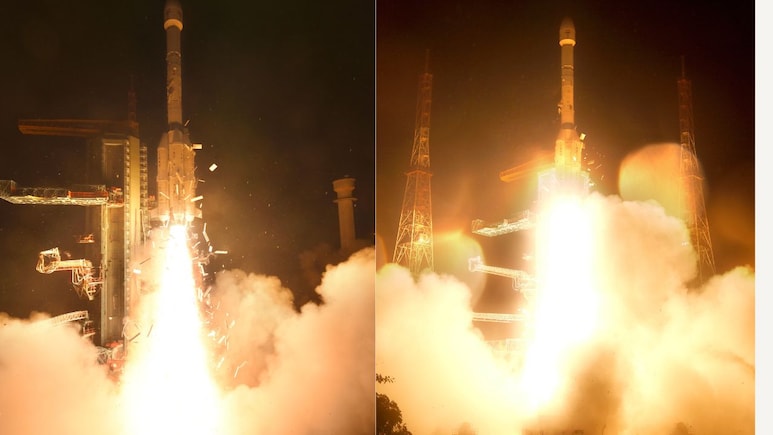
- ISRO launched the EOS-05 satellite using GSLV-F17 from Sriharikota on September 4 at 2:55 am IST
- GSLV-F17 successfully placed EOS-05 into the intended Sub-Geosynchronous Transfer Orbit
- EOS-05 is India’s first geosynchronous imaging satellite for continuous Earth observation
The Indian Space Research Organisation (ISRO) successfully launched EOS-05 Earth Observation Satellite aboard the GSLV-F17 rocket from the Second Launch Pad at Satish Dhawan Space Centre (SDSC-SHAR), Srihakota, Andhra Pradesh, in the early hours of Friday, September 4. The launch took place at 2:55 am IST.
ISRO subsequently confirmed that GSLV-F17 successfully placed the EOS-05 into its intended Sub-Geosynchronous Transfer Orbit (Sub-GTO).
Mission Success!
GSLV-F17 has successfully accomplished its mission, placing EOS-05 into the intended orbit.
Sharing a few memorable moments from the lift-off.
For more information:https://t.co/VneB2jgZoY#GSLVF17 #EOS05 #ISRO pic.twitter.com/kv0zB6V5ViAlso Read | Layoffs Are Rising In Tech, But These Skills Are Helping People Unlock Better Pay
— ISRO (@isro) September 3, 2026
ALSO READ: ISRO To Launch EOS-05 On GSLV-F17, India's First Geosynchronous Imaging Satellite
ISRO Chairman V Narayan announced the mission's success after its launch and said that the GSLV-F17 had successfully and precisely injected EOS-05 into its intended orbit, while also stating that the satellite was in good health.
In a statement, quoted by PTI, Narayan said, "This is going to continuously scan a particular portion of the Earth, mainly India and its surroundings. For persistent monitoring purposes, it is going to be useful. Regarding GSLV-F10, there was a small problem with the cryogenic stage. After that, a national-level committee clearly addressed the reason, and we have made all the improvements. With that, not only this vehicle, but last year we also had two important missions, including the NISAR mission using this vehicle, and we have improved the reliability of the total vehicle itself. That we have done.”
Union Minister Jitendra Singh also posted about the launch on X, applauding the ISRO team on the launch of the satellite under the visionary leadership of Prime Minister Narendra Modi.
Another giant leap for India in Space!
— Dr Jitendra Singh (@DrJitendraSingh) September 3, 2026
Kudos to Team @isro on the successful launch of GSLV-F17/EOS-05.
EOS-05 is a state-of-the-art Earth Observation satellite and India's first imaging satellite from Geosynchronous Orbit, enabling advanced imaging across visible, infrared,… pic.twitter.com/1HHJrWM7ze
What is the EOS-05?
According to ISRO, EOS-05 is a state-of-the-art Earth observation spacecraft and India's first imaging satellite intended to operate from geosynchronous orbit. It is designed to provide high frequency Earth observation and imaging, with applications extending across civilian and strategic requirements.
According to ISRO's stated objectives and reports based on the mission's capabilities, its imagery can support areas such as agriculture, disaster management, weather and environmental monitoring, flood monitoring, cyclone observation, forest fire monitoring, natural resource assessment, land and environmental monitoring, and strategic Earth observation.
The major advantage is temporal resolution, which is the ability to observe a particular region repeatedly and quickly, which can be particularly viable when monitoring rapidly changing events such as cyclones, floods or large-scale fires.
Geosynchronous Orbit
EOS-05 was injected into a Sub-Geosynchronous Transfer Orbit, rather than being placed directly into its final operational geosynchronous orbit. The spacecraft is subsequently expected to use its own propulsion system to raise and adjust its orbit toward the operational geosynchronous region, roughly 36,000 km above Earth.
The geosynchronous orbit allows a satellite to travel around Earth at a rate corresponding closely to Earth's rotation, enabling it to repeatedly observe the same broad region rather than passing over it only periodically like many low-Earth-orbit satellites. This is the key capability behind EOS-05's proposed frequent and wide-area Earth imaging.
GSLV-F17 - The Rocket Behind the Mission
The satellite was launched using GSLV-F17, the 19th flight of India's Geosynchronous Satellite Launch Vehicle (GSLV), according to ISRO's official mission brochure. ISRO specifies the rocket's height as 51.7 metres, lift-off mass as 420.5 tonnes, payload as approximately 2,367 kg, and the number of propulsion stages as three. The three stages are: S139 core with four L40H strap-on boosters, GL40HT, and CUS15 cryogenic upper stage.
The biggest significance is that EOS-05 is India's first dedicated imaging satellite designed to operate from geosynchronous orbit according to ISRO. Most Earth observation satellites operate from lower orbits and therefore move across the sky relative to a particular location on Earth. EOS-05's much higher geosynchronous operating position will allow it to maintain repeated observations of the same broad geographical area. This makes the mission particularly useful for near real-time or high frequency monitoring, rather than simply obtaining occasional satellite images.
ALSO READ: From Carrying Rocket On Bicycle To Launch Of Vikram-1, A Look At India's Space Journey
Essential Business Intelligence, Sharp Market Insights, Practical Personal Finance Advice, Daily Fuel, Gold and Silver Prices and Latest Stories — On NDTV Profit.