- IRCTC's UPI ticket bookings rose to 51.22%, surpassing half of total sales
- Convenience fee revenue stagnated despite higher passenger volumes and trains
- UPI fees (₹10-20) are lower than card fees (₹15-30), reducing IRCTC's income
As a Parliamentary panel pushes for a calibrated Merchant Discount Rate on high-value transactions to ease the burden of zero-MDR UPI payments, IRCTC's latest earnings call offers a live case study of exactly the strain the Committee is flagging, playing out inside one of the country's largest digital ticketing platforms.
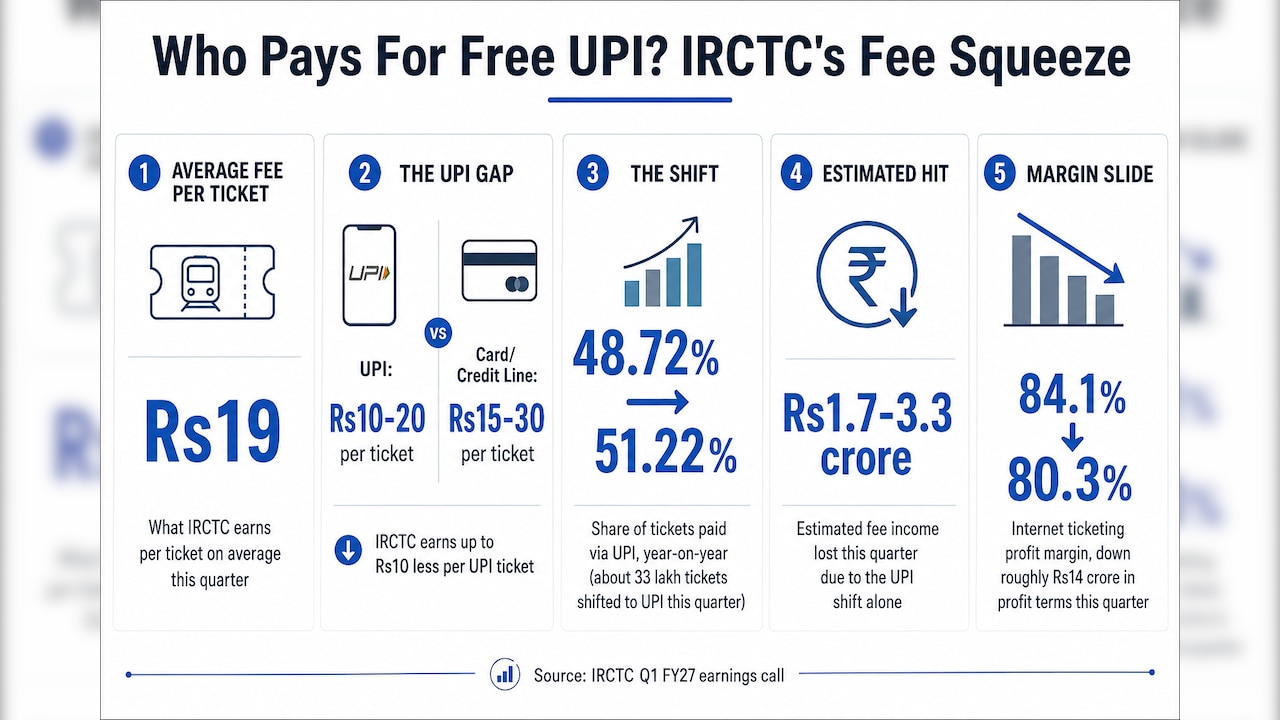
On the Q1 FY27 call, Chairman and Managing Director Rahul Himalian confirmed that UPI's share of ticket bookings has crossed the halfway mark, rising to 51.22% from 48.72% a year earlier. But the shift has not translated into proportionate fee growth.
An analyst on teh call pointed out that internet ticketing revenue has "just not grown" over eight quarters despite rising passenger volumes and a growing number of trains. Himalian did not dispute the trend. "The UPI, like we said, that we are charging against 15 and 20, 10 and 20. This is one aspect where we will have to think and come about," he said, adding that "UPI is something which has grown... that is why it is digging into your profits."
ALSO READ: Train Passengers Opting Out Of Meals On The Rise — IRCTC Management Explains Why
The arithmetic behind that admission is straightforward. IRCTC earned Rs 248 crore in convenience fees this quarter on 13.27 crore tickets, working out to roughly Rs 19 per ticket on average. But UPI transactions carry a convenience fee of Rs 10-20, against Rs 15-30 for card and credit-line payments, a gap of up to Rs 10 per ticket. With UPI's share rising 2.5 percentage points quarter-on-quarter, an estimated 33 lakh tickets shifted to the cheaper payment mode this quarter alone.
At the low end of that fee gap, that shift alone could account for roughly Rs 1.7-3.3 crore in foregone fee income in the quarter, an illustrative estimate based on IRCTC's own disclosed numbers rather than a figure the company itself put out.
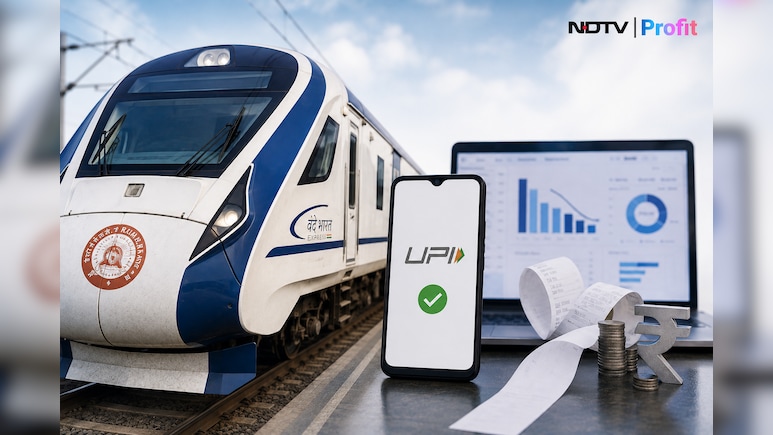
IRCTC is taking a hit on its numbers due to passengers preferring UPI payment option.
Photo Credit: NDTV Profit
The comment lands squarely on the fault line the Standing Committee on Finance has identified at a national level. The panel, headed by Bhartruhari Mahtab, found that the Centre's Rs2,000-crore allocation to compensate for zero-MDR transactions covers only a fraction of the industry's estimated Rs20,700-crore operational cost, and has called for an expeditious, calibrated MDR on high-value transactions to close that gap.
ALSO READ: More Bottled Water, No Partner Still: IRCTC's Rail Neer Fix Remains Half-Built
IRCTC's own workaround points to the same underlying economics. Rather than wait for a policy shift on UPI pricing, the company has begun differentiating its fee structure by payment mode, charging higher convenience fees on credit card and credit line transactions than on UPI. "In this one way, we are trying to circumvent that aspect," Himalian said, while conceding that convenience fee growth has slowed to 4.89% quarter-on-quarter, a rate the analyst on the call noted has "hardly" kept pace with inflation over seven years.
With internet ticketing's EBIT margin down to 80.33% from 84.12% a year earlier, a 3.8 percentage point drop that works out to roughly Rs14 crore in lost profit on the segment's Rs 361-crore revenue base, and management admitting the convenience fee "depends on the policy decision" rather than commercial discretion, IRCTC's quarter offers a rare, numbers-backed glimpse of the exact tension the Parliamentary panel wants Delhi to resolve: who ultimately absorbs the cost of keeping UPI free at the point of use.
ALSO READ: Who Pays For Free UPI? Parliamentary Panel Seeks MDR On High-Value Transactions
Essential Business Intelligence, Sharp Market Insights, Practical Personal Finance Advice, Daily Fuel, Gold and Silver Prices and Latest Stories — On NDTV Profit.