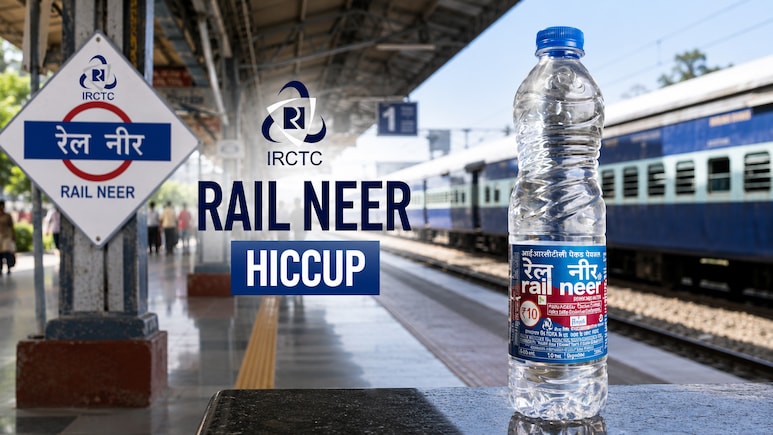
- IRCTC's Rail Neer capacity is 17.77 lakh bottles daily, below peak demand of 25-30 lakh.
- Two plants at Ambernath and Danapur are expanding capacity to meet supply shortfall.
- New plant sites in Prayagraj, Mysore, and Ranchi face delays and partial land allotment.
IRCTC's search for a partner to bridge the Rail Neer supply gap remains unresolved, but the company is now leaning harder on capacity expansion at existing plants and a pipeline of new sites to close the shortfall, according to management commentary on the Q1 FY27 earnings call.
Chairman and Managing Director Rahul Himalian said Rail Neer's installed capacity stands at 17.77 lakh bottles a day, down from 18.4 lakh after the closure of one plant, against supply of around 15.5 lakh bottles. Demand at some stations runs as high as 25-30 lakh bottles a day. "The requirement is much higher," Himalian said, adding that the gap is "unfortunately utilised by the unauthorised vendors," a problem he said is recognised by both the railways and IRCTC.
On expansion, Himalian confirmed capacity at two existing plants is being scaled up. "For Ambernath, we are going from 2 lakh bottles to 3 lakh. For Danapur, we are trying to increase from 1 lakh to 2 lakh bottles per day," he said, adding both should be finalised this financial year.
Also Read | Layoffs Are Rising In Tech, But These Skills Are Helping People Unlock Better Pay
ALSO READ: IRCTC's Rail Neer Has A Supply Gap And No Partner To Fill It
Progress on greenfield sites remains mixed. Of four new plants planned for Prayagraj, Mysore, Ranchi and Bhagalpur, land has been allotted only in Prayagraj and Mysore, while Ranchi's allotment was confirmed only the previous day, Himalian said. He did not rule out further delays, saying the timeline "can easily extend to the financial year beyond '26, '27," and flagged possible additional plants in Varanasi and Pune depending on the 250-kilometre radius each plant can serve.
The segment's near-term profitability also took a hit in the quarter. Rail Neer revenue grew 2.83% year-on-year to Rs109 crore, but margins fell to around 10% from 14% a quarter earlier. Himalian attributed this to a roughly 30% rise in resin costs tied to the West Asia crisis, which pushed material costs up from Rs55 crore to Rs61 crore and cut segment profit by about Rs4 crore.
The pattern mirrors what management flagged a year earlier, when then-CMD Sanjay Kumar Jain told analysts that talks with established beverage brands, including IEX, had made little headway and IRCTC's experience finding a partner was "not very encouraging." No tie-up has since materialised, leaving the company to rely on internal capacity additions and new plants rather than a partnership route to close what remains a persistent 90-lakh-bottle-a-day-plus supply gap during peak demand periods.
ALSO READ: Train Passengers Opting Out Of Meals On The Rise — IRCTC Management Explains Why
Essential Business Intelligence, Sharp Market Insights, Practical Personal Finance Advice, Daily Fuel, Gold and Silver Prices and Latest Stories — On NDTV Profit.