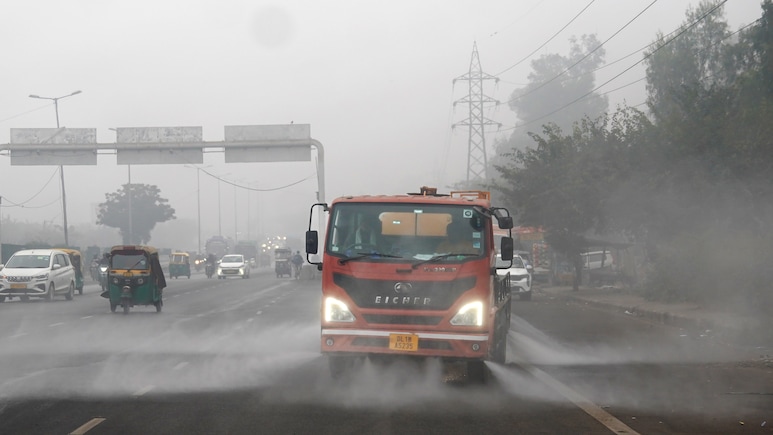
The Commission for Air Quality Management (CAQM) on Thursday invoked Stage I of the Graded Response Action Plan (GRAP) across Delhi-NCR after the air quality in Delhi deteriorated to the “poor” category.
The decision was taken during a meeting of the Sub-Committee on GRAP held on April 16, as authorities noted a rising trend in pollution levels.
Under GRAP Stage I, a set of preventive measures will be enforced to curb further deterioration.
Also Read | Layoffs Are Rising In Tech, But These Skills Are Helping People Unlock Better Pay
"The AQI of Delhi has been showing increasing trend outing to unfavorable meteorological conditions and recorded as 226 ('Poor' Category) today i.e on 16.04.2026. Further, the forecast by IMD/ IITM has also predicted AQI to remain in 'Poor' category in next two days. The Sub-Committee, accordingly, decides to invoke all actions under Stage-I ('Poor' Air Quality) of the extant GRAP in the entire NCR, with immediate effect."
ALSO READ: Air Pollution: India Can Learn From London, Mexico City, Tokyo, Beijing | The Reason Why
The CAQM said that actions under Stage-l of the extant GRAP shall be implemented, monitored and reviewed by all the agencies concerned in the entire NCR to ensure that the AQI levels do not slip further.
"All implementing agencies shall keep strict vigil and intensify measures of the extant GRAP schedule. Citizens may be requested to strictly adhere to the crtrzen charter under GRAP Stage-I."
The agency said that the Sub-Committee, shall be keeping a close watch on the air quality scenario and review the situation from time to time for further appropriate decision depending upon the Air Quality in Delhi and forecast made by IMD/IITM.
Meanwhile, a study published in the journal Neurology has flagged that exposure to air pollution could be associated with an increased migraine activity.
"These results help us to better understand how and when migraine attacks occur," author Ido Peles, of Ben-Gurion University of the Negev in Be'er Sheva, Israel, said.
"They suggest that for people who have a susceptibility to migraine to begin with, environmental factors may play two roles: intermediate-term factors such as heat and humidity may modify the risk for attacks, while short-term factors such as spikes in pollution levels may trigger attacks," Peles said.
Essential Business Intelligence, Sharp Market Insights, Practical Personal Finance Advice, Daily Fuel, Gold and Silver Prices and Latest Stories — On NDTV Profit.