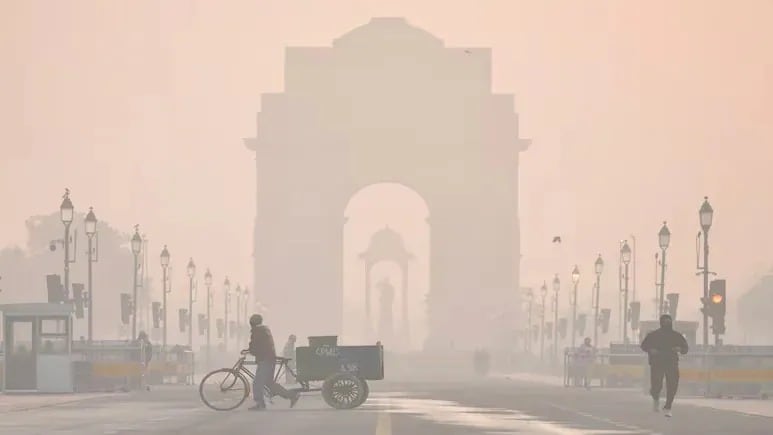
New Delhi recorded the highest Air Quality Index (AQI) among six Indian cities, with a reading of 275. The national capital's air quality fell in the 'Poor' category as of Friday evening.
The reading comes on a day when the Commission for Air Quality Management (CAQM) invoked Stage III of the Graded Response Action Plan (GRAP) across Delhi-NCR with immediate effect.

-
 Indian Markets Turning Corner After Two Tough Years, Says Sandeep Tandon
-
 NDTV Profit Ignite 2026: Experts See Opportunity In Equities, Stay Bullish For Long-Term
-
 Buy Right, Sit Tight Does Not Work for Individual Stocks, Says Dinshaw Irani
-
 'Worst Is Behind': Quant MF Sees Market Bottom, Flags 'Extreme Euphoria' In Midcaps
-
 India's Mutual Fund Industry Could Become A $1 Trillion Opportunity, Say Fund Managers
-
 'Foreign Investors Are Baraatis': Raamdeo Agrawal's Take On LTCG Tax
-
 Stay Invested Through Market Cycles: Raamdeo Agrawal at NDTV Profit Ignite
-
 Ramesh Damani Remains Bullish On India For Next 20-30 Years, Sees Bargains Amid Market Weakness
-
 CAS Came After A Long Consultation Process: SEBI Chairman Tuhin Kanta Pandey AT NDTV PROFIT IGNITE
-
 Aim To Cut FPI Onboarding Time From Mth To Five Days: SEBI Chairman Tuhin Kanta Pandey AT NDTV PROFI
The decision was taken as a precautionary measure ahead of Diwali, after Delhi's average AQI reached 382.
Also Read | Layoffs Are Rising In Tech, But These Skills Are Helping People Unlock Better Pay
ALSO READ: Delhi AQI Worsens Ahead Of Diwali, GRAP Stage 3 Restrictions Imposed: What's Banned, What's Allowed
Mumbai recorded an AQI of 158, while Kolkata reported a reading of 169. Both cities fell in the 'Moderate' category.
Bengaluru recorded an AQI of 60, while Chennai and Hyderabad reported readings of 95 and 90, respectively. All three cities were in the 'Satisfactory' category.
India's Cities AQI Today
The air quality readings across six Indian cities are:
| City | AQI |
| New Delhi | 275 |
| Mumbai | 158 |
| Kolkata | 169 |
| Bengaluru | 60 |
| Chennai | 95 |
| Hyderabad | 90 |
New Delhi's Air Quality Today
New Delhi recorded an AQI of 275, the highest among the six cities. Under India's National Air Quality Index classification, the reading falls in the 'Poor' category.
An AQI between 201 and 300 is classified as 'Poor' and may cause breathing discomfort to people on prolonged exposure. Children, older adults and people with respiratory conditions may be particularly vulnerable.
The national capital has also been placed under GRAP Stage III restrictions. The CAQM invoked the stricter measures across Delhi-NCR on Friday, November 6, after Delhi's average AQI reached 382, placing it in the 'Very Poor' category.
The move comes less than two days before Diwali and brings additional pollution-control measures across the region.
AQI Today: How Do Other Cities Compare?
Kolkata recorded an AQI of 169, followed by Mumbai at 158. Both cities fall in the 'Moderate' category under India's National Air Quality Index classification.
Bengaluru reported an AQI of 60, while Hyderabad recorded 90. Chennai's AQI stood at 95. All three cities were in the 'Satisfactory' category.
The readings show a considerable difference in air quality across the six cities, with New Delhi recording the highest AQI and Bengaluru reporting the lowest.
What Do The AQI Readings Mean?
The Air Quality Index is a measure used to communicate air pollution levels and their potential impact on health. India's Central Pollution Control Board (CPCB) classifies AQI readings into six categories.
An AQI between 0 and 50 is classified as 'Good', while readings between 51 and 100 are considered 'Satisfactory'. The 'Moderate' category covers readings between 101 and 200, followed by 'Poor' (201-300), 'Very Poor' (301-400) and 'Severe' (401-500).
What Are PM2.5 And PM10?
The AQI is calculated using different air pollutants, including particulate matter.
PM2.5 are fine particles of 2.5 micrometers or less in diameter, PM10 are particles of 10 micrometers or less in diameter.
These pollutants can be inhaled into the respiratory system. The problem with PM2.5 particles is that because they're so small they can travel deep into the lungs.
At high levels particulate matter can make it harder to breathe and can aggravate existing heart and lung conditions.
Who Should Be Careful?
People with asthma and other respiratory conditions, children, older adults and those with heart-related illnesses are more vulnerable to the effects of air pollution.
ALSO READ: Delhi-NCR Air Pollution Like Smoking 30 Cigarettes a Day', Supreme Court Told
When the air quality is poor, long exposure outdoors and vigorous physical activity can increase the risk of health problems.
Residents should stay updated on local air quality and take precautions as needed. Reducing exposure may be possible by minimizing outdoor exposure during periods of high pollution.
The AQI readings may vary throughout the day depending on the weather conditions, wind speed and pollution levels. Numbers can also differ between air quality platforms and monitoring stations.
Essential Business Intelligence, Sharp Market Insights, Practical Personal Finance Advice, Daily Fuel, Gold and Silver Prices and Latest Stories — On NDTV Profit.