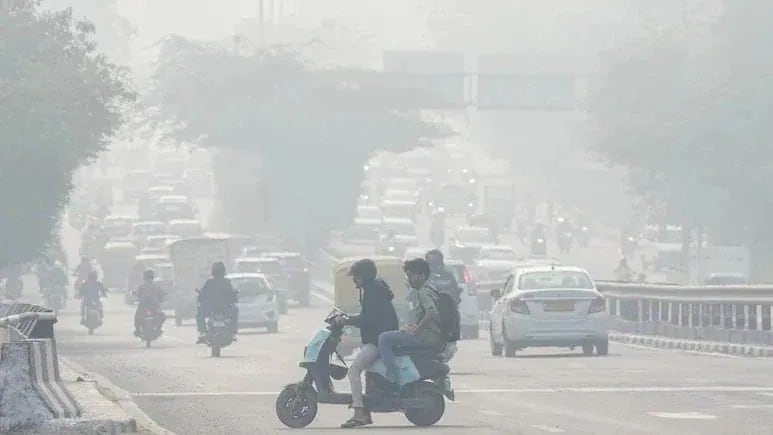
Begusarai in Bihar has emerged as India's most polluted city, recording an Air Quality Index (AQI) of 498, according to the latest city rankings.
Ghazipur in Uttar Pradesh follows closely with an AQI of 483, while Rewa in Madhya Pradesh occupies the third position with a reading of 446.
The list of India's 10 most polluted cities features locations from Bihar, Uttar Pradesh, Madhya Pradesh and Haryana. Uttar Pradesh has the highest representation, with three cities making it to the list. Bihar and Madhya Pradesh have two entries each, while Haryana also features two cities.
Also Read | Layoffs Are Rising In Tech, But These Skills Are Helping People Unlock Better Pay
As per the rankings, Begusarai's pollution level is listed as 21 times above the standard value. Ghazipur is also 21 times above the standard, while Rewa stands at 20 times.
ALSO READ: Delhi's Air Quality Remains 'Severe' As Chennai Nears 200; How Polluted Is Your City Today?
Gorakhpur in Uttar Pradesh ranks fourth with an AQI of 414, followed by Jaunpur at 390 and Prayagraj at 384. Umaria in Madhya Pradesh occupies the seventh position with an AQI of 356.
Haryana's Rohtak and Sirsa rank eighth and ninth, recording AQI readings of 323 and 321, respectively. Bihar's Saharsa rounds off the top 10 with an AQI of 320.
All 10 cities are marked under the 'Hazardous' category in the ranking. The readings were last updated on November 19, 2026, at 8:14 PM.
India's 10 Most Polluted Cities: Full List
Here is the list of India's 10 most polluted cities, along with their AQI readings and pollution levels compared with the standard value:
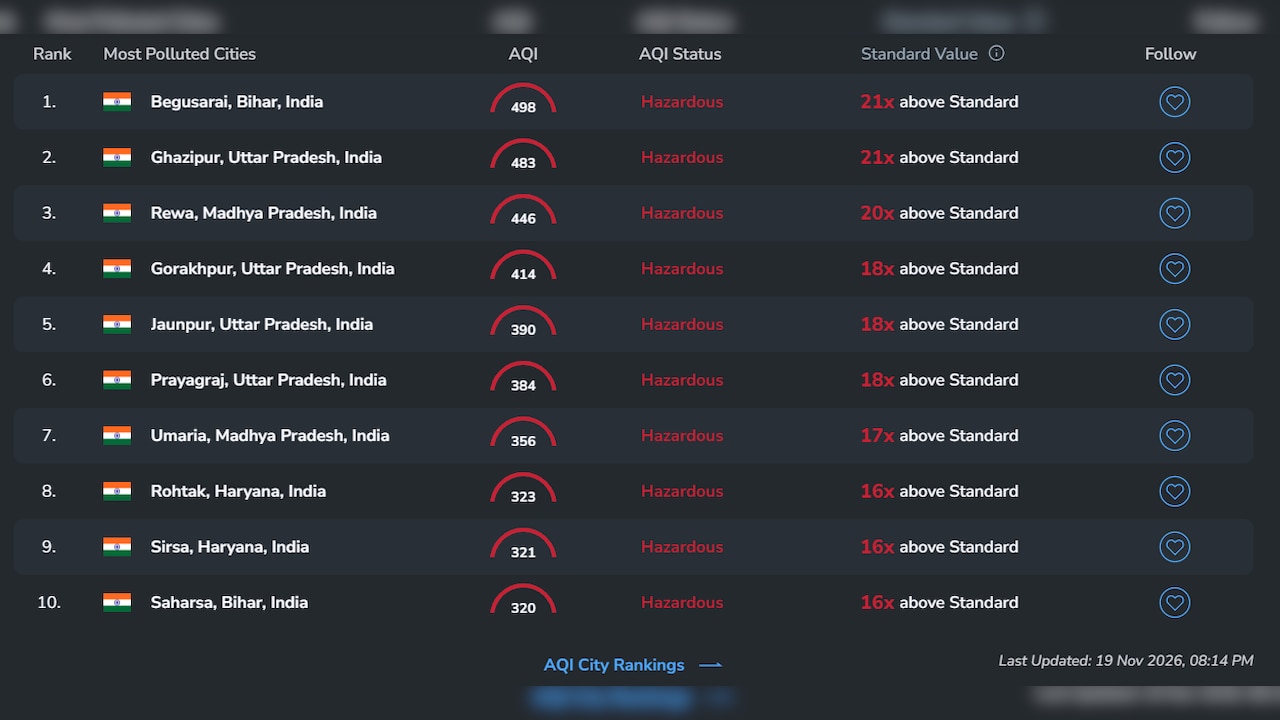
The rankings were last updated on November 19, 2026, at 8:14 PM.
What Is AQI And How Is It Measured?
The Air Quality Index (AQI) is a measure used to communicate the quality of air and the potential health risks associated with pollution. It converts measurements of different air pollutants into a single number, making it easier for people to understand the condition of the air they breathe.
India's Central Pollution Control Board (CPCB) calculates the National AQI using eight pollutants, including particulate matter (PM2.5 and PM10), nitrogen dioxide (NO2), sulphur dioxide (SO2), carbon monoxide (CO), ozone (O3), ammonia (NH3) and lead (Pb).
Under the CPCB's National AQI framework, readings are classified into six categories:
Good: 0-50
Satisfactory: 51-100
Moderate: 101-200
Poor: 201-300
Very Poor: 301-400
Severe: 401-500
ALSO READ: New PUC Norms Notified: What Private And Commercial Vehicle Owners Need To Know
High concentrations of particulate matter can affect respiratory health. Fine particles known as PM2.5 are particularly concerning as they can penetrate deep into the lungs.
Children, older adults and people with existing respiratory or heart conditions are more vulnerable to the effects of air pollution. Prolonged exposure to polluted air can worsen existing health problems and cause breathing discomfort.
Essential Business Intelligence, Sharp Market Insights, Practical Personal Finance Advice, Daily Fuel, Gold and Silver Prices, Watch Business News Live and Latest Stories — On NDTV Profit.