I was amused to see a female bartender at an airport lounge in Chennai. This was a couple of years ago, and to date, in all my travels, I haven't seen a female bartender at any Indian airport. This isn't about bartending or lounges. It's about women working. I believe women should work at almost all places where men work.
We are aware of the social and cultural hurdles that women overcome to study and get jobs. But they face another challenge during or after the job search - finding a place to live.
The Problem Begins After Getting The Job
Large factories or industrial clusters usually provide housing for workers. For example, garment firms in Tirupur provide subsidised accommodation to retain workers, and Foxconn's Sriperumbudur factory has dorm-style housing for women just a 5-minute walk away. But we don't find similar examples for banking or IT jobs. Employees of the services sector are expected to get this done themselves.
Also Read | Layoffs Are Rising In Tech, But These Skills Are Helping People Unlock Better Pay
Also, India's economic growth is skewed towards cities, especially the services sector. Therefore, for many young educated women, moving to a new city is a real struggle.
Safety becomes paramount. Families become apprehensive, even the progressive ones that bat for higher education and a career. However, sending a daughter alone to an unfamiliar city is a different decision altogether. Great Lakes Institute of Management's study finds that safe and affordable housing is the missing link between getting educated and getting employed. According to it, the answer might lie in providing safe and affordable hostel services for working women.
ALSO READ | India's Next Strategic Opportunity Lies Beneath The Ocean | The Reason Why
What Makes A Good Working Women's Hostel?
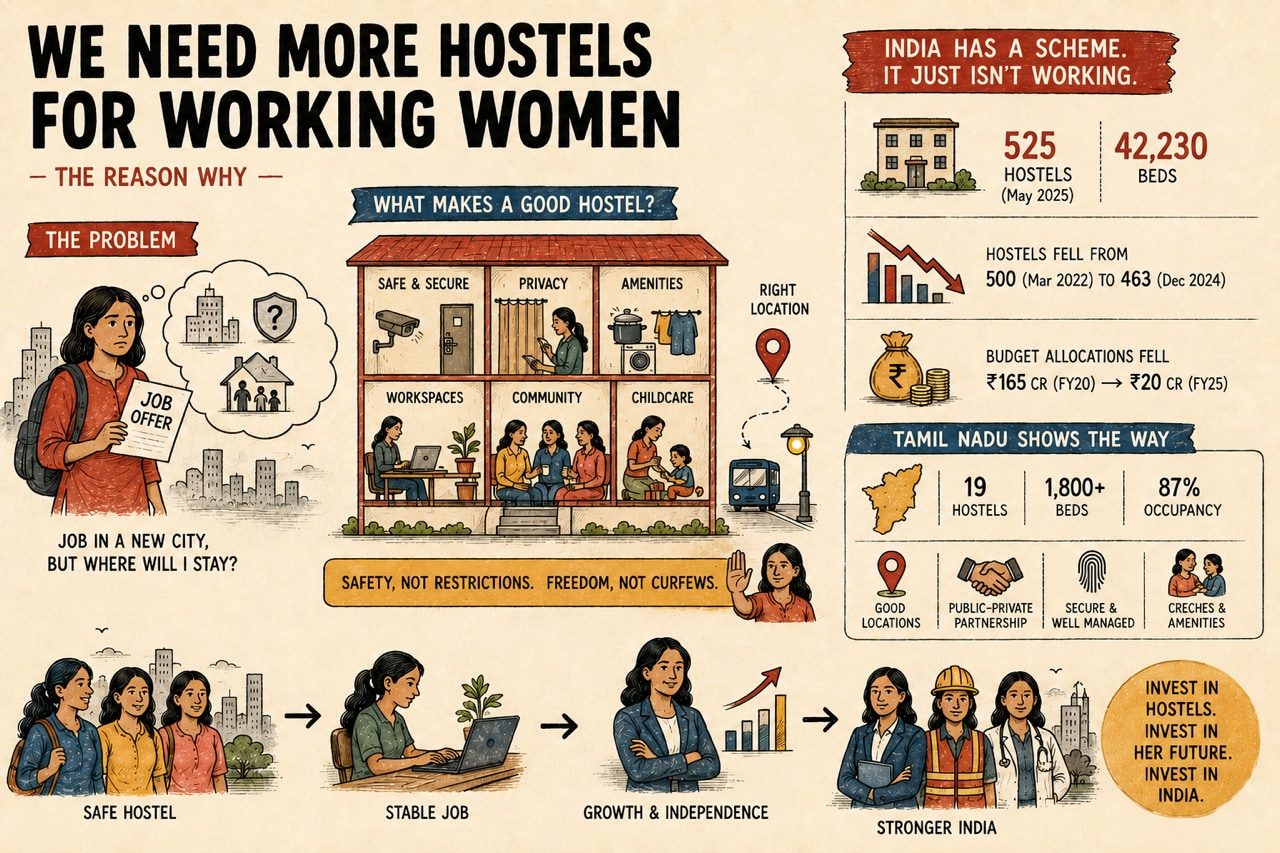
But hostels shouldn't be restricted to four walls and a roof. Udaiti Foundation's white paper on safe accommodation for working women argues that women need different things from a hostel than men do. Privacy, safety and community matter just as much as affordability. Common kitchens, secure lockers, curtains or partitions, laundry areas, workspaces, childcare facilities and even salons can make a hostel feel more livable.
But that's one part of the story. Many hostels rely on curfews for safety, even restricting late-night food deliveries. That limits autonomy and reflects an environment that still expects women to avoid jobs involving odd hours or night shifts. Women expect safety, privacy and security, but not more restrictions. The report points to trained permanent staff, gender-sensitisation, stronger policing and community-building as better ways to create a safe environment.
Then, location matters too. A good hostel in the wrong place is still a bad hostel. Something as simple as a well-lit street or reliable last-mile connectivity can determine whether a woman accepts or keeps a job. Free bus rides don't help if the walk home feels unsafe. That's why hostels need to be located close to workplaces or major transit corridors.
Finally, hostels offer something that many, especially men, would overlook. They give women their first community in a new city. They replace the local knowledge that family and friends would otherwise provide, making it easier to navigate both city life and careers.
India Already Has A Scheme. It Just Isn't Working.
Now, the government of India recognised this need quite early. It launched the Working Women's Hostel Scheme in 1972. In 2017, it was revised as Sakhi Niwas. However, the performance of this scheme has been poor.
According to information obtained by BehanBox through an RTI response from the Ministry of Women and Child Development in May 2025, India had 525 Sakhi Niwas hostels with a combined capacity of 42,230 beds. That's a tiny number for the size of the country.
The shortage is neither surprising nor new. In 2006, the Parliamentary Committee on the Empowerment of Women noted that only 607 of the 873 hostels sanctioned since 1972 had been completed. More recently, a parliamentary reply stated that the count has fallen from 500 in March 2022 to 463 by December 2024. However, the RTI stated that in May 2025, there were 525 hostels. This means that there is either a sudden increase in a few months or inconsistencies or discrepancies in reporting.
Further data suggests that it could be the latter. That's because the budgetary allocations on this scheme have been falling continuously. Allocations fell from Rs. 165 crore in FY20 to Rs. 20 crore in FY25. It doesn't stop here. The actual spending has been lower than the budgeted estimates, falling from Rs. 33 crore to just Rs. 6 crore for the respective years.
ALSO READ | What Holds Us Back? | The Week In Whys
Tamil Nadu Shows The Way
But there's still hope. Tamil Nadu offers a glimpse of what other states could do. Nearly half of the state's women are in paid employment, compared with just one-third across India. The state's focus is no longer just on getting women into the workforce, but on ensuring they can remain there.
Through Thozhi hostels, the state is building one of the promising governance models. As of late 2025, the state had 19 operational hostels across 15 districts, offering over 1,800 beds with an overall occupancy of 87%. Hostels in Chennai, Coimbatore and Trichy operated at or near full capacity.
The hostels are strategically located, which makes commuting easier. They are operated through a public-private partnership. Residents benefit from affordable rents, furnished rooms, biometric entry, CCTV surveillance, common kitchens, laundry facilities, and creches.
The Great Lakes Institute of Management's survey found that safety, family approval and affordability were the primary reasons for choosing Thozhi hostels. Many women said their parents would not have allowed them to migrate without the assurance of a government-backed hostel.
Yes, there's still some scope for improvement, but the broader lesson is clear.
Investment in Growth
States must see safe accommodation that gives more freedom to working women as a long-term investment in human capital and economic development, rather than a welfare scheme. Tamil Nadu has demonstrated it with professional management, which other states can follow.
A few weeks ago, I wrote about how more than half of urban Indian women fall into the NEET category. That's short for 'neither in employment, education, nor training'. For men, that stage is
supposed to be temporary. But women usually don't re-enter the workforce once they are out of it. If something as simple as safe and affordable hostels can help more women make that transition, they won't just create better careers; they will help India realise the returns on the education it has already invested in.
Disclaimer: The views expressed in this article are solely those of the author and do not necessarily reflect the opinion of NDTV Profit or its affiliates. Readers are advised to conduct their own research or consult a qualified professional before making any investment or business decisions. NDTV Profit does not guarantee the accuracy, completeness, or reliability of the information presented in this article.
Essential Business Intelligence, Sharp Market Insights, Practical Personal Finance Advice, Daily Fuel, Gold and Silver Prices and Latest Stories — On NDTV Profit.