Men And Women Follow Different Labour Market Paths | The Reason Why
Across India's million-plus cities, three out of every ten potential workers fall into the NEET category.

Let's talk about NEET. Not the exams. We can have that conversation somewhere else. I am talking about a statistical indicator in labour markets, which doesn't get much limelight. It's short for ‘Not in Employment, Education or Training'.
Usually, we discuss unemployment rates, but NEET captures something more intricate. We include people who are seeking jobs and not getting them in unemployment numbers. But NEET includes those who are not working or studying, and they aren't even searching for jobs. These are the folks that are out of the labour market. This becomes a clearer indicator of untapped human resources.
Recently, the Ministry of Statistics and Programme Implementation (MoSPI) released a detailed report titled Labour Market Dynamics in Million-plus Cities. It covers 46 municipal corporations across India with populations above one million. It looks at everything from labour force participation and unemployment to wages, workplace types, and reasons for staying out of the labour force.
Difference In Men & Women Labour Markets
Across India's million-plus cities, three out of every ten potential workers fall into the NEET category. But the gender divide is enormous: 6% for men versus 56% for women. While most men are working, studying, or searching for jobs, more than half of urban women are doing none of these.
The gap is visible across cities. Prayagraj records one of the widest differences, with male NEET at 6% compared with 81% for women. Coimbatore has the lowest difference, where male and female NEET are 7% and 37%, respectively.
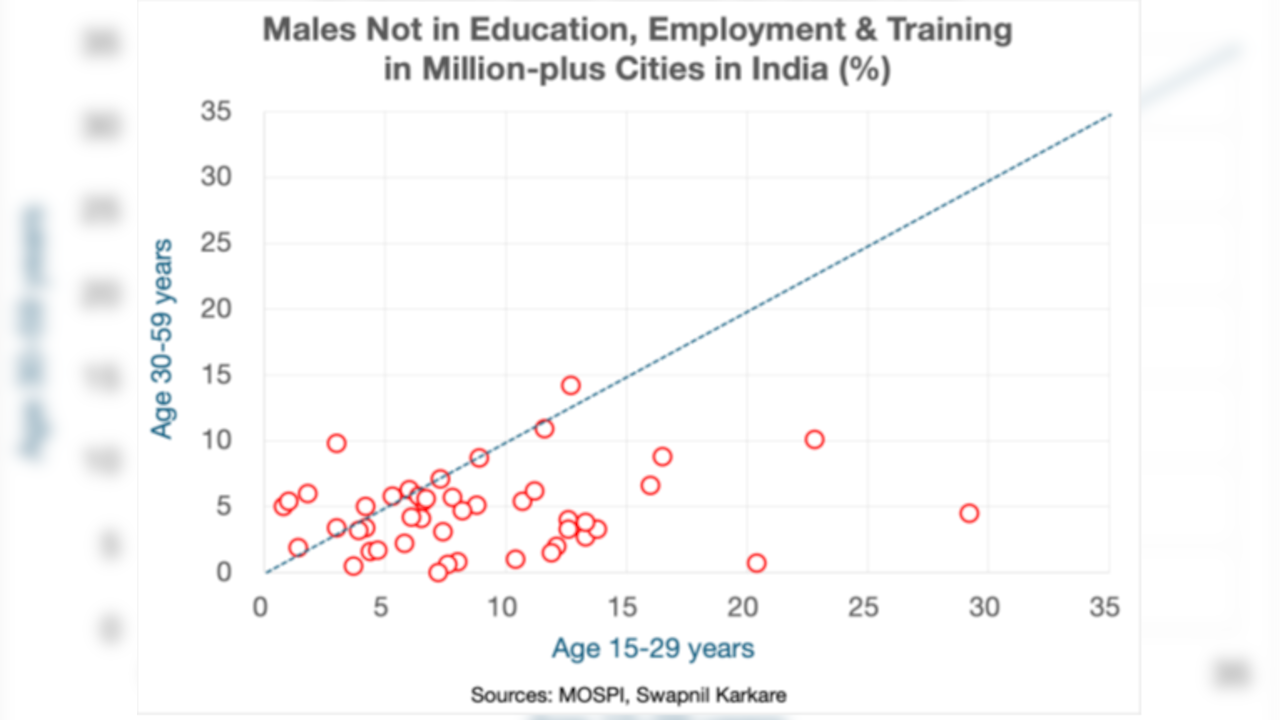
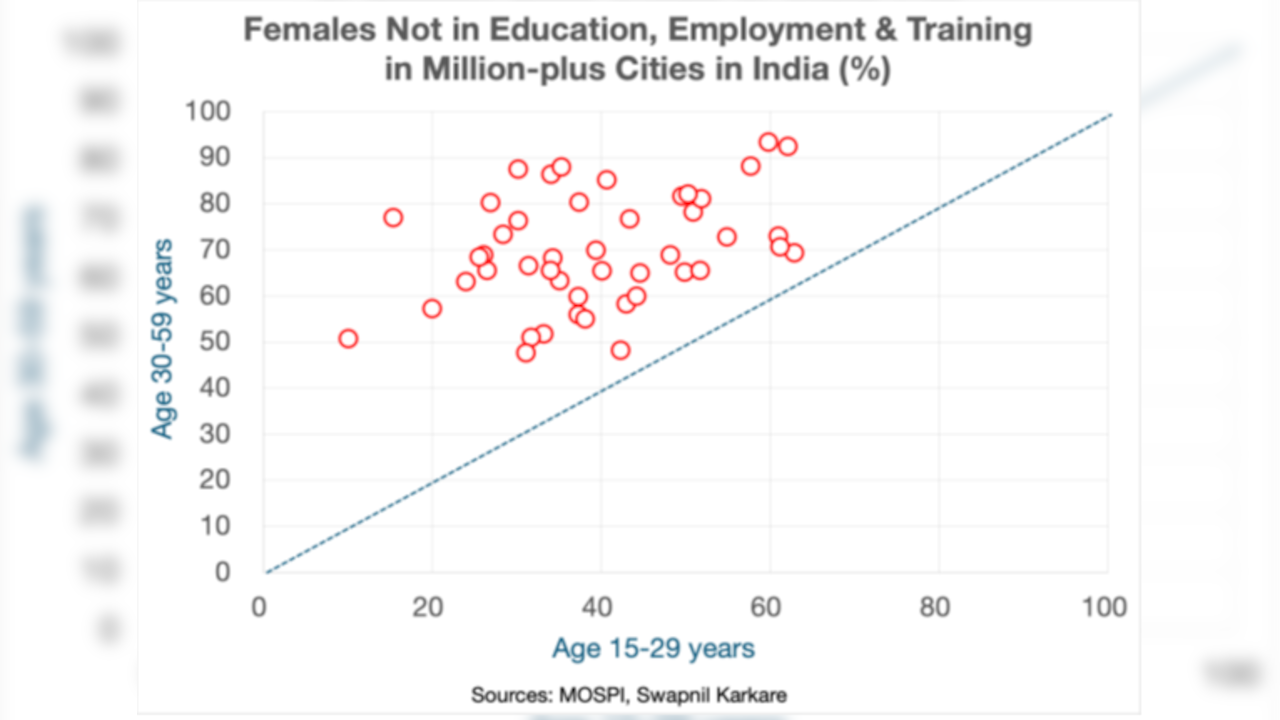
The divide also widens with age. For ages 15-29, male NEET rate stands at 8%. It falls to 4% in prime working years, 30-59. Women move in the opposite direction, with NEET rising from 38% to 67%. Note that NEET rates are calculated within each age and gender category. The NEET rate of 38% for young women means that 38% of women aged 15–29 in that city are not in employment, education or training.
The contrast becomes immediately visible in the two charts below. In the male chart, almost every city lies below the 45-degree line, indicating that NEET rates decline as men move into their prime working years. The female chart shows the opposite pattern, with almost every city above the diagonal, meaning female NEET consistently rises with age.
From Young To Prime Age
Amritsar records the country's highest male youth NEET at 29%, yet this falls to just 5% in the prime working years. Madurai drops from 20% to barely 1%, while Jaipur drops from 23% to 10%. High male youth NEET therefore often reflects delayed entry into work rather than permanent exclusion.
Women experience the reverse transition. Not a single city records a decline in female NEET with age. Navi Mumbai rises from 15% to 77%, Rajkot from 30% to 88%, and Srinagar from 27% to 80%. Prayagraj and Dhanbad record the country's highest prime-age female NEET at around 93%, which means almost all women in these cities are not part of the labour market.
The story is quite simple, but stark. Men get absorbed into work, while women leave the labour market as they hit the prime working ages.
Job Opportunities
Cities that generate a high absolute volume of formal jobs allow women to stay in the labour force. In Pune, the sheer scale of the formal service economy means nearly 1 in 4 adult women holds a regular salaried job. This keeps prime-age female NEET comparatively low (48%).
Contrast this with highly informal economies like Prayagraj or Varanasi. In these cities, formal jobs are so scarce that they are monopolised by men or a tiny elite of highly educated women. For the average woman, the only alternative is the street-level gig or informal economy. Because safety, mobility, and pay in the informal sector are poor, most women exit the labour force entirely, driving prime-age female NEET to 80-93%.
Final Take
Industrial growth alone has not translated into gender-inclusive employment. For many people, the NEET stage is a temporary one – at least to begin with. They are preparing for competitive exams, acquiring more qualifications, or searching for better jobs before eventually entering the workforce.
Men still succeed. Women usually don't. By their prime working years, this temporary absence often becomes permanent.
Cities such as Pune, Madurai, and Coimbatore show that a different trajectory is possible, retaining far more women in employment. But one thing is clear. The difference is not simply the number of jobs available, but whether cities create formal, accessible, and socially acceptable work that women can enter and remain in through different stages of life.
Also Read | India's Education Is Failing On Learning, Accountability | The Reason Why
-
High US Salaries, No Green Card Certainty: The Financial Calculation Facing Indian H-1B Families

The suspension of PERM processing at eight technology employers does not cancel existing H-1B visas. What it does is force a question many Indian families have been avoiding: is the US salary worth tying your career and family plans to one employer?
-
Unhedged Position: Can India See An Indonesia-Style Time Correction?
The Nifty is trading below levels it first clocked in 2024. Is there, then, as I have suggested in the headline, potential that the current time correction drags on painfully for the next three-five, even ten years?
-
Navigating Friction And Energy Realities: An Analysis Of Marco Rubio's October Visit To India
Occurring at a critical juncture marked by stalled trade negotiations and escalating geopolitical pressures over global energy supplies, the visit offers a profound window into modern US-India relations.
-
India Exports Capital. Why Not Export Trusteeship?
The big question, then, is whether India can build an institution that global borrowers, investors, banks, and lawyers can trust, even without an Indian connection.
-
France's Economy & Politics Are In Crisis | The Reason Why
Let's look at how the French economy and politics evolved under Nicolas Sarkozy, Franois Hollande and Emmanuel Macron.
-
You May Inherit The Business. You Must Earn Its Credibility.
Succession tests the founder's ability to share authority as much as it tests the next generation's readiness to assume it.
-
Signing Deals Is One Thing; Making Them Work Is Another | The Week In Whys
Sometimes, things don't turn out as planned. Indian companies have lost some bids to rivals, some projects won't produce until 2030.
-
FOMC Wall, PERM Suspension, Hospital Stocks | Talking Points This Week
A PERM suspension would directly affect green-card sponsorship rather than H-1B visas, so the near-term earnings impact could remain relatively limited. The key question is whether this marks a new phase in US scrutiny of Indian IT.
-
Everything, Everywhere, All At Once: Dalal Street's Week To Forget | Joining The Dots
Visa curbs, a Starlink spat and cancer drug caps: what connects this week's shocks for Indian markets
-
India Is Going Abroad For Critical Minerals. But It May Take Years To Pay Off | The Reason Why
Although India's steps are in the right direction, they remain modest compared with India's growing dependence.