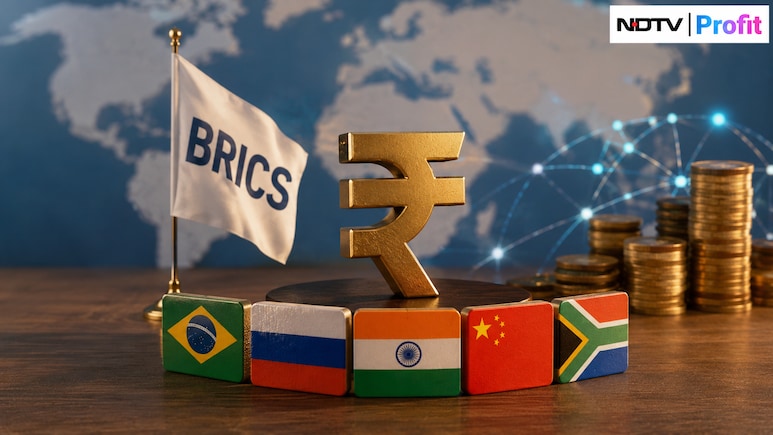
- India opposes a BRICS common currency due to economic and political reasons
- A common currency removes independent exchange rate shock absorption for members
- Successful currency unions need labor mobility, fiscal support, and similar economies
A few days ago, India's Commerce Minister Piyush Goyal said that India doesn't support a BRICS currency. We don't know the real reason for this remark. But multiple theories have started floating around on social media since then. Some say that India will not like China receiving higher allocations, while others say the government fears actions from Donald Trump. He had warned BRICS members of higher tariffs if they had a common currency.
Keeping the noise aside, the economic case for having a common currency remains weak.
Losing One Shock Absorber
Having a common currency means the economy loses one tool of shock adjustment. Assume a country's economy is undergoing a problem, say growth slows, companies cut production, and unemployment rises. In a normal situation, its currency weakens. This depreciation becomes a self-correcting valve for the economy.
Also Read | Layoffs Are Rising In Tech, But These Skills Are Helping People Unlock Better Pay
When the currency depreciates, the country's goods become cheaper for the rest of the world. That lower price makes the country's exports more attractive. Similarly, imports get more expensive and therefore, people buy more local products. This helps domestic businesses recover. In short, a weaker currency redirects demand back into the country, helping it climb out of a slowdown.
But when the country shares its currency with others, its exchange rate cannot move independently. The shock-absorbing and self-healing mechanism goes off under a common currency.
ALSO READ | We Need More Hostels For Working Women | The Reason Why
Pre-requisites of a Common Currency
In such cases, all the countries operating a common currency must absorb such shocks in other ways.
One way is labour mobility. If people are allowed to move between the member countries, they can move from weaker regions to stronger ones. That's how unemployment in the slowing economy reduces, and people can still earn a livelihood. But it also means physical proximity, open borders, and cultural compatibility.
The other way to manage such shocks is to have wage and price flexibility. If wages can adjust quickly, firms can cut costs without laying off workers.
The third way is fiscal support. A single authority diverting funds from healthier economies to the struggling ones can take countries out of crisis. Then, if the member countries have similar industrial profiles, they face similar ups and downs, and a single monetary policy can be more effective for all the members.
These ideas trace back to economists like Robert Mundell, Ronald McKinnon, Peter Kenen, James Ingram, Tamim Bayoumi, and Barry Eichengreen, who built the foundations of Optimum Currency Area theory and shaped our understanding of the trade-offs of sharing a currency.
Stages of Common Currency
They argued that if these conditions are satisfied, countries may introduce a common currency. But it's not a cakewalk. Before a common currency, there are a few stages through which this arrangement needs to evolve to avoid high frictions. It's called Bela Balassa's stages of economic integration. It starts with shallow coordination to deeper integration.
The stages are as follows:
- Free Trade Area (FTA): Zero tariffs between members while each member sets its own tariffs for the rest of the world.
- Customs Union: FTA + common tariffs for the rest of the world
- Common Market: Customs Union + free movement of labour, capital, and services + regulatory harmonisation
- Economic Union: Common Market + coordinated monetary, fiscal, and industrial policies + supranational institutions.
- Monetary Union: Economic Union + single currency and unified monetary policy.
- Political Union: Monetary Union + federal political authority with sovereignty over taxation, spending, and defence.
The idea of a common currency isn't new. The European Union (EU) is a living example. It's not as successful as one might intend, but it has been here for a long time. It didn't become an economic union in the strict sense, as above. It created a monetary union without a fiscal union, and that has repercussions.
Shared Grievances Don't Mean Shared Currencies
Now, let's talk about BRICS. It is a group of convenience and has, over time, gained power to counter the Western-dominated trade, finance and payment systems. However, they differ in almost all aspects from having a common currency.
Take the exchange rate. Russia and China control exchange rates and don't allow free capital movements. Moreover, Russia is under immense geopolitical pressure because of sanctions. India, Brazil, and South Africa operate flexible, market-determined systems, but Brazil's real comoves with global commodity prices, creating short-term volatility.
Their production structures also differ. Brazil and South Africa are commodity exporters, while Russia is an energy exporter. India is an energy- and manufacturing-heavy importer, while a leading services exporter. China is on the other end of the spectrum, dominating manufacturing production and exports.
A currency union also requires deep political trust. China and India have active border disputes and strategic competition. Then, almost all members trade far more with the US or EU than amongst themselves. Moreover, cultural, linguistic, and ideological differences run wide, and there is limited tourism, migration, or knowledge exchange to build social cohesion.
These patterns overlap more than they complement.
ALSO READ | India's Next Strategic Opportunity Lies Beneath The Ocean | The Reason Why
Coordination is More Important
A common currency doesn't really solve anything for this group. And BRICS members know it well. Therefore, they are trying smaller, more practical fixes. A bilateral local-currency settlement, like rupee-ruble trades or yuan-real arrangements, and BRICS Pay, a retail-level system that lets people pay in their own currency inside another member country, are on the cards.
But we shouldn't mistake this patchwork for a stepping stone to a common currency. It is the alternative and likely the more realistic path.
Further, I would expect more coordination on trade policy, standards, and other economic issues not just within the BRICS platform, but across the multilateral forums where these countries sit together. If BRICS wants to be taken seriously as a bloc, it must show alignment beyond annual communiqués and summit rhetoric.
Right now, coordination is sporadic and often inconsistent. Without visible unity, the group looks more like a loose coalition of convenience than a coherent economic pole that the Global South could look to.
Disclaimer: The views expressed in this article are solely those of the author and do not necessarily reflect the opinion of NDTV Profit or its affiliates. Readers are advised to conduct their own research or consult a qualified professional before making any investment or business decisions. NDTV Profit does not guarantee the accuracy, completeness, or reliability of the information presented in this article.
Essential Business Intelligence, Sharp Market Insights, Practical Personal Finance Advice, Daily Fuel, Gold and Silver Prices and Latest Stories — On NDTV Profit.