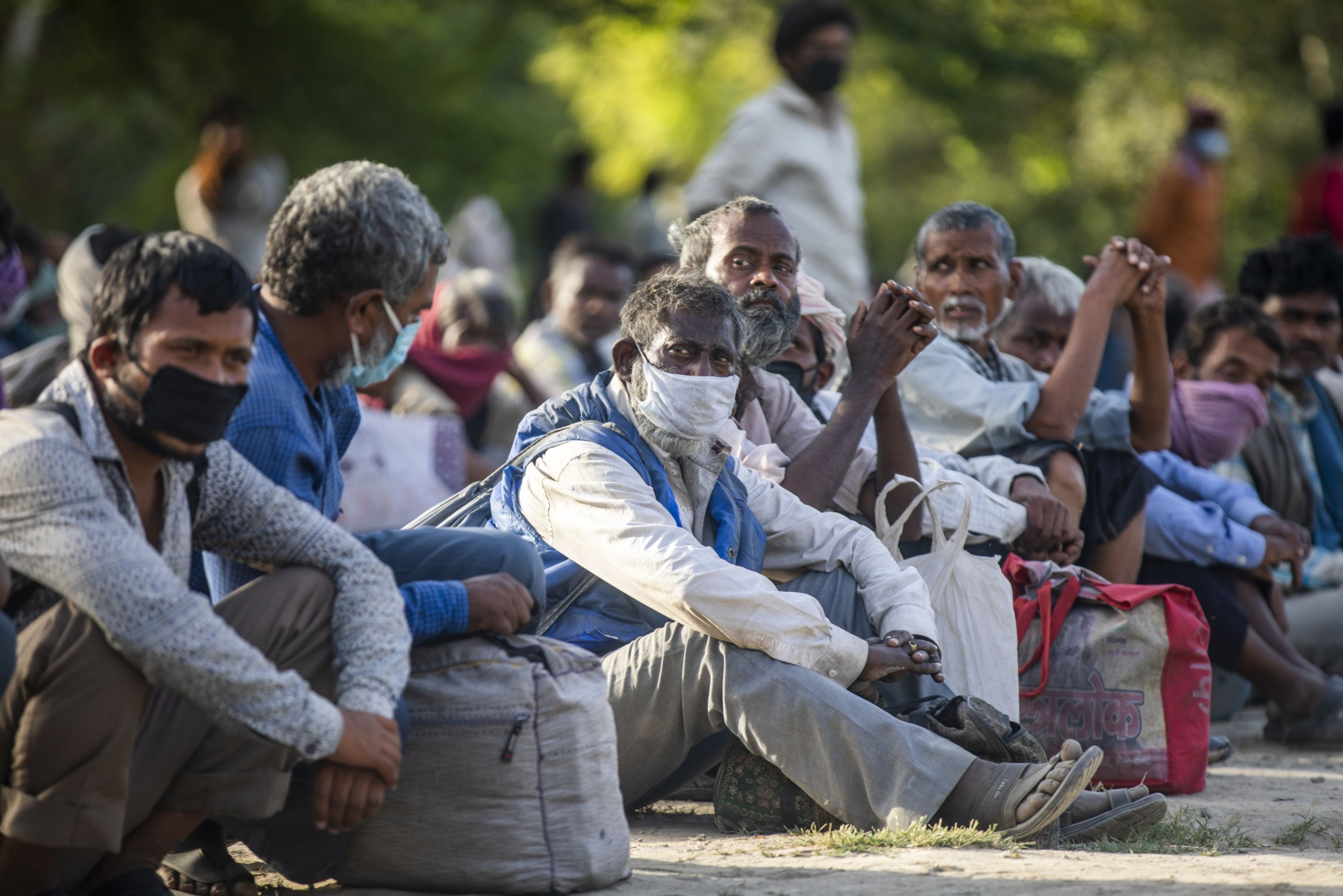
Sudhir Paswan, 29, is back to square one--in his village in Bihar's Muzaffarpur district, counting his losses. It has been more than a week since he returned, after failing to secure a job in Delhi. A labourer who loaded and unloaded goods in Delhi's Okhla Industrial Area, he would earn between Rs 200 and Rs 700 a day. "Since the lockdown, there was no work and access to food and essentials became difficult. I had to leave the city," he said. Over 800,000 migrants left India's capital, for instance, for their hometowns in 2021. Paswan is just one of them.
Jobs have been hit harder since the lockdowns of 2021, put in place to control the second wave of Covid-19. May has shown double-digit unemployment figures, said Mahesh Vyas, chief executive officer of Centre for Monitoring Indian Economy, a think-tank. "More than 97% of India's population became poorer compared to where they were in terms of income," he said. Its effect on the informal sector, which had barely recovered from the effect of the first lockdown in 2020, has been debilitating.
Paswan returned home with his wife and their ailing three-year-old son, whose treatment at the All India Institute of Medical Sciences they had to discontinue midway. They had to borrow money from family and friends for their train journey.
Like Paswan, Rabiya (she uses one name), a 35-year-old single mother of three from Kanpur, who has been working in Gurugram, is struggling to make ends meet. She had been earning Rs 7,000 at a facility manufacturing motorcycle parts when work came to a halt with the April 2021 lockdown. She now gets work only if there is a need to clean machine parts at the facility.
Besides job precarity, the migrant workforce is facing another grim reality--hunger. Rabiya's ration card to access subsidised foodgrains has not been active since she moved from Uttar Pradesh to the National Capital Region nearly three years ago. "I have no family support and need rations to feed my children. It is becoming difficult to get by," she said.
None of the migrant workers IndiaSpend spoke to had ration cards with them--their cards were with their families in their villages or hometowns. "I left the card with my parents who stay in the village," said Gobardhan Adivasi, a mason from Tikamgrah in Madhya Pradesh, who works in Faridabad. "By the time we finish work in the evening, we have to buy dry rations in black because of the lockdown." His contractor owed him money for three days' work, he complained.
Every state in India has announced mini-lockdowns or extended them to curb the rise of record infections in the country. The current lockdowns have been tougher for migrant workers compared to last year's all-India lockdown, workers in Delhi-NCR told IndiaSpend--months of unemployment in 2020 had left them with little or no savings, and now jobs are scarce and living costs have rocketed.
The number of Indians reporting less than the national floor-level minimum wage of Rs 375 increased by 230 million due to the pandemic. The Stranded Workers Action Network, with a presence across the country, has been running a helpline to support stranded migrants since March 2020. Nearly 58% of the roughly 5,000 workers who called the helpline, for whom data were available, said their families had less than two days of ration left; more than half said they had less than Rs 100 in their pockets, according to SWAN's analysis.
As India reports a record number of Covid-19 cases and deaths, the migrant crisis has continued. The story is the same across the country--of workers struggling to return to their home states, their inability to access adequate and often basic food essentials in cities where they work, and coping with a fall in income, activists and researchers told IndiaSpend.
No work, no savings
"I am trying to get work, but there are no jobs," said Rakesh (he uses one name), 29, a migrant from Bihar who has been a construction worker in Delhi. Before the lockdown, he would earn Rs 350 a day. Job losses and the struggle to recover them were more for younger workers, and women, IndiaSpend reported in January 2021. Although employment rates recovered, the quality of employment deteriorated, with individuals moving into less secure self-employment in agriculture, construction and small-scale trade, the report had noted.
Rakesh rents a room for Rs 3,200 a month for his family of four. NGOs have been helping him buy food supplies. But the situation is not tenable. "I did not go back during the national lockdown last year because I had some savings. This time when I want to go back home, I do not have any money to buy train tickets."
"Migrant workers have been left to fend for themselves more during this lockdown than last year," Shreya Ghosh, an activist with the pan-India Migrant Workers Solidarity Network, told IndiaSpend. Unlike last year when there were trains and relief measures, workers seem to be left on their own despite Supreme Court orders to ensure support for them, she added.
"Last time there were Shramik trains, but this time there is nothing of that nature," said Benoy Peter, executive director of Centre for Migration and Inclusive Development, a Kerala-based non-profit. Many migrants went back with their families, but returned alone because of the fear of disease and lack of relief measures.
On May 20, 93% of 221 workers in NCR who called SWAN's helpline (1,260 migrants and families) reported that both daily and contractual work has stopped due to locally declared lockdowns; 59% of workers said they had not received their full wages for the previous month, and only 9% had received any money from their employer since the work had stopped.
India's labour force participation--that is, the number of people working or looking for employment--shrank by 1.1 million in April 2021 to 424.6 million compared to 425.8 million in March 2021, according to a May 10 CMIE report. "In spite of this smaller labour force looking for employment, a greater proportion failed to find employment [in these two months]," it said. The unemployment rate increased by 1.5 percentage points to 8% over the month in April, said the report.
Second round more crippling
With lesser work available since the national lockdown, workers' savings have been depleted, said Ghosh. "They were paying back debt from the last lockdown, which also included a backlog of rent."
The impact of the second wave is likely to be more serious because people have not yet recovered from the first wave's impact, scholars at the Centre for Sustainable Employment believe. This is cause for concern. The Indian middle class was estimated to have shrunk by 32 million in 2020 as a consequence of the pandemic-related economic slowdown, a Pew Research Center analysis of March 2021 had found.
"Unfortunately, its lessons have not been learnt," Rajendran Narayanan, economist, Azim Premji University told IndiaSpend, recalling the widespread distress witnessed due to the national lockdown. Government accountability is central for a rights-based approach to work, and shying away due to lack of administrative capacity is at odds with the stated objective of developing a rights-based approach, he added.
The issue of dry rations
"Last year we got some cash and rations from some NGOs and friends. But this time I could not get any support from them or from the government," said Paswan. People who hold permanent jobs can still earn even if there is a lockdown, but a daily wage earner like him cannot, he added.
Migrant welfare groups such as SWAN and MWSN had written to the Centre and the state governments warning of food insecurity and demanding that they ensure rations for migrants including those who do not have public distribution system cards or ration cards, as per May 13 and May 24 Supreme Court orders. The Court asked states to file affidavits, "indicating the mechanism by which the dry rations should be distributed to those migrant workers, who do not possess a ration card".
MWSN has written to @PMOIndia re: yesterday's SC order on ensuring #RationForMigrantWorkers across states/UTs.
May 25, 2021
Only Union intervention can orient state govts and CSOs direction in surviving this crisis. @narendramodi @FCI_India @LabourMinistry #UniversalPDS #MigrantLivesMatter pic.twitter.com/l0HEATLrLYMWSN has received requests from more than 4,600 workers and their families asking for immediate and urgent supply of rations, according to its May 24 letter to the Delhi government. For nearly one-and-a-half months, "no measures'' have been taken to address the migrant crisis, it added.
5th week and counting.
May 18, 2021
Delhi govt's partial response is disappointing.
Registration by labour dept is not for workers but for employers and shramik helplines are helpless unless concrete relief measures are announced.
Read our full response here: pic.twitter.com/G7ZIpjJ0IGBoth Rabiya of Gururgram and Rakesh of Delhi are managing with a bare minimum of food. "These days, we eat aloo bhujiya or some potato dish or the other. We used to give our infant Cerelac, but we now just about manage to give him some milk," Rakesh said. Rabiya spends Rs 2,000 on rent and Rs 3,000 on food. She has debts to pay.
In May 2020, the Centre announced a Rs 1.7-lakh-crore ($22 billion) Pradhan Mantri Garib Kalyan Yojana relief package for the poor. This included free rations for beneficiaries under the National Food Security Act, which was extended until November. On April 23, 2021, the Centre approved allocation of additional foodgrain for beneficiaries under NFSA for May and June.
"The first wave saw some relief measures from the central government in the form of PMGKY, which was a combination of provisions, subsidies, and cash transfers," said Chitra Rawat, research assistant at India Migration Now. "The second wave, on the other hand, has not seen targeted interventions towards migrant workers."
On May 18, Delhi Chief Minister Arvind Kejriwal announced that rations would be distributed even without ration cards. Although the government announced guidelines for distribution of rations for those without cards, it did not announce when the distribution would start. The initial procurement and allocation will be made for 200,000 beneficiaries, it said. The guideline has estimated a procurement for upto 2 million probable beneficiaries. In 2020, nearly 7 million non-PDS beneficiaries were given free rations by the state government following the national lockdown.
"We don't know how that will be allocated, it seems to be on a first-come-first-serve basis," said Ghosh of MWSN. There is an apprehension over the rollout since the total number of non-ration card holders in Delhi is clearly way higher by the government's own estimates, she added.
Government policies on migration will only make a difference if implemented on the ground, said Peter of CMID, adding that NITI Aayog's draft national policy on migrant workers is still not in the public domain.
Universalise PDS and provide wage compensation
In May 2020, the Centre had announced that it would achieve 100% national portability of PDS by March 2021. "But the benefits of national portability are likely to be small. Most people want their food rations where they live, and not far away," said Jean Dreze, economist and social activist, in June 2020. "Even migrant workers will generally prefer that their ration cards be used by their families at home rather than for themselves."
"Portability is a problem," said Seema Mundoli, a SWAN volunteer in Karnataka. "When they approach a PDS shop, they are unable to access rations." Many migrant workers are single men and their names may be on their parents' cards, she added. The Karnataka government announced a Rs 1,250-crore relief package in May for farmers, workers from the unorganised sector, auto and cab drivers and street vendors, and is considering a second one to to help the unorganised sector.
"It is now certain that the health crisis will be followed by a livelihood crisis, especially for migrant workers," said Rawat.
The Right to Food campaign had demanded an immediate universalisation of the PDS of foodgrains, distribution of additional 5 kg of foodgrains per person, 1.5 kg of pulses and 800 gm cooking oil under the PDS for at least six months. Narayanan agreed that the PDS must be universalised. A wage compensation of Rs 7,000 per month for four months for every poor household must be immediately announced, he added.
This copy was published in a special arrangement with IndiaSpend.
Essential Business Intelligence, Sharp Market Insights, Practical Personal Finance Advice, Daily Fuel, Gold and Silver Prices and Latest Stories — On NDTV Profit.













%20(25).jpeg?im=FeatureCr)