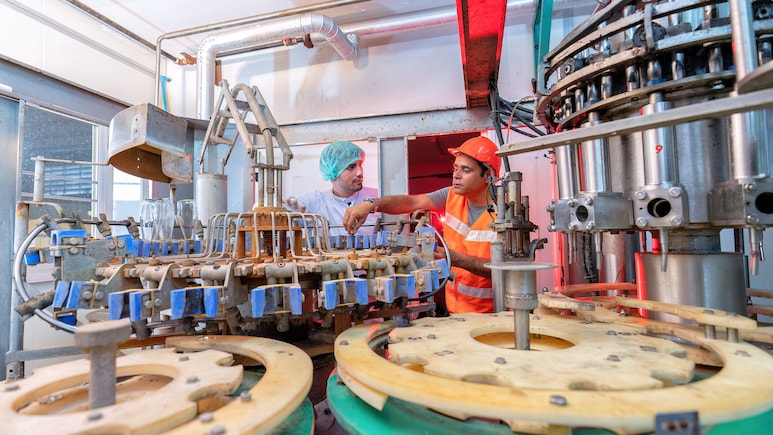
India's manufacturing sector activity witnessed mild recoveries in growth of new business intakes and production, but rates of increase were the second-weakest in nearly four years.
The seasonally adjusted HSBC India Manufacturing Purchasing Managers' Index rose from 53.9 in March to 54.7 in April, signalled the second-slowest improvement in overall operating conditions in close to four years.
HSBC India Manufacturing Purchasing Managers' Index (PMI) is a gauge of overall conditions derived from measures of new orders, output, employment, supplier delivery times and stocks of purchases.
Also Read | Layoffs Are Rising In Tech, But These Skills Are Helping People Unlock Better Pay
In the PMI parlance, a print above 50 means expansion, while a score below 50 denotes contraction.
The two largest sub-components of the PMI, new orders and output, rose since March but trailed readings seen in at least three-and-a-half years.
"India's manufacturing PMI rose to 54.7 in April, up from 53.9 in March, but still marking the second-slowest improvement in operating conditions in nearly four years," said Pranjul Bhandari, Chief India Economist at HSBC.
Survey participants indicated that advertising and demand resilience supported sales and production, but that growth was hampered by competitive conditions, the war in the Middle East and a reluctance among clients to approve pending quotes.
"Spillovers from the Middle East conflict are becoming more evident, particularly through inflation: input costs increased at the fastest pace since August 2022, and output prices rose at the quickest rate in six months," Bhandari said, adding that "output, new orders (including exports) and employment all grew moderately, pointing to continued resilience in India's manufacturing sector." Meanwhile, new export orders expanded sharply at the start of the first fiscal quarter, with the pace of growth reaching a 7-month high. Firms noted better demand from clients in several countries, including Australia, France, Japan, Kenya, mainland China, Saudi Arabia, the UAE and the UK.
ALSO READ: Auto Sector Faces Rs 25,000 Crore Hit For FY26 On End-of-life Vehicle Rule
On the price front, companies continued to indicate that the war in the Middle East exerted upward pressure on inflation. Input costs and output charges rose at the quickest rates in 44 and six months respectively.
Amid reports of higher prices for aluminium, chemicals, electrical components, fuel, leather, petroleum products and rubber, average cost burdens rose further in April. Panellists often attributed hikes to the Middle East war.
The overall rate of inflation climbed to its highest in August 2022. Subsequently, goods producers lifted their fees to the greatest extent in six months, the survey noted.
In terms of employment, despite only a marginal increase in outstanding business volumes, manufacturers recruited additional workers at the start of the first fiscal quarter. Moreover, the rate of job creation was marked and the strongest in ten months.
Indian manufacturers remained optimistic towards growth prospects. However, the overall level of positive sentiment slipped since March. Confidence was pinned on hopes that marketing efforts would bear fruit and that pending projects would be approved.
The HSBC India Manufacturing PMI is compiled by S&P Global from responses to questionnaires sent to purchasing managers in a panel of around 400 manufacturers.
ALSO READ: Gold And Silver Likely To Be Range Bound Due To US-Iran War, Macroeconomic Data, Analysts Say
Essential Business Intelligence, Sharp Market Insights, Practical Personal Finance Advice, Daily Fuel, Gold and Silver Prices and Latest Stories — On NDTV Profit.