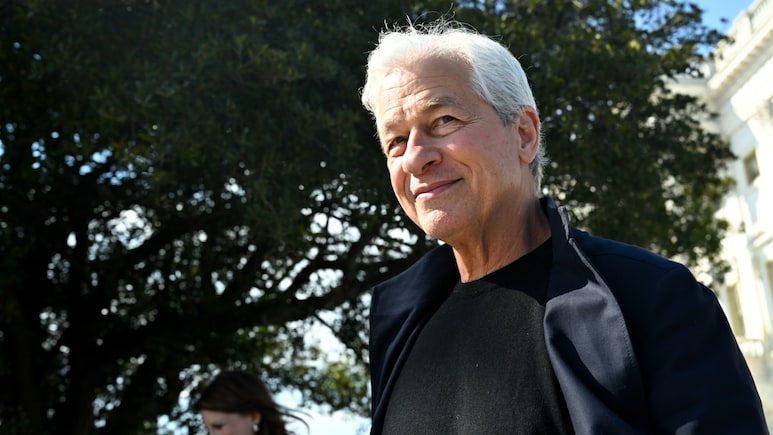
JPMorgan Chase & Co. Chief Executive Officer Jamie Dimon said the US needs to “get stronger” in order to maintain its military and economic might, and detailed his bank's plans to deploy more than $1 trillion to ensure that happens.
“With the right policies and committed actions, the United States will maintain the strongest military and strongest economy and will remain the bastion of freedom and the arsenal of democracy,” Dimon wrote in a letter to shareholders Monday. But “no country has a divine right to success.”
Dimon's latest remarks follow JPMorgan's launch of the second of a pair of initiatives to tackle big-picture policy issues. The bank unveiled an “American Dream Initiative” last week, which is aimed at expanding economic opportunity in local communities in the US. That followed a “Security and Resiliency Initiative” announced in October, through which JPMorgan vowed to plow $1.5 trillion into industries that bolster US economic security and resiliency over the next decade.
Also Read | Layoffs Are Rising In Tech, But These Skills Are Helping People Unlock Better Pay
The moves also mark a new chapter in Dimon's stewardship of JPMorgan. His interest in policy is well-known, and speculation that he might jump to Washington for a government role has brewed for decades, despite never panning out. Now, Dimon is pursuing his own kind of policy agenda from atop the bank he's run for more than 20 years.
“We have a responsibility to help shape the right policies, not just for our company but for the country and the world,” Dimon wrote. “Many companies will only thrive if their countries thrive.”
Dimon, who turned 70 last month, has built JPMorgan into America's biggest and most profitable US bank and has become the industry's elder statesman along the way. His closely-read annual letters have veered increasingly into policy matters beyond those directly impacting banking.
In this year's missive, which totals 48 pages including footnotes, the longest section is the one titled “Critical Issues Facing America and the World.”
Among those issues are conflicts across the globe that “should permanently dispel the illusion that the world is safe,” he said.
Dimon has for years been warning about geopolitical risk, repeatedly saying it dwarfs any other concern throughout his career. The war in Iran risks future oil and commodity price shocks, and “time will tell” whether it achieves short- and long-term goals in the region, he wrote.
Europe, which America needs to succeed, is “currently on a bad path,” Dimon wrote. He reiterated a call for “one big, beautiful free trade agreement with all of Europe,” in exchange for economic and military reforms.
ALSO READ: US Request Prompts Planet Labs To Withhold Iran War Images
Private Credit
Also in his shareholder letter, Dimon included private credit among a list of potential risks on the horizon. Last year, the JPMorgan CEO warned that some emerging credit losses likely signaled a risk of more cockroaches in the system.
High-profile collapses and frauds, as well as fears about artificial intelligence disrupting software companies, have continued to sting direct lenders in recent months. That's led investors to seek to pull more money from funds overseen by asset managers including Blue Owl Capital Inc.
Dimon said private credit “probably does not” pose a systemic risk. But he cautioned that losses on leveraged lending will be higher-than-expected in part because of “modestly” weakened credit standards.
“By and large, private credit does not tend to have great transparency or rigorous valuation ‘marks' of their loans — this increases the chance that people will sell if they think the environment will get worse — even if actual realized losses barely change,” he said.
He also expressed some apprehension about the private equity industry, saying that it's a “little surprising” that the alternative asset managers didn't seize as much on healthy markets to take more of their companies public. Instead, some have been moved to continuation funds, he said.
“Private equity investments are now held for an average of seven years — this is virtually double what it used to be,” he said. “We have generally had nothing but a bull market since the great financial crisis — it's hard to imagine what will happen if and when we have an extended bear market.”
Other highlights from the letter:
He wrote that cities need to remain competitive. New York City has “much going for it,” but also has high taxes. Dimon noted that JPMorgan has fewer people working in New York City than it did a decade ago, while the bank has boosted its headcount in Texas. “This trend will likely continue,” he said.
The pace of AI adoption is likely to be “far faster” than other technological improvements such as electricity or the internet, he said. “We will not put our heads in the sand,” he said about JPMorgan reacting to AI.
Dimon said the bank's reaction to a recent package of capital proposals from regulators was “mixed,” saying that there were still parts that were “frankly nonsensical.”
(This story has not been edited by NDTV staff and is auto-generated from a syndicated feed.)
Essential Business Intelligence, Sharp Market Insights, Practical Personal Finance Advice, Daily Fuel, Gold and Silver Prices and Latest Stories — On NDTV Profit.