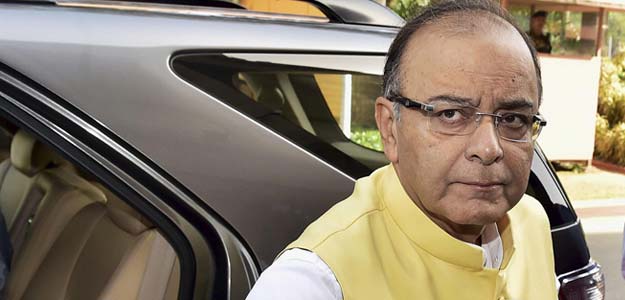
Finance Minister Arun Jaitley is staring at a big revenue shortfall as the government again misses an unrealistic target for raising cash from selling off state assets.
New Delhi: Finance Minister Arun Jaitley wants to present a credible Budget this month with realistic targets for tax revenues and asset sales, people involved in the process say, but businesses may end up picking up much of the tab.
Mr Jaitley is staring at a big revenue shortfall as the government again misses an unrealistic target for raising cash from selling off state assets, while sliding commodity prices and exports have dented revenues.
Prime Minister Narendra Modi has questioned whether businesses should continue to benefit from tax "incentives" worth Rs 62,400 crore ($9.2 billion) that he described as subsidies in all but name.
"My aim is not to eliminate subsidies, but to rationalise and target them," PM Modi said in a keynote speech last week.
Those familiar with the Budget process said Mr Jaitley may pare tax breaks on capital investment, research and development, and projects in under-developed regions. As of now, the government is not considering raising its deficit target.
They declined to estimate how much those measures would raise, but one said they would more than offset revenue losses from cuts in India's corporate income tax announced a year ago.
Then, Mr Jaitley promised to bring down the tax to 25 per cent from 30 per cent over four years, pruning exemptions as he goes.
Businesses have hailed the promised tax cuts but they, and their advisers, say closing loopholes too aggressively would hamper PM Modi's 'Make in India' drive to attract foreign investors and boost export industries.
"If Mr Modi is talking about Make in India, it has to be the foreign multinational companies setting up manufacturing facilities in India and using it as an export hub like China," said Rahul Mitra, a tax partner at KPMG. "If you want to do that you can't wish away the necessary exemptions for exports."
The statutory burden of all taxes on the typical Indian company is about 34 per cent. That's relatively high by international standards, but tax breaks bring the effective rate down to 23 per cent.
Getting the balance right will be key for Mr Jaitley even though, as a Reuters poll of economists shows, financial markets would give him a free pass if he backslides a bit on next year's deficit goal of 3.5 per cent of GDP.
Mr Jaitley may set an economic growth target of 7.5 to 8 per cent for the fiscal year starting in April, an official said, while the asset-sale target could be halved to some Rs 35,000 crore ($5.17 billion).
Putting the brakes on tax breaks
The corporate income tax breaks make up a relatively small part of $80 billion in business giveaways, the lion's share of which comes from incentives on customs and excise duties.
"With unsatisfactory growth in tax receipts, the Finance Minister doesn't have much choice except to cut most corporate tax exemptions," said another official who, like his colleague, was not authorised to speak on the record.
To give one example, the government estimates that a tax break on capital depreciation cost it Rs 37,000 crore ($5.47 billion) in revenues in the last fiscal year.
In some cases, companies, particularly those in IT, pharmaceuticals and some manufacturing sectors, get exemptions of up to 200 per cent on the sum invested. That could be scaled back to 60 per cent.
Mr Jaitley could also put a "sunset clause" on tax exemptions where there is now no timeline, while allowing others to die a natural death, the sources said.
A delegation of industrial chambers met Mr Jaitley last month and asked him to balance cuts in tax exemptions with lower tax rates.
Tax experts doubt PM Modi would turn hostile on business, not least because he has just launched a "Start-up India" drive backed by a state fund and three-year exemptions from tax and compliance checks.
"The corporate tax cut is more of a 'feel good, look good, India's open for business and we mean it' exercise," said Rohinton Sidhwa, a tax partner at Deloitte.
"I'm pretty certain the Finance Minister will attempt to make the cut as cash-neutral as possible."
($1 = Rs 67.6800)
Mr Jaitley is staring at a big revenue shortfall as the government again misses an unrealistic target for raising cash from selling off state assets, while sliding commodity prices and exports have dented revenues.
Prime Minister Narendra Modi has questioned whether businesses should continue to benefit from tax "incentives" worth Rs 62,400 crore ($9.2 billion) that he described as subsidies in all but name.
"My aim is not to eliminate subsidies, but to rationalise and target them," PM Modi said in a keynote speech last week.
Those familiar with the Budget process said Mr Jaitley may pare tax breaks on capital investment, research and development, and projects in under-developed regions. As of now, the government is not considering raising its deficit target.
They declined to estimate how much those measures would raise, but one said they would more than offset revenue losses from cuts in India's corporate income tax announced a year ago.
Then, Mr Jaitley promised to bring down the tax to 25 per cent from 30 per cent over four years, pruning exemptions as he goes.
Businesses have hailed the promised tax cuts but they, and their advisers, say closing loopholes too aggressively would hamper PM Modi's 'Make in India' drive to attract foreign investors and boost export industries.
"If Mr Modi is talking about Make in India, it has to be the foreign multinational companies setting up manufacturing facilities in India and using it as an export hub like China," said Rahul Mitra, a tax partner at KPMG. "If you want to do that you can't wish away the necessary exemptions for exports."
The statutory burden of all taxes on the typical Indian company is about 34 per cent. That's relatively high by international standards, but tax breaks bring the effective rate down to 23 per cent.
Getting the balance right will be key for Mr Jaitley even though, as a Reuters poll of economists shows, financial markets would give him a free pass if he backslides a bit on next year's deficit goal of 3.5 per cent of GDP.
Mr Jaitley may set an economic growth target of 7.5 to 8 per cent for the fiscal year starting in April, an official said, while the asset-sale target could be halved to some Rs 35,000 crore ($5.17 billion).
Putting the brakes on tax breaks
The corporate income tax breaks make up a relatively small part of $80 billion in business giveaways, the lion's share of which comes from incentives on customs and excise duties.
"With unsatisfactory growth in tax receipts, the Finance Minister doesn't have much choice except to cut most corporate tax exemptions," said another official who, like his colleague, was not authorised to speak on the record.
To give one example, the government estimates that a tax break on capital depreciation cost it Rs 37,000 crore ($5.47 billion) in revenues in the last fiscal year.
In some cases, companies, particularly those in IT, pharmaceuticals and some manufacturing sectors, get exemptions of up to 200 per cent on the sum invested. That could be scaled back to 60 per cent.
Mr Jaitley could also put a "sunset clause" on tax exemptions where there is now no timeline, while allowing others to die a natural death, the sources said.
A delegation of industrial chambers met Mr Jaitley last month and asked him to balance cuts in tax exemptions with lower tax rates.
Tax experts doubt PM Modi would turn hostile on business, not least because he has just launched a "Start-up India" drive backed by a state fund and three-year exemptions from tax and compliance checks.
"The corporate tax cut is more of a 'feel good, look good, India's open for business and we mean it' exercise," said Rohinton Sidhwa, a tax partner at Deloitte.
"I'm pretty certain the Finance Minister will attempt to make the cut as cash-neutral as possible."
($1 = Rs 67.6800)
© Thomson Reuters 2016
Essential Business Intelligence, Sharp Market Insights, Practical Personal Finance Advice, Daily Fuel, Gold and Silver Prices and Latest Stories — On NDTV Profit.