
(Bloomberg Opinion) -- Would you trust an 80-year-old driver with your life on some of the developed world's most complex streets?
If you're one of the millions visiting Tokyo, you might have to, if a plan to raise the age limit for taxi drivers by five years from the current 75 proceeds. But if the idea of a cabdriver in their ninth decade gives you pause, you're not alone: The discussion has met with criticism even in the typically elder-friendly local media, coming after years of programs encouraging older motorists to return their licenses amid an increase in accidents.
The talks indicate the need for increasingly radical suggestions to deal with a labor crunch that is hitting Japan's services sector especially hard. As the economy has rebounded from Covid-19, the last of the slack in the jobs market has vanished. Over half of the country's businesses say they can't find enough full-time staff.
Taxis, already dependent on older workers, are particularly hamstrung. The number of drivers in Japan has fallen 20% since 2019. In fact, many are already over 75 years old; the government limit applies only to privately owned vehicles, with cab companies free to set their own retirement ages. Lifting a longstanding ban on ride-sharing is also on the cards.
And it's not just cabs that are struggling. Perhaps closer to home for Tokyo's business travelers, Central Japan Railway Co.'s Shinkansen bullet train will soon end food-cart sales, a staple for any traveling workers, long used to relaxing over coffee, beer or the train's famously hard-frozen ice cream . Citing a staff shortage, the wagon sales will conclude this month, with riders encouraged to stock up before embarking (the Shinkansen has no dining car; only passengers on the luxury “green cars” will be able to order snacks to their seat from their smartphones).
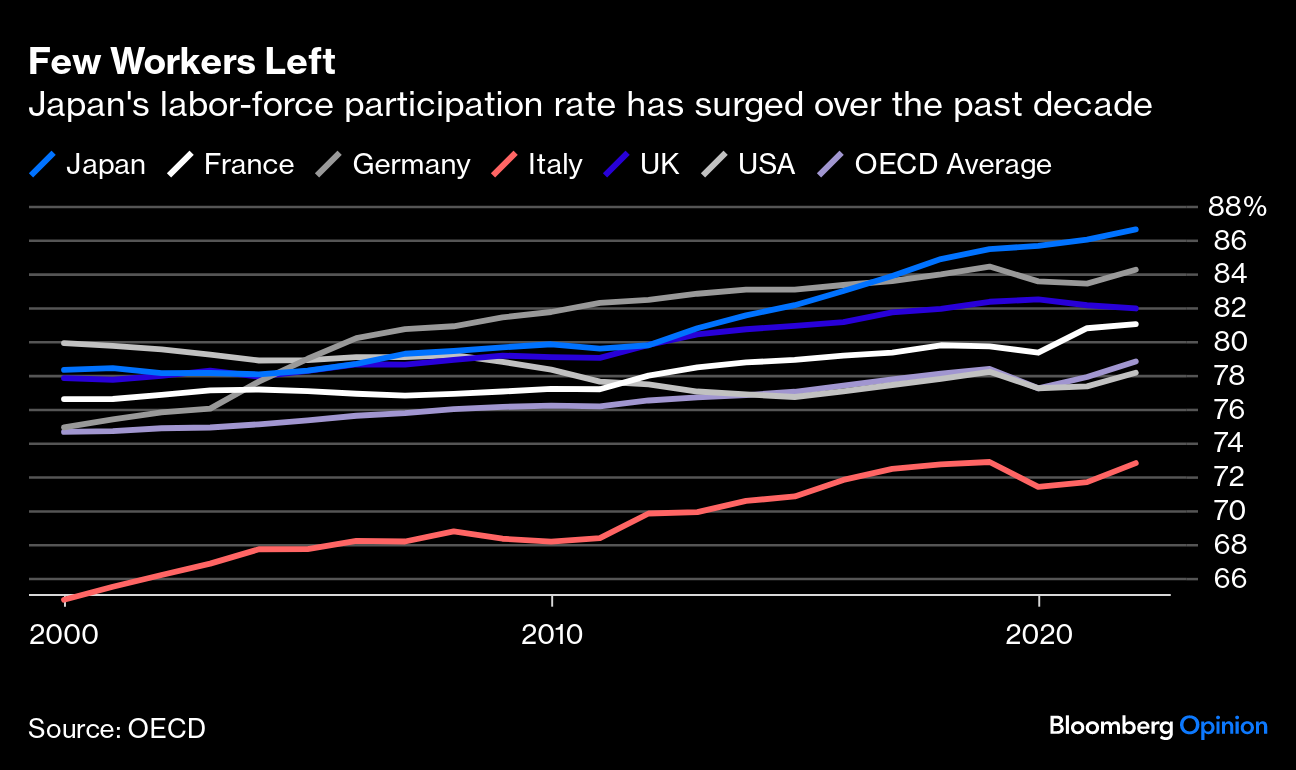
These are just some of the shocks coming in a country where one in 10 people is now over 80. Though the working-age population has been declining for some time, Japan has coped by tapping previously ignored resources, most notably women. But those easy gains are gone; the country now has one of the highest labor-participation rates globally. Nearly 87% of the working-age populace is employed, well above the 79% average of countries in the Organization for Economic Cooperation & Development.
An aging society would seem to inevitably lead to declining economic strength. But intriguingly, some see opportunity in this historic shift from too much supply to a surplus of demand. The longtime Japan watcher and economist Jesper Koll sees the shortage leading to a new “golden age” in which full-time jobs replace irregular youth employment, with wage increases and opportunities accruing to the younger generation.
Junichi Makino, the chief economist at SMBC Nikko Securities Inc., expects the higher labor costs that will inevitably result to spur company investment in raising Japan's unusually low labor productivity and lift economic growth.
“Over the past 20 years, economic actors in Japan have moved to reduce wages and employment and curb capex amid a deflationary environment,” Makino writes. “From here though, Japan is set for a macro environment of insufficient supply, which will require more capex to bridge the gap, and we expect this to be an engine for economic growth to accelerate again.”
That optimistic outcome depends on the country finding solutions. One of the most pressing issues is what's being referred to as the “2024 Problem” — a looming logistics crisis that could hit next year, when regulations limiting overtime hours in the already stretched trucking industry will come into effect. Estimates say it could result in a 14% drop in transportable cargo by 2025, ballooning to 34% by 2030.
The government is scrambling for solutions, including cutting wasteful journeys by encouraging customers to avoid deliveries when no-one is home. Everything is on the table: The types of jobs that the country's increasing number of foreign workers can take are being expanded, with bus drivers possibly next to be added. Self-driving cars and other automated solutions are being proposed. But not every industry has such easy productivity gains. Japan's Self-Defense Forces, which require levels of manpower that can't be met through immigration, missed its recruiting goal for the last fiscal year by more than half.
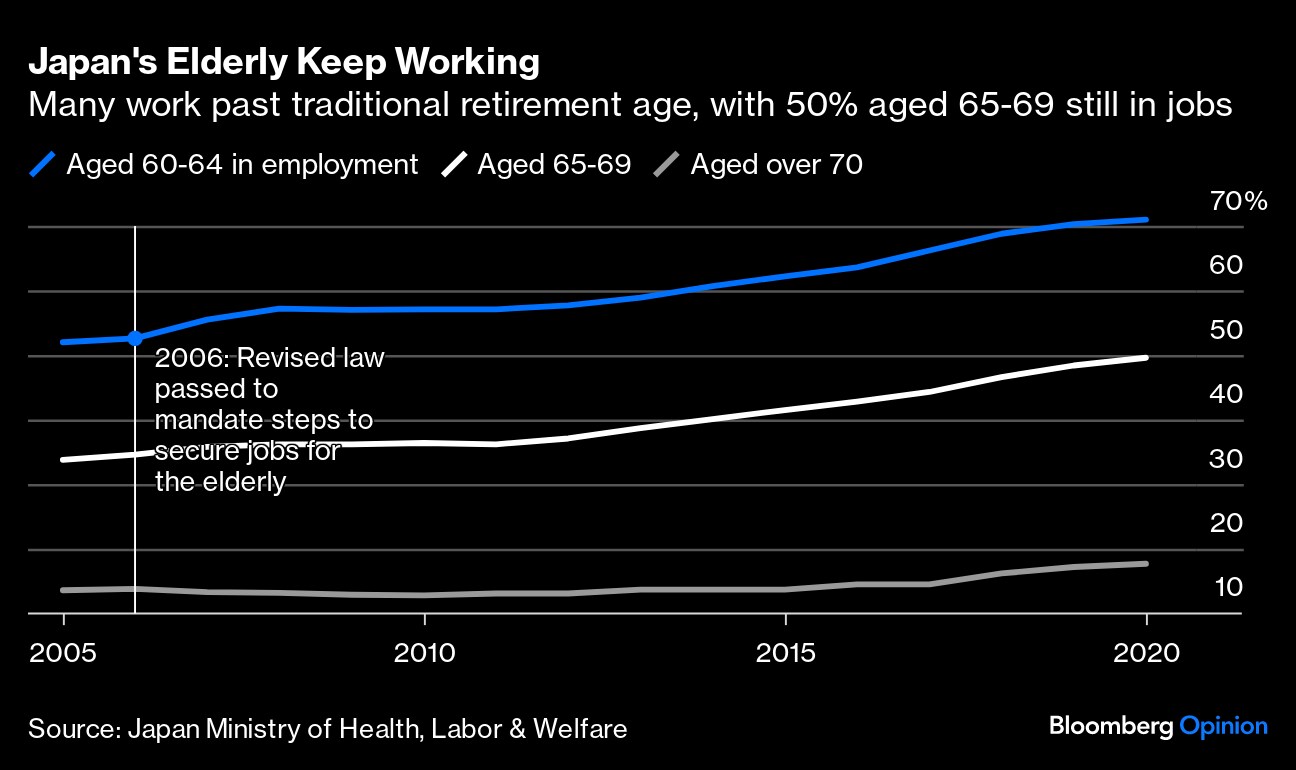
The simplest option for many industries might be what the taxi sector is doing — keeping people in the workforce longer. Japan already employs more elderly than almost any other country, with about 50% of those age 65 to 69 working, a figure that's up from just a third in 2005.
Clearly, there's more to do. Despite government efforts to encourage companies to lift the retirement age, some 70% of firms still enforce it at 60, the lowest legally allowed, giving the average Japanese man some 21 years still to live, and the average woman 27 years. This is often a cynical cost-saving move: Workers who retire are often immediately rehired on lower-cost, part-time contracts.
And many say they want to continue working. While it's tricky to separate those who to carry on working for its own sake from those who feel they to due to a lack of savings, it's clear that most at least want the . In a 2019 survey by Japan's largest labor union, 71% approved of government steps to enable those who want to stay on until 70.
Nearly 60% of those in the 65-to-69 bracket who continued to work cited “maintaining their health” as a rationale — higher than any other age group. Local press recently profiled the country's oldest worker at a McDonald's Holding Co. Japan Ltd. outlet, a job often typically associated with teenagers. He's 95, and intends to stay on until he's 100, citing his desire to stay active.
Not everyone will be lovin' the idea of spending their golden years cleaning up french fries. With Japan at the forefront of dealing with an aging population — a change coming soon to the rest of the developed world — how the country copes bears close attention. Like the passenger in a cab driven by an octogenarian — don't take your eyes off this one.
More From Bloomberg Opinion:
-
Begging Companies to Hike Wages Is Not the Answer: Gearoid Reidy
-
Exploiting Child Labor Won't Make America Great: Kathryn Edwards
-
End of Growth in Working-Age Population Has Upsides: Justin Fox
This column does not necessarily reflect the opinion of the editorial board or Bloomberg LP and its owners.
Gearoid Reidy is a Bloomberg Opinion columnist covering Japan and the Koreas. He previously led the breaking news team in North Asia, and was the Tokyo deputy bureau chief.
More stories like this are available on bloomberg.com/opinion
©2023 Bloomberg L.P.
Essential Business Intelligence, Continuous LIVE TV, Sharp Market Insights, Practical Personal Finance Advice and Latest Stories — On NDTV Profit.