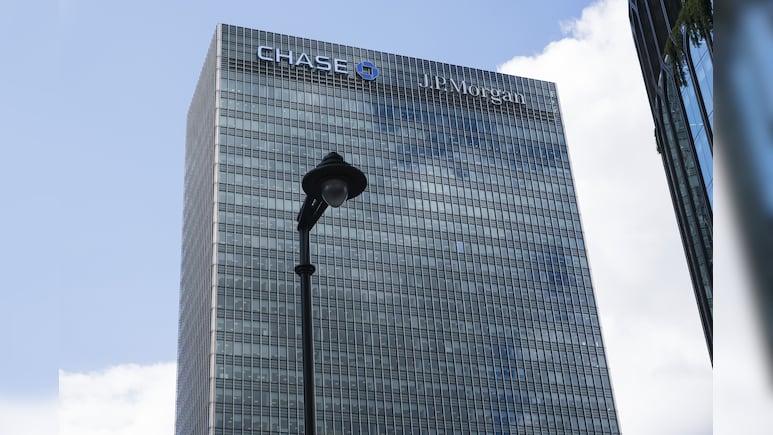
As investors increasingly turn to artificial intelligence for help with everything from stock picking to risk management, JPMorgan Chase & Co. has been testing whether a model can do something more ambitious: allocate money itself.
The early results are encouraging. Researchers at the bank built an array of AI-powered investing agents that shift between stocks and bonds depending on changing market conditions. In backtests spanning the past two decades, the best-performing system topped a traditional 60/40 portfolio — 60% in stocks and 40% in bonds — by 0.7 percentage point a year with lower volatility, while also beating JPMorgan's own rules-based market regime model, according to strategists led by Thomas Salopek.
The results come with an important caveat. They are based on historical simulations rather than live investing, and JPMorgan warns against treating them as proof that AI can consistently outperform markets. Still, it's a sign of things to come as the boom in automated trading shows little sign of slowing.
“The AI agent can be set up with a process to be empowered to make decisions under uncertainty, producing outperformance vs a reasonable benchmark,” the strategists wrote in a note Thursday, describing the work as the firm's first attempt to build an AI system for identifying market regimes.
The experiment offers an early glimpse of Wall Street's next phase of AI adoption. Banks have spent the past two years embedding large language models into research, coding and internal investing tools. Increasingly, they are testing whether those same systems can move beyond assisting workers to making one of the industry's most consequential decisions: how to allocate capital across markets.
As a leader in Wall Street's relentless drive to leverage technology breakthroughs for an investing edge in today's rapidly evolving markets, JPMorgan has capitalized on this momentum by deploying large language models to build thematic baskets and integrating these tools across its internal investing platform.
The findings come as a growing body of academic research raises questions about what happens if everyone turns to similar AI models to make investment decisions. While the technology may make investors faster and better informed, researchers have warned it could also produce more crowded trades, make markets easier to manipulate and amplify periods of stress if too many firms reach similar conclusions.
ALSO READ: SK Hynix ADRs Shoot 17% After Nasdaq Debut As Investors Raise Bet On Memory Chip Giant
The JPMorgan strategists also acknowledged such risks.
“We strongly caution against uncritically accepting what amounts to in-sample, overly confident answers of AI,” they wrote. “Agentic AI needs to be grounded in a well thought-out asset allocation process, rather than naively assuming the agent can be the source of the domain knowledge.”
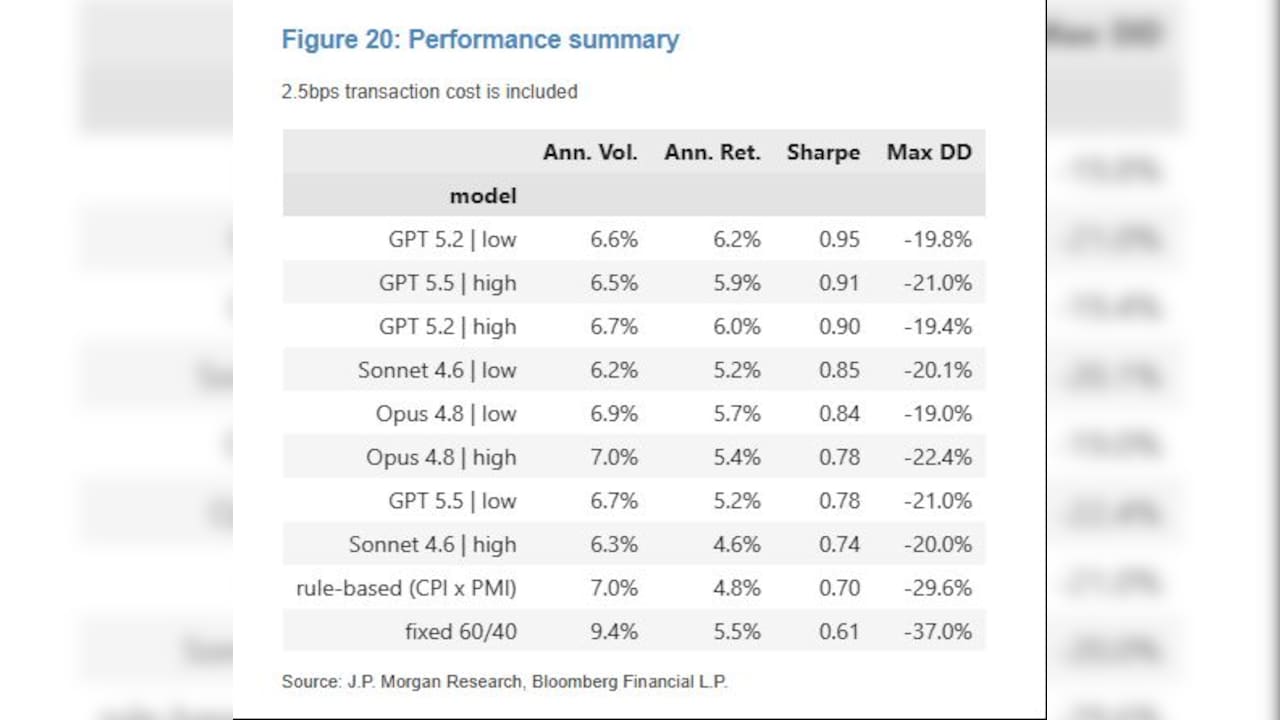
Photo Credit: Bloomberg
Still, the findings add to a growing body of evidence suggesting AI can perform increasingly sophisticated investment tasks. Using agents powered by models from OpenAI and Anthropic, the JPMorgan team designed a system that classifies the market into four regimes based on growth and inflation: Goldilocks, reflation, stagflation and risk-off.
The AI agents were then tasked with deciding how to allocate money across asset classes in each environment — favoring equities during periods of strong growth, for example, and increasing fixed-income exposure as the outlook deteriorated.
All eight of the AI agents tested outperformed the traditional 60/40 portfolio on a risk-adjusted basis. They also beat JPMorgan's existing rules-based market regime model, suggesting the technology was able to improve on a framework already used to guide asset-allocation decisions.
“We are enthusiastic about the possibilities of agentic AI, even as we are wary to hand off asset allocation decision-making to an agent,” Salopek and his colleagues wrote.
(This story has not been edited by NDTV staff and is auto-generated from a syndicated feed.)
Essential Business Intelligence, Sharp Market Insights, Practical Personal Finance Advice, Daily Fuel, Gold and Silver Prices and Latest Stories — On NDTV Profit.











%20India%20Aviation,%20aeroplane,%20aircraft%20(6).jpeg?im=FeatureCrop,algorithm=dnn,width=350,height=197)