(Bloomberg Opinion) -- A rebound in bookings and flights has the aviation industry closely watching the ratio of seats being filled, a crucial measure of demand and a guide to profitability. Yet an equally consequential number will need to be tracked if we're to understand whether the sector has truly recovered from the Covid epidemic.
Passenger load factor, a commonly used measure that shows the percentage of capacity utilized, stands at 81.3% in Asia for the year through to the end of September. That's a huge jump from 69.2% a year ago, and roughly in line with the level recorded for the same period in 2019. Yet operators are running well below pre-pandemic levels, so such standard metrics don't tell the whole story, and indicate that while passengers may be returning, economic uncertainty is holding them back from taking as many flights as they used to.
Airlines around the region are being hit on multiple fronts. First, they fired so much of their workforces that many now lack enough pilots, cabin crew and ground staff to operate aircraft. Cathay Pacific Airways Ltd. says personnel levels are sufficient for its current schedule, yet it will add 4,000 people this year and needs to double the number of staff it trained last year. Carriers also parked their jets in the desert during lockdowns and are still bringing them back home to run the required checks to get the aircraft back into service.
Then there's supply-chain bottlenecks caused by the pandemic, Russia's ongoing war in Ukraine, and a shortage of staff across sectors from technology to food service. These compounding issues range from slow delivery of new planes and a recent scandal around spare parts, to catering and replacement tap fixtures.
To help gauge airline health, the industry has a slew of abbreviations. Among the most cited is revenue passenger kilometers (RPK) that multiplies the number of fare-paying commuters by the distance each person flew. The cargo equivalent is revenue ton kilometers (RTK). To chart how many an airline have flown, they use available seat kilometers (ASK) and available freight tonnage kilometers (ATK).
Aviation is among the most transparent sectors in the world, with most carriers releasing data monthly. Parsing this information we can see that rosy load-factor numbers published in recent months actually hide a deeper truth. Airlines are operating well below the levels of four years ago, but their constrained capacity artificially inflates utilization figures.
Instead, we need to track a different metric: return-to-normal that can be abbreviated as RTN. This metric tells us current seat availability as a percentage of the figure for the same period in 2019, before the pandemic.
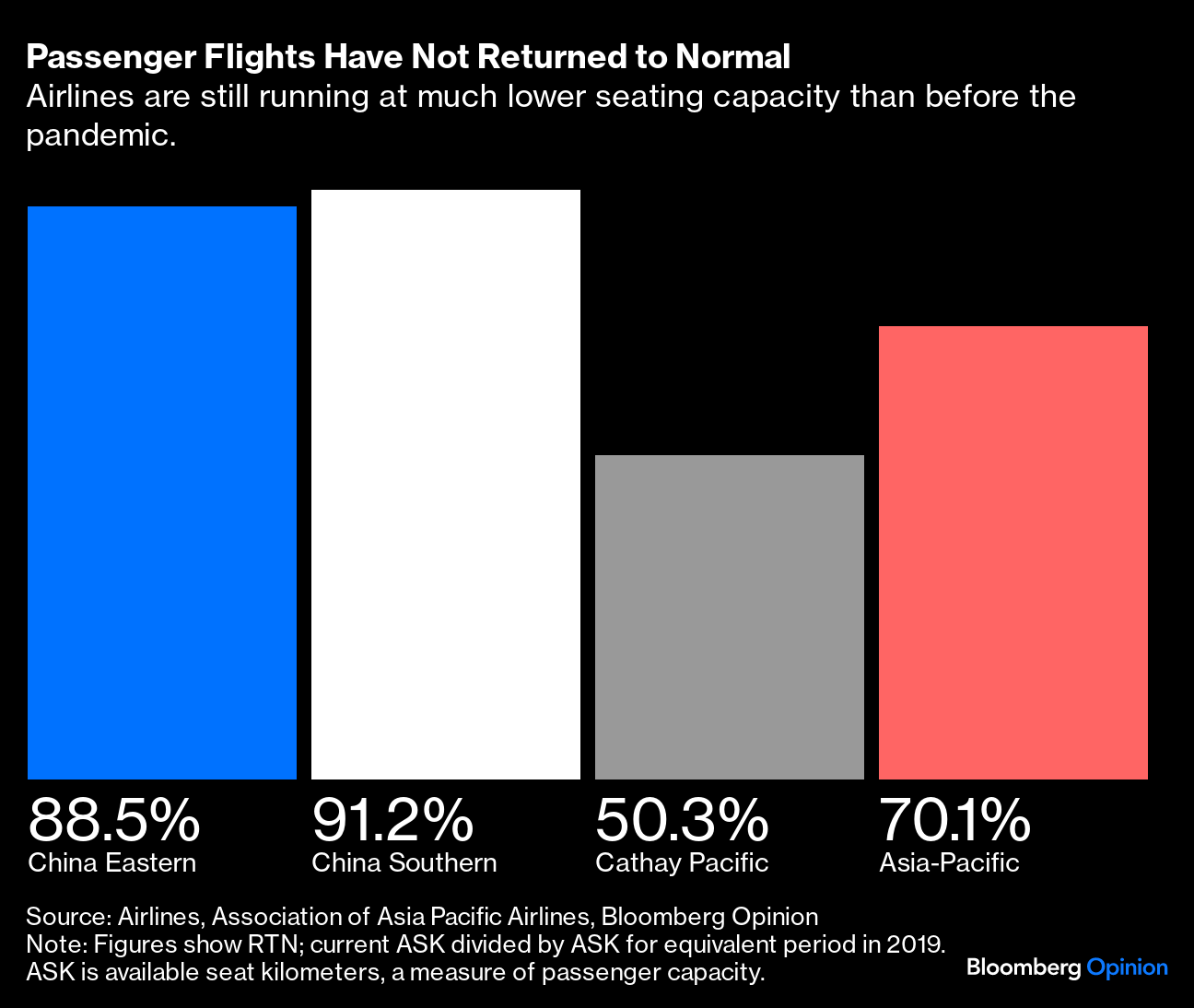
Measured on this basis, the numbers are even bleaker. China Southern Airlines Co. and China Eastern Airlines Corp., two of the region's biggest carriers by seats, are only operating at around 90% RTN. For the year through October, Cathay was running at just 50% RTN. The Hong Kong carrier expects that by December it'll operate around 70% of its pre-pandemic flights covering 80 destinations.
Across Asia, airlines are running at an average of just 70% RTN for the year through September, according to Bloomberg Opinion analysis based on data from the Association of Asia Pacific Airlines, whose members include Singapore Airlines Ltd., Cathay Pacific, Japan Airlines Co. and Taiwan's China Airlines Ltd. This means that even if airlines were running at a 100% load factor — full capacity — they're still operating 30% lower than before the pandemic.
Fewer flights mean fewer expenses. Yet fatter schedules increase the risk of empty seats that lose money on every kilometer flown. Airlines are always trying to find the perfect mix of capacity so that they can generate revenue and cover both flight costs and ground operations, without having excess seating and cargo space that could force prices down.
Right now, executives don't truly know whether the high-load factors they're running now will remain elevated when new capacity is added, or if demand for travel is already near its peak. In the past, patterns of demand were quite predictable. Festivals like Lunar New Year, Christmas and China's Golden Week boosted bookings. At other times, travelers include business executives and seasonal vacationers.
Already, we're seeing signs that things may not be returning to the old norms. Singapore Airlines, for example, isn't enjoying a rebound in corporate travel which usually fills first and business class — yet well-heeled leisure travelers are mopping up that capacity. Equally, flights between China and the US were cut drastically both by the pandemic and ongoing political friction. If capacity returns, as Presidents Xi Jinping and Joe Biden agreed this month, there's no guarantee demand will follow.
Many Western business executives have turned cold on China, while three years of closed borders proved to many companies that constant trans-Pacific travel wasn't needed. Chinese students, academics and tourists are also less enamored with the US than they were four years ago. Many will resume travel, but thousands won't. We just don't know, and that's the challenge for the aviation industry.
It's impossible to accurately assess if airlines have fully recovered from the catastrophic impact of Covid-19, and whether old travel patterns apply, until capacity returns to normal.
More From Bloomberg Opinion:
- Even the US Military Has a Fake Parts Problem: Tim Culpan
- Actually, Airplanes Aren't Crowded Enough: Brooke Sutherland
- UK Forgot the Reason Japan High-Speed Rail Works: Gearoid Reidy
This column does not necessarily reflect the opinion of the editorial board or Bloomberg LP and its owners.
Tim Culpan is a Bloomberg Opinion columnist covering technology in Asia. Previously, he was a technology reporter for Bloomberg News.
More stories like this are available on bloomberg.com/opinion
©2023 Bloomberg L.P.
Essential Business Intelligence, Continuous LIVE TV, Sharp Market Insights, Practical Personal Finance Advice and Latest Stories — On NDTV Profit.