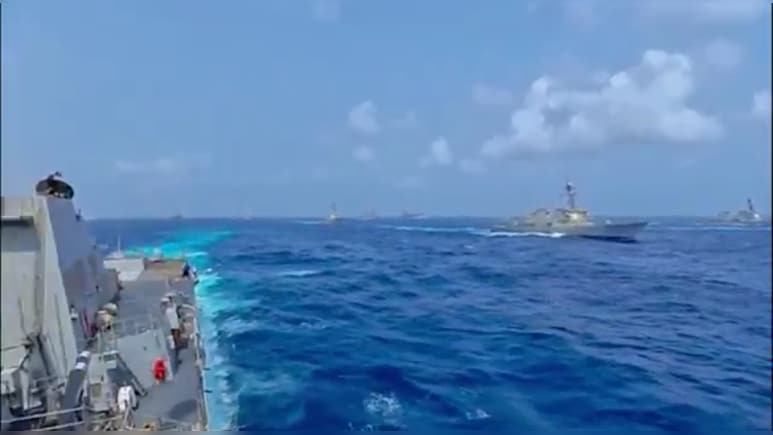
The United States launched a new wave of military strikes against Iran on Tuesday under the direction of President Donald Trump, as Washington intensified pressure on Tehran amid escalating tensions in the Gulf region.
In a statement posted on X, US Central Command (CENTCOM) said the latest wave of strikes began at 4:45 pm ET, adding that the operations would "continue imposing a heavy cost on Iranian forces and degrade their ability to attack innocent civilians and commercial shipping in the Strait of Hormuz."
At 4:45 p.m. ET today, U.S. Central Command began launching the third consecutive night of strikes against Iran, at the Commander in Chief's direction. These strikes will continue imposing a heavy cost on Iranian forces and degrade their ability to attack innocent civilians and…
Also Read | Layoffs Are Rising In Tech, But These Skills Are Helping People Unlock Better Pay
— U.S. Central Command (@CENTCOM) July 13, 2026
Shortly after the strikes were announced, Iranian state media reported explosions in the southern port city of Bandar Abbas and on the strategically located islands of Kish, Qeshm and Abu Musa.
CENTCOM also announced that it would resume its maritime blockade of vessels entering and leaving Iranian ports beginning at 4 p.m. ET on 14 July. The blockade applies to ships transiting to or from Iranian ports and coastal areas, while commercial and humanitarian vessels complying with US directives will continue to be permitted through regional waters.
— U.S. Central Command (@CENTCOM) July 13, 2026
During the previous blockade, which lasted from 13 April to 18 June, CENTCOM said it redirected more than 140 compliant vessels, disabled nine non-compliant ships, and allowed over 50 humanitarian aid vessels to pass. Mariners have been advised to monitor official navigation broadcasts while operating in the Gulf of Oman and the approaches to the Strait of Hormuz.
The latest escalation follows an Iranian missile attack on two UAE oil tankers in Omani territorial waters in the Strait of Hormuz, which the UAE Defense Ministry said killed one crew member.
ALSO READ: Stock Market Today: All You Need To Know Going Into Trade On July 14
Flight-tracking data also showed a significant US military air presence over the region as the strikes unfolded. At least a dozen aircraft, including nine KC-135R and two KC-46A aerial refuelling tankers, an E-3B Sentry Airborne Warning and Control System aircraft, and a US Navy P-8 Poseidon maritime surveillance aircraft, were operating over the Persian Gulf, the Gulf of Oman and near Saudi Arabia. The refuelling aircraft support sustained combat operations, while the E-3B provides long-range airborne surveillance capable of tracking hundreds of aerial and ground targets simultaneously.
Essential Business Intelligence, Sharp Market Insights, Practical Personal Finance Advice, Daily Fuel, Gold and Silver Prices and Latest Stories — On NDTV Profit.