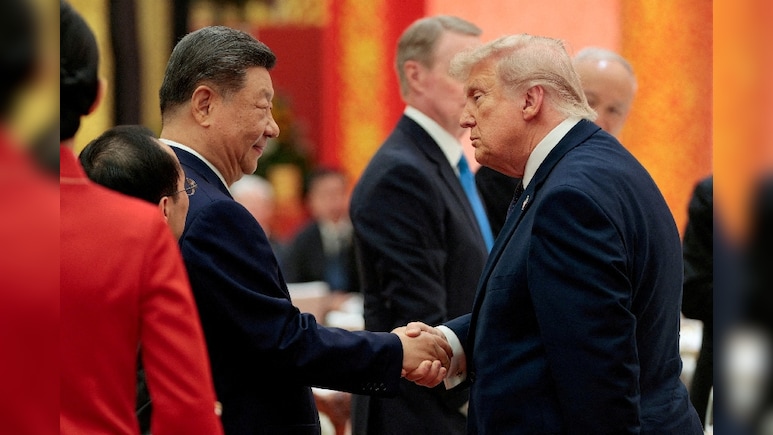
China called for a rapid reopening of the Strait of Hormuz, a goal it shares with the US, though there was no sign of a breakthrough between the superpowers on how to achieve that after President Donald Trump's trip to Beijing.
Chinese Foreign Minister Wang Yi said Friday that the strait should be opened to shipping as soon as possible, according to state-run Xinhua News Agency. Both Iran and the US are blocking traffic through the crucial waterway for global energy flows.
The statement came as the world's two largest economies sought to emphasize points of agreement on the Middle East conflict during Trump's meetings with President Xi Jinping this week - even as they're essentially on opposite sides, with China repeatedly criticizing the US-Israeli attack on its Iranian ally. Oil extended gains Friday as the war headed toward its 12th week with no clear path to a resolution.
On his way back from China, Trump also told reporters he spoke with Xi about potentially lifting sanctions on Chinese oil companies that buy Iranian crude. The Treasury Department has escalated those penalties in recent weeks as the US tries to pressure Tehran on talks. Beijing ordered its companies to ignore the sanctions. "I'm going to make a decision over the next few days," Trump said aboard Air Force One when asked if he'd consider lifting the sanctions. "We did talk about that."
Also Read | Layoffs Are Rising In Tech, But These Skills Are Helping People Unlock Better Pay
Follow Live Updates: US-Iran War News Updates: ISIS Second-In-Command Abu-Bilal al-Minuki Eliminated By US Forces, Says Trump
The conciliatory comments follow a summit that was overshadowed by the Iran war, given China is the largest buyer of Iranian oil. But they did little to ease the conundrum now facing the White House: How to reopen the strait, lower global energy prices and wind down an increasingly unpopular conflict that has caused the biggest oil supply disruption in history ahead of midterm elections in November.
Brent crude jumped more than 3% to end the session above $109 per barrel, extending its gains since the start of the war to about 50%. Traders are worried about a fresh escalation in hostilities between the US and Iran after Trump's visit to China failed to yield any concrete progress on a plan to restart the vital Strait of Hormuz.
A modest recovery in vessel movements seen earlier this week has faded as owners remained cautious about transits amid reports of a ship seizure near the waterway.
"Negotiations are deadlocked, violence erupts sporadically and the economic costs of the prolonged closing of the Strait of Hormuz are rising," Bloomberg Economics defense lead Becca Wasser wrote in a research note on Friday. "Threats to return to war continue to fly, and the status quo is becoming increasingly unsustainable. We think a return to open conflict is likely."
Trump said earlier in Beijing that he and Xi shared common goals for resolving the conflict - namely that Hormuz should reopen and Iran shouldn't possess a nuclear weapon. China, like the US, was a signatory to the 2015 accord on curtailing Iran's atomic program, which Trump abandoned during his first term.
Trump stopped short of asking Xi to lean on Iran to ease traffic through the strait, but predicted the Chinese leader would do so. On Thursday, Iran's semi-official Fars news agency said Tehran would allow Chinese vessels to transit following discussions with Beijing.
Asked about the prospects of an accord with Iran, Trump told Fox News in an interview, "We're dealing with people that I think are right, but they're afraid to make a deal. They don't know how to make a deal. They've never been put in this position before."
Iran has little interest in loosening its hold on the waterway. Tehran has insisted it wants to maintain control after the war, and attacked two commercial ships leaving Hormuz under US protection in a quickly-shelved effort to prise open the strait known as Project Freedom.
Iran's ability to shut down Hormuz has sent global energy prices soaring and given Tehran enormous leverage in talks with US negotiators, who want Iran to yield on several issues - from its missile and nuclear programs to its support for militant groups in the Middle East.
ALSO READ: Joining The Dots: Trump, Xi And The Next Tariffs Test | Tamanna's Take
The only real prospect of a short-term deal now appears to be putting off talks about Tehran's stockpile of highly enriched uranium, with both sides suggesting that issue be dealt with later - despite Trump citing Iran's nuclear program as the main justification for the war.
Iran said it had "come to the conclusion with the Americans" to postpone the topic until the later stages of negotiations, calling it "very complicated," Foreign Minister Abbas Araghchi said at a press conference in India on Friday.
Trump also said aboard Air Force One that he's willing to send US forces to remove Iran's uranium "at the right time," though he earlier suggested in a Fox News interview such a mission was "more for public relations than it is for anything else."
Iran's highly enriched uranium, which has been in an unknown location since a US and Israeli bombing campaign in June last year, remains one of many obstacles to a peace agreement.
Another is the US naval blockade of Iranian ports, designed to pressure Tehran economically, which US Central Command said on Friday had redirected 75 commercial ships from sailing through Hormuz.
(This story has not been edited by NDTV staff and is auto-generated from a syndicated feed.)
Essential Business Intelligence, Sharp Market Insights, Practical Personal Finance Advice, Daily Fuel, Gold and Silver Prices and Latest Stories — On NDTV Profit.